“Invest in me”
Investment Opportunities
Channel News Asia, (CNA), is an English language news network based in Singapore where it started in 1999. It underwent an international launch two years later and is now viewed in 24 territories across Asia – but, sadly, not here in Kyrgyzstan although the channel’s satellite footprint stretches across the Middle East, much of Asia, and Australia abd it is now a major news broadcaster across the continent.
One of the programmes on the network is called “Invest in Me“, where a selection of businesses compete over three months for a USD10,000 prize. They weren’t just any businesses, however, as they had to be “a social enterprise”; that is, a business that is not only focused on profit but also aims to benefit the needy, disadvantaged groups and to achieve overall positive social change. They had two “bottom lines“, the first being the traditional profit, (they were still a revenue-generating business, not a charity), whilst the second was the social change that they were able to generate.
Although both are important, it seems to me that the balance between these two “bottom lines” is, quite often, lost. Many people concentrate exclusively on pursuing profit whilst others concern themselves more with the concepts of Corporate Social Responsibility, (CSR), and underplaying if not overlooking that without a profit it is not possible to look after the needs of society. (This conflict of ideas that has been around for some years and was explored by Ayn Rand, for example in her novel Atlas Shrugged).
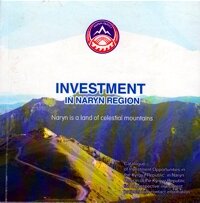
Anyway, when I was up in Naryn last weekend, I was handed a copy of the latest edition of “Investment in the Naryn Region – a catalogue of investment opportunities” – a sort of “Invest in Me” showcase without the glamour of the TV studio.
As the title says, it was a catalogue of potential investment projects and was published by the Development Policy Institute, (DPI), together with the Deutsche Gesellschaft für Internationale Zusammenarbeit, (GIZ), and the Kyrgyz authorities. (The previous edition was also supported by the Organization for Security and Cooperation in Europe, (OSCE), but it looks as if their funding has run out).
It was prepared as part of a project producing a marketing campaign, to promote investment opportunities in several regions of Kyrgyzstan, (specifically Talas, Naryn and Issyk Kul regions … I am not sure what happened to Barken, Djalal Abad and Osh). The project was aimed at helping to bring specific potential investment projects to the attention of potential investors, (be they private businesses, financial institutions, or donor and “innovative” organizations), through the dissemination of the catalogue.
I say that this was the latest edition of the catalogue because I have seen previous editions for several of the Kyrgyz oblasts. For the 2012 edition I have only seen the Naryn publication. Although the basic information is more or less the same, the list of prospective investment projects was slightly longer than in previous versions; the page count was more or less the same, (111 as opposed to 104), but there were a few more projects listed, (65 as opposed to 59).
Another difference was that, instead of printing two separate versions, (one in Russian and the other in English), this volume contained both versions and you simply flipped the book over to see the other. Personally, I am never sure that is a good idea. Although I can see a couple of advantages of a dual language publication, I think there are far more things to count against it. For example, where the language versions are together in one volume, it is easier to check details in the second version when there seems to be something unclear in the other, (maybe the translation is not that clear), and, then again, it might be nice for someone who is trying to learn one of the languages. The chief advantage, however, is that printing costs per unit are likely to be less printing more copies of one publication rather than fewer copies of what is, in effect, two publications. On the other hand, most people don’t need the second language and so have to carry a much thicker tome – which could be important if they have collected several such volumes, for example for several different oblasts or at an exhibition. I know that I don’t like it.
The catalogue is divided into three sections, or chapters. The first addresses the question “what are the reasons for investing in the Kyrgyz Republic?”, and takes a look at the basic economic situation, the reforms that have been introduced. The second deals with the question “why is investing in the Naryn region necessary?” and outlines some of the local factors that might affect an investment decision. Finally there is the list of projects with a description of what is entailed with contact details for anyone wanting further information.
Among the varied projects listed are:
Mini hydroelectric Power Stations; Sewage gas and bio-humus production; coal mining; brick production; production of rock salt; tourist centers; yurt camps; guest houses; craft workshops; “recreational complexes”; Furniture manufacturing; a sports complex; a fish farm; veterinary service; livestock breeding – including projects for cattle Horse, Sheep and Yak breeding; laboratory services for agriculture; a training center; construction of a “greenhouse” for academic research into crop cultivation; cultivation of herbs; dairy processing; a recycling plant; a retail center; a petrol station and a textiles factory.
The amount of investment required varies from a couple of thousand dollars to several million, with repayments periods varying from one year to 15 years. One of the more interesting statistics offered for each project is the number of new jobs each one hopes to produce, varying from two to a couple of hundred.
To be honest, personally, I am not sure to what extent the publication of such catalogues is useful. Although they do show the wide range and diversity of potential in the region, I am not convinced that potential investors will be persuaded to select a business venture from them. On the other hand, I hope that someone will be able to prove me wrong on that point.
They also have an online version at www.naryninvest.kg which, for anyone who is interested might be worth a visit. (Although there is a problem with the html code, it shouldn’t make it impossible to have a look at the various projects.)




 Bishkek