Misha’s Bones
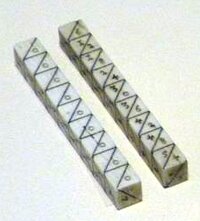
A couple of Napier's Bones - for 0 and 6
When I was a teacher, we used have a topic which was quite popular and that I used to enjoy teaching called the History of Computing. We would look at the major technological developments that led up to and lay behind the electronic devices and wonders of modern technology that sat on the desks. One of those was an aid to multiplication called Napier’s Bones. – developed by a Scotish mathematician, John Napier and described in his book Rabdology, published in 1617. Apparently some of the early examples were engraved on bone or ivory cylinders, and hence the name – although most of the examples I have seen been made from wood or plastic or simple bits of card.
A relatively simple device, they offer an intuitive, (both physical and graphical), calculating aid and teaching aid. At the time of John Napier, however, they represented something new and revolutionary as they were based on the use of the relatively new innovation of the Hindu-Arabic numerals.
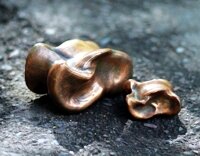
Alchiki - Misha's Bones
Misha’s bones are not useful for mathematics, and are not made of bone … although they are modeled on actual bones. Also, they are not really called Misha’s Bones – they are properly known as Alchiki.
However, I call them Misha’s Bones … let me explain.
I have known Misha for a long time – almost as long as I have been in Kyrgyzstan. The first time I was introduced to him I did a double take – well, I was being told that his surname was Kalashnikov. Actually, it’s Kolesnikov, but I heard it wrong and thought I heard Kalashnikov. It was an easy mistake to make, wasn’t it. Anyway, over the years Misha has had a number of different jobs but the one that interests him most, and to which he constantly returns, is as a sculptor.
He’s worked in a number of different media, but metal is his favourite. He used to bring pieces to show me and, to be honest, in the hope that I would buy some of them. At first I wasn’t very keen – why would I want, for example, a statuette of an alligator? I had to admit, however, that his bust of Josephine, candelabra, crucifix, and plaque of the Madonna were all very beautiful and well crafted. I would tell him that if he really wanted to sell to foreigners, especially tourists, then he should turn his attention to local themes – and that I was sure many locals would also be interested in purchasing such a works.
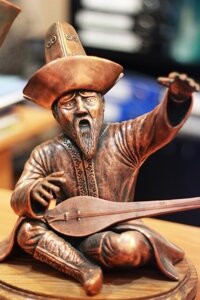
Bronze Manashi
I am pleased to say that he took my advice and produced several statuettes of horses, Marco Polo Sheep and the like. Impressed by his Madonna, I suggested that he do one of Manas, based on an engraving by Theodore Hertzen. I also suggested that he try some other traditional topics such as a Komuz player or Manaschi.
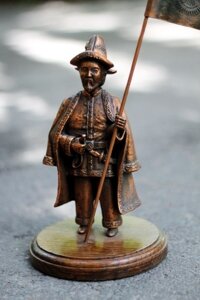
An Askar ?
One year, we even commissioned him to produce an “Askar“. We were running a competition and wanted a trophy to award as a first prize and thought it would be nice to present a statuette in the style of the Hollywood Oscars, (hence the name). Then came the Tulip Revolution and the name Askar was no longer in vogue, so they were never awarded and I still have the two prototypes in my office. The project having been abandoned, Misha has since made a few more examples of the figure which I understand are quite popular.
I had to point out, however, that he was unlikely to sell many of these object d’art to tourists as souvenirs. Although they were fine pieces, the problem was that metal tends to weigh a lot, which takes up a lot of their “baggage allowance” and so makes it difficult for tourists to take their purchases home with them in their luggage.
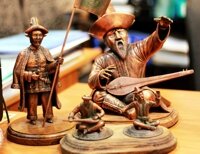
Bronzes, large and small
As a result he produced a number of smaller pieces but, although they are considerably lighter, I am not sure that they are all that popular as souvenirs.
I was really pleased, therefore, the day that he brought the alchiki to show me. These are small and relatively lightweight, (compared to the statuettes), and represent an aspect of traditional nomadic culture.
They are modeled on sheep bones, choko, that are used by Kyrgyz children in a number of traditional games.
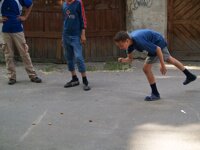
Children paying Upai
One type of such games is similar to “marbles” that I used to play when I was growing up. The idea of the game is to knock as many chuko as possible by throwing a large, weighted choko (or a rock) at them from a distance. (In one version of the game, each three choko make an upai (point) or basym and the idea is to gain as many upai as possible.
Whereas marbles are spherical balls, the choko have different sides, each with their own name and there are given specific meanings and values so that in another game a choko is thrown like a dice and the next move depends on how it falls, which face is uppermost.
Those faces were also used in nomadic times, in practices similar to casting runes, each facade of the choko bearing its own significance in the same was as cards in the Tarot pack or the I Ching.
I have also been given alchiki as a present when visiting Kyrgyz families as a sort of “good luck charm”.
In many ways they make a good subject for a tourist to take home as a souvenir: they are small, light and represent am interesting aspect of traditional culture. However, tourists from many countries in the world could find themselves in trouble if they tried to take one home because there may be restrictions on importing objects incorporating animal “body parts” … so one made from bronze would be safe option.
I was so impressed that ordered a number of them to give as presents. Interestingly, the locals are just as fascinated by them as our foreign visitors and I have probably given as many away to local people, (to serve as paper weights, etc.), as I have to foreign visitors.





 Bishkek