Meaningful signs
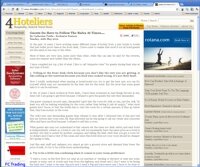
The post:
There’s an old saying that there is nothing more difficult than dealing with people. People are people … and on the whole most of them are pleasant enough, (at least most of the time), but everyone has their “off moments” when it’s best not “cross” them.
A short while ago I came across a post, a sort of cri de couer, from someone who has worked in the hotel industry about some of the more idiosyncratic, (dare I say annoying), aspects of guest behaviour.
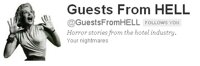
"Guests from Hell" on Twitter
It didn’t go as far as the tweeter who called their account “Guests from Hell“, (subtitled: “Horror stories from the hotel industry. Your nightmares“). Unfortunately, that tweeter has sadly left the world of hotels, but the account is still active so it’s possible to still review their 178 tweets featuring some of the things that people said and asked for.
The author of the post began with a copuple of heartfelt pleas that were obviously drawing on bitter experience such as, ”Try to be a little less confusing when it comes to your room preference” and with advice that could be summed up as: “Don’t shoot the messenger” (just because you don’t like the message) or “Don’t shoot the pianist – he’s doing his best”, (with thanks to Oscar Wilde – who despite Whistler’s put down of him, never did try to claim authorship of this particular quip).
My favourite on the list of gripes was “hotels in small towns and town you have never heard of do get sold out” and told how guests would demand “what am I suppose to do now, I need a room!” when faced with the fact that there was “no room in the inn”. That’s probably because I have encountered exactly this situation several times over the years. I have to admit that when I first met this sort of reaction I was tempted to respond sarcastically with spomething like: “I’m sorry, but it will take us a little while to build a new corpus,” or “If we had a stable I would see if there was a spare manger”, but instead I would bite my tongue and offer to see if we could try to find some alternative in another hotel.
The author’s own favourite, however, (which I admit was a close contender), was : This sign means what it says.
It comprised a litany of examples where guests blatantly ignored a prominently displayed sign such as: “Do not enter”, “Employees only”, “I have stepped away from the desk, I will return shortly”, “Hours to pool are 10am to 10pm” or “For security these doors are locked after 7pm and unlocked at 5am”.
Sometimes people seem to behave as if they think the sign is just a suggestion which can be acted upon, or not, as they see fit. However, there is a reason behind each of these signs. For example: pool hours may have been set because of the proximity of the pool to rooms and the need to limit noise after a certain hour of the night to avoid disturbing guests.
Now, let’s be honest, although signs are important and often covey useful and even vital information, some of them can be the source of much amusement … or bemusement. It may be that they are placed in a slightly inappropriate position, or maybe they contain some error in spelling or grammar, (especially when they involve translations from another language or culture) and there are several places on the internet which pander to this sort of humour, such as the site signspotting.com or the regular Sign Language photogalleries on the site of the Daily Telegraph, (offering a “selection of strange signs sent in by readers on their travels.”).
I have on occasion been tempted to photograph a sign and send it in. For example, there was the sign outside a (closed) hamburger joint that proudly proclaimed that it worked “24 hours” … but apparently 7:30 on a Saturday morning wasn’t one of those 24 hours. Now, please don’t misunderstand me; I do realize, of course, that were probably good reasons for this. Sometimes “things” happen that causes a break in the usual routine. For example, in the hotel a receptionist may need to leave the desk, (perhaps a guest has asked for help), and so they put a notice saying that they will be back shortly.
The cause of the amusement, or bemusement, isn’t always obvious. Take for example the signs on the cash desk at the entrance to the Historical Museum. There it clearly states the entry fee for different people: children, adults, pensioners, foreigners (… no I don’t want to go on about that particular gripe this time), and so on. There is also a sign that says there a fee payable for anyone who wants to take photos … 200 som.
Now, that seems to me quite enlightened. After all, there are museums around the world that don’t allow people to take photographs, (you are not allowed to take photographs of the Gold Collection in the museum, for example), and 200 soms seems a reasonably modest fee, (a little under five dollars, four Euros – or about three pounds). However, it seems that things are not always what they seem.
A friend of mine, a local person, walked into the museum with his camera – and a tripod for his camera (!) – asking for an entrance ticket and a ticket to enable him to take photographs. The assistant asked him: “What are you going to photograph?” Now, he’s a very calm person and where I would have asked something like “What difference does it make?”, he apparently said he wasn’t sure till he got inside, and then asked if there was some limit, (for example – a time limit). The Cashier told him to go and see the administrator – which he did.
Once he said that he wanted to photographs to put on a website, he was passed up the chain of command until he was eventually asked to write a letter asking for permission, to be allowed to take the photographs.
Excuse me … but, if he pays his fee of 200 som and then wants to place his photographs on the internet – for example: on his Facebook page, on Flikr, his personal website page, or … whatever, then what difference does it make?
When he told me his story I began to wonder about all the tourists we have taken there who have placed their photographs on their websites. I wondered about the photographs that I have already taken in the museum (having paid my 200 som), and which I might want to post here on ianbek.kg – especially if and when I decide to write a postcard about the Historical Museum.
Just what is that fee of 200 som for?


 Bishkek