Textiles
This week there is an international trade fair taking place in the Sports Palace here in Bishkek: the International Exhibition Fair “Fashion Industry”, products and equipment ready-made garments, knitwear, fur.
The Kyrgyz textiles industry is quite an interesting aspect of the Kyrgyz economy. It has developed largely as a result of indiviual initiative, without any government encouragement or interference and with little foreign investment.
Furthermore, in the first decade of the twenty-first century, it has been a success story with rapid growth in production, most of which, (estimates range from two thirds to 95%), goes as export to Russia, Kazakhstan and other neighbouring countries. It has been acquiring a good reputation in various markets – even in the high-end boutiques in Russia where it used to be sold with fake labels of foreign quality brands – something which led to an international investigation. Nowadays, however, it is just as likely to be marketed under a “Made in Kg” label.
The industry is not exactly new to Kyrgyzstan.
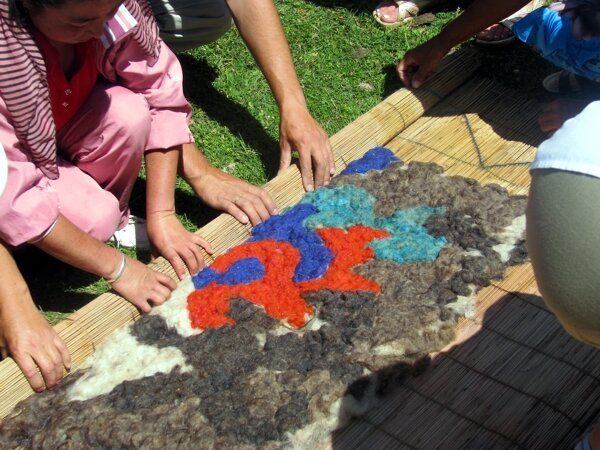
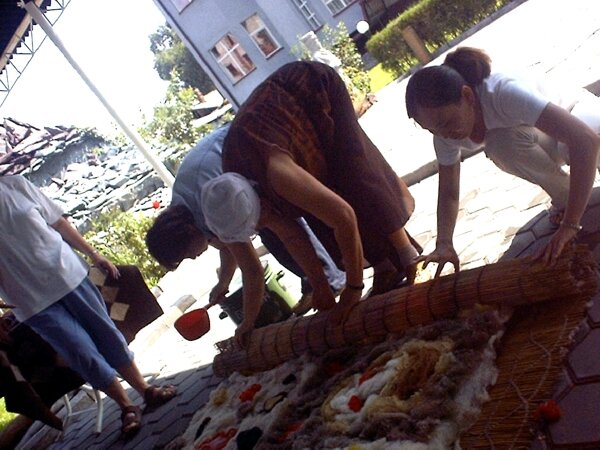
Textiles played an important part in traditional nomadic Kyrgyz culture. Kyrgyz women, for example, would produce a wide range of textiles, mostly from felt made from the wool from their sheep. Ancient patterns are nowadays adapted to the tourist and export market, but it is still a living tradition, in that all yurts and most houses contain the hand-made felt carpets or rugs called shyrdaks and ala kiyiz.
Tush kiyiz, (large, elaborately embroidered wall hangings), were traditionally made by elder women to commemorate the marriage of a son or daughter. Flat cushions or mats, (usually made in shadow-pairs), are seen in use on chairs, padding the seat.
In addition to felt work, there is also a strong tradition of patchwork, (kurak).
The colors and designs used to decorate fabrics symbolize Kyrgyz traditions and rural life: flowers, plants, animals, stylized horns, national designs and emblems of Kyrgyz life.
During the Soviet period there were several initiatives to move from the traditional “cottage industry” to a more modern industrialized system of production:
- Several large manufacturers operating factories which turned out garments to Moscow’s orders using cotton from Uzbekistan;
- During the Second World War, the production of clothing in the republic made an important contribution to the overall war effort;
- There was, and is, a silk factory in Osh, but it is in need of modernization – the equipment dates from the Soviet period and can only produce narrow skeins of material.
The marble facade on the Western side of Ala Too square in Bishkek is just that – a facade, constructed to mask a clothes factory, (Ilbirs - Kyrgyz for “snow leopard” – which still operates today), and create a unified, impressive, symbolic architectural ensemble suitable for the main square in the capital of the USSR’s constituent Republics.
The collapse of the Soviet Union, however, led to drastic falls in output and many of the workers were laid off in the economic upheavals in the following years and factories closed.
In fact, it is hard to give accurate statistics for the current state of the textiles industry because, (as in many places around the world), it is basically a cottage industry which for many years was operating largely in the Shadow Economy. The government has introduced some special reforms and initiatives in an attempt to improve transparency and bring the industry out of the “shadow” – and views differ as to how successful these has been. It is estimated that in the Bishkek region alone, approximately 35000 small companies involved in the clothing industry employ about 150,000 people – or 15% of the population – and, it is said. 10,000 sewing machines were sold in Bishkek in 2007 alone.
Despite the strength of the local industry, most of the local production, (about 95%), is exported, (with about 80% of the exports being female garments), and the local market is dominated by imported clothing – especially from China and Turkey. The items available in local markets tend to be cheap and poor quality and counterfeit items abound. Specialist shops exist, especially in the capital, which offer better quality goods, but the costs are normally quite high – as expensive or more so than in the West.
The fact that so much of the output from the industry is exported to Kazakhstan and Russia means that the potential entry of Kyrgyzstan into the Customs Union, (which consists of Russia, Kazakhstan and Belarus), could have a significant impact on it. As a result, it has been announced that the government are trying to negotiate special arrangements in order to protect the industry.
There are a number of fashion designers, (often specialising in combining traditional materials and styles with modern ones), and several modeling agencies that often organise fashion shows which are popular, (although, to be honest, personally, it’s not “my cup of tea”). Designers also participate in a number of trade fairs, for example in Kazakhstan, Russia and Turkey.
In fact, as well as the trade fair, Bishkek also hosts “Fashion Week Kyrgyzstan” which was launched in 2006 with the aim of supporting the development of the creative potential and professional level of young designers in the country. It consists of a number of fashion shows where over sixty designers from all over the country exhibit their work in the capital city. There is a competitive element and since 2009 the best collections have taken part in international projects, presentations and events in Europe; for example, in Berlin, Milan and Paris.
The week is organized by the Promotion Center, “VitLine”, which was established in 2001. (Their first event was a photo-model competition called “Portfolio”, and they have also organized the national finals of a number of international beauty competitions.) Today it is the most important and well-known fashion event in Kyrgyzstan, and is held twice a year; in both Spring and Autumn.
A video displaying some of the Fashions on show at
Kyrgyzstan Fashion Week, March 2010
http://www.youtube.com/watch?v=i0kJW9fSESA



 Bishkek