Peace Corps

Peace Corps Logo
On March 1st, 1961, President John F. Kennedy signed an Executive Order creating an organization by which volunteers, (mainly recently qualified college graduates), to countries around the world with the aim of :
- providing technical assistance;
- helping people outside the United States to understand US culture; and
- helping Americans to understand the cultures of other countries.
This organization was called the Peace Corps.
The idea had been long in the making. Following the end of the Second World War, several influential Americans proposed the establishment of volunteer organizations in developing Countries, and one of the Democratic Representatives in the Congress; the same John F. Kennedy. The idea was taken up by a number of his colleagues who proposed an “army” of young Americans to act as “missionaries for democracy”.
Hubert Humphrey introduced a bill, in 1957, which would have created a Peace Corps, but in his own words, “It did not meet with much enthusiasm.” However, the torch had been lit, and was passed around and Kennedy picked it up again in the 1960 presidential campaign. His opponent, Richard Nixon, and others were not convinced. It would be a “haven for draft dodgers” and provide a “cult of escapism”; the graduates would not have the necessary skills and maturity to perform the tasks with which they were entrusted, and so on. Kennedy, on the other hand, saw the possibility of countering the “Ugly American” and “Yankee Imperialist” sterotypes that were common, even in those days.
A programme called “Operation Crossroads Africa”, founded in 1958 by a Presbyterian clergyman, provided a prototype. The first group of volunteers were recruited and left for Ghana and Tanzania in August, 1961. Over the next two years the number of volunteers rose to 7,300 serving in forty four different countries.
Having said that, many of the volunteers, (and they are not all young graduates these days – although the average of volunteers is 28, apparently some 7% are over 50), have had positive experiences and President Jimmy Carter commented that his mother, (who had served as a nurse in the program), had “one of the most glorious experiences of her life” in the Peace Corps.
Although in many respects the programme has been a great success, it hasn’t been an easy time for the volunteers. Early on, a post card home from one volunteer was critical of the conditions they found in the host country and that led to threats of deportation and accusations that the volunteers being spies and agents. Some volunteers have been attacked and there have been instances of rape. Last year the Peace Corps were abruptly asked to leave neighbouring Kazakhstan.
Since they were founded, over 200,000 volunteers have joined the programme, which reached its peak in 1966, when there were 15,000 volunteers in the field; currently there are just over 9,000 volunteers. They have served in a total of 139 different countries, although at the moment they can found in only 68 countries. Kyrgyzstan being one of them.
The first volunteers arrived here in 1993, (although one page on their website says 1992). Each Summer a new contingent arrives and after a period of orientation and language training, they go out into the regions to take part in one of the programmes: teaching English as a foreign language (TEFL); Sustainable Oganizational and Community Develeopment and Health Promotion.
The TEFL project started in 1993 when the first group of 19 Volunteers arrived in Kyrgyz Republic to teach English at secondary schools and universities. Since then about 500 volunteers have served as teachers at 189 secondary schools and 15 regional universities in the country. The 19th contingent, which arrived in June 2011, consisted of 41 volunteers.
The Sustainable Organizational and Community Development program began in 1996. It aims to support the country in its effort to develop and strengthen civil society and assist non-governmental organizations, (NGOs), cooperatives and other grassroots organizations to meet their long-term sustainability goals. The volunteers are located in predominantly rural areas addressing the needs of people living and working in these areas. They may be engaged on activities connected in a wide variety of fields, ranging from the protection of children’s rights to designing proposals to obtain finance for short term projects in handicrafts or agriculture; offering training in the form of workshops and conferences.
Volunteers working in Health Promotion work in provincial health departments, health promoting schools and NGOs in the health education and promotion sector and may be involved in developing informational and educational materials on life style and personal hygiene; methods of preventing disease; running classes and out of school activities; and conducting life skills training for young people introducing such life skills as decision making, critical thinking, effective communication, interpersonal relationship skills, empathy and coping with emotions, possibly training young people to act as “peer educators”.
Most of the volunteers serve for two years and live with a host family, often in remote rural districts. They become embedded in, and often identify with the local community.
Some volunteers maintain blogs describing some of their experiences, (you can find a list of some of their blog journals here, some of them make for interesting reading and give a colourful picture of life in Kyrgyzstan). Some of the more recent blogs include graphic accounts of the events of last June … and, unfortunately, some stop abruptly; the volunteers having been evacuated as a result of the troubles experienced in Southern Kyrgyzstan.
Others have written books. One is called “This is not civilization“, by Robert Rosenberg who served in the first tranche of volunteers and another is “100 letters home: My two years in Kyrgyzstan” by Emily Ross who served between 1997 and 1999.
Fortunately, the events of last June, the “expulsion” of the Peace Corps from other former Soviet countries, two revolutions, the evacuation after the events of September 11th, 2001 and again last year, the Peace Corps are still here … and doing sterling work.


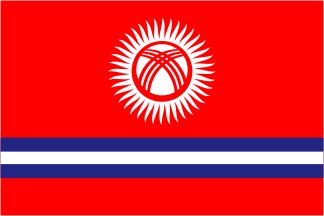
 Bishkek