Togolok Moldo Street
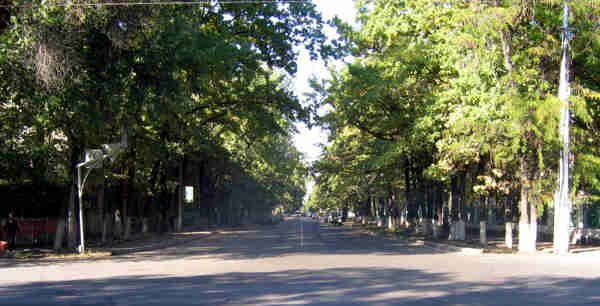
Looking Down (North) along Togolok Moldo
This street is named after the bard Togolok Moldo, (his real name was Bayymbet Abdyrakhmanov), who lived between 1860 and 1942 He was a poet and one of the better known twentieth century manaschi – a special class of itinerant minstrel (akyn) who give recitals of the Manas epic. Unlike the other great akyn, Toktogul, Togolok Moldo could write and so many of his verses were written down. He recorded and wrote down many national folk songs as well as his own verses, and many of the texts are now kept in the Manuscript Library of the National Academy of Sciences. He appears on the 20 some banknote.
- Originally called Barracks Street because there was a military barracks where it now crosses Toktogula … currently the barracks of the National Guards.
- It is not clear when, but it was then renamed Voroshilova after Kliment Voroshilov, a Soviet political and military leader in the Civil War and who replaced Mikhail Frunze, after his death in 1925, as the People’s Commissar for the Army and Navy and later became Chairman of the Presidium of the Supreme Soviet – to be replaced in turn by Leonid Brezhnev in 1960.
- in 1957 it was renamed, once more as Sports Street.
- Finally, in 1960 it was renamed Togolok Moldo.
This tree lined street has an eclectic mix of apartment blocks, offices, small shops and cafes/restaurants, a night club, a cinema, official buildings, a university, sports facilities and medical facilities.
It continues from Leo Tolstoy in the South to the outskirts of the city and the region of Lower Ala Archa (Nizhny Ala Archa) – but the medical complex and the Ministry of Health interrupt the street. Here we describe just the five blocks in central Bishkek.
|
East |
South |
West |
|
|
At the top of the street is the building of the Ministry of Health |
To the West is Togolok Moldo Park – with a bust of the akyn in the center | ||
|
Moskovskaya |
|||
|
HospitalFamily Health Clinic
The Cardiology Institute |
Set back from the road, between the first two buildings are the offices of CACSA(The Central Asia Craft Support Association).The former Kazakh Embassy. They have now moved to the Southern outskirts of town – up Prospect Mir.
The Consular Department of the Ministry of Foreign Affairs. The building on the corner houses the Captain Nemo Restuarant. |
||
|
Toktogula Street |
|||
| Behind the wall are the barracks of the National Guards after which the street took it’s original name. | |||
|
Kievskaya |
|||
| On the corner is the Djalal Abad Chaihana (literally = “tea-house”, but this is a “Kyrgyz style” fast food cafe where they serve a variety of traditional local dishes). The cafe is notable for its wooden carving. It is possible to sit outside – or in the building just down the street which is also part of the cafe. | |||
|
Prospect Chui |
|||
|
The Rossia Cinema(Russia) with a large plaza in front of itThe next building is the former Planetarium which for a time served as a Disco/Night Club and was one of the towns Gay nightspots.
A rose bed marks the start of the central park area … in the distance is the White House, or Government House. Behind the cafe is the Small Arena – which was used for sporting events – but now serves as a car park. After the cafes is a driveway to the main park area (Panfilov Park and the Dietsky – Children’s - Park with its fairground and amusements. It is also the direction the central Tennis courts, and the restaurants Millennium and Applesine (Orange) The Spartak Stadium – the main sports arena in the city and can accommodate 23000 spectators. It is used to host not only sporting events, such as football, athletics and even American Football, but also festivals, dog shows and pop concerts. The Turnstiles are rarely used. The building on the corner houses the offices of the State Agency for Sport and Physical Culture. The complex also houses a gymnasium and boxing hall in which many local sportsmen train. |
The large building on the corner is the The Technical College, built in 1962. The building also houses the Mountain Institute. | ||
|
Pushkin Street |
|||
| The Sports Palace – strictly speaking the Kojumkol Sports Palace. Named after a “giant of a man” from the Kekemeren valley – near Suusamyr, on the other side of the mountains – who is famed for many deeds of strength – including carrying a horse on his back for over a hundred meters. This feat is depicted in the massive statue outside the front of the building. The Sports Palace is used for a variety of purposes, not just sports events. It houses a casino/computer games emporium; there is an auditorium which is used for concerts; exhibitions are regularly held here. At the back of the complex there a large open air swimming pool, and sauna. | |||
|
Ryskuova Street |
|||
| The Museum of the Decorative Arts, formerly known as The Tinibek Sadykov Museum This museum contains some of the smaller works of the Kyrgyz monumental sculptor Tinibek Sadykov – some of whose larger works can be found in the Philharmonia, The Martyrs to the Revolution at the corner of Prospect Chui and Sovietskaya and in Victory Square. | |||
|
Abdumomunova Street |
|||
| The blue painted building with rectagular flying buttresses on the corner, is the head office of the bank “Kyrgyzstan” – one of Kyrgyzstan’s biggest banks with branches throughout the country – with the countries third largest network of branches. It was established in 1989 as a state owned bank (it was the “social bank” – and still has a social element in that it serves customers with small savings and loans. It has since been gradually privatized.The building on the corner houses the State Statistical Office of the Kyrgyz Republic. | |||
|
Frunze |
|||
| The ground floor of the apartment block on the corner of Frunze and Togolok Moldo houses the local ZAKS – the Registry Office – where weddings are sometimes officiated. | The building on the corner is the Bishkek State University of Business and Economics formerly known as the Bishkek Commercial College. | ||
|
Jibek Jolu |
|||
| The Russian Orthodox Cathedral Church of the Resurection (Voscrensceniye) | |||
|
North |
|||




 Bishkek