Sven Hedin – Swedish Explorer
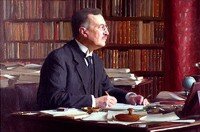
Sven Hedin - oil painting by Carl Emil Österman (1923)
The Swedish explorer Sven Hedin was born in Stockholm, Sweden, on 19th February, 1865. His father, Ludwig, was an architect. As a young boy he read widely, but especially adventure novels and travelogues – and especially about Asia - and this helped shape an ambition to become a traveler and explorer which was to be fulfilled in later life.
A man of many talents: a traveler; cartographer; linguist (he was fluent in seven languages); author; artist; a student of geography, geology, paleontology and zoology; and (somewhat controversially) a “participant in the political course of events”.
A mild exterior concealed a determined and sometimes ruthless character. Apparently he sometimes found himself being threatened by “bandits” and “war lords”, (for example: one of his trucks was “commandeered” by the rebel leader Ma Zhongying, to escape over the Soviet border from the advancing Chinese armies), but fortunately he was always able to reach a compromise or talk himself and his people out of awkward situations. He had a very simple and down to earth Christian faith and opposed to killing – even animals.
He studied Physical Geography in Berlin under Baron Ferdinand von Richthofen, the renowned explorer of the Asian continent who coined the phrase “The Silk Road” to describe the myriad of routes used by merchants and traders throughout history – to transport goods and ideas between the Orient and Western Europe.
His travels began in 1885 when, at the age of 21, he undertook a teaching post in Baku (Azerbaijan) and traveled for three months through Persia on horseback. This was just the first of a number of journeys of exploration – the last finishing in 1935. Amongst his many discoveries were the remains of the Silk Road garrison town, Lou-Lan, which had lain buried under sand since the 4th century. Amongst his finds were 30 paper fragments which, at that time, were the oldest known samples of paper.
In 1890/1, he participated in a diplomatic mission to the Shah of Persia (now Iran) and afterwards made a reconnaissance trip in preparation for his major expedition two years later. This reconnaissance trip took him through parts of Central Asia including Kyrgyzstan. Traveling South from Tashkent he visited the city of Osh – and then crossed the mountainous border to Kashgar. Returning over the Torugart Pass, he visited Naryn, the Northern shores of Lake Issyk Kul and the city of Prezhervalsk, where he visited the tomb of the famous Russian explorer, before traveling back to Tashkent via Tokmok and Pishkek (Bishkek).
In his book describing his travels he records a number of impressions, including:
“Tokmok is a small insignificant town with wide streets, large gardens, small bazaars and low houses situated on the Tchu. The population which consists of Russians, Sarts and Kyrgyz number only 2000.
At a distance of 59 versts (1 verst = 1066m, or just over 1 km) and 19 versts south of the western shore of the Tchu you find the town of Pishpek. It is of the same size as Tokmok and looks exactly the same. Both of the towns were taken by the Russians under Colonel Zimmermann in 1860. In the south the Alexander range reaches its greatest height with peaks at 1500 to 1600feet … We needed 3.5 hours between the two towns …
The road between Pishpek and Aulie Ata runs straight west on absolutely level ground at the Northern foot of the Alexander range. It is 263 versts long and divided in 13 stations with the following names: Sokuluk, Bjelovodskoje, Karabaltij, Tschaldavar, Merke, Munkinskaja, Trtij, Kumarik, Maldihajevskaja, Akair Tube, Ak Tschulak, Utsch Bulak and Aulie Ata.”.
(Thanks to Gosta Wetterlind, nephew of the explorer, for the translation).
He was the first foreigner to explore the ancient cities and ruins to be found in the Taklakaman Desert, and his journey into the Taklakaman Desert – which almost ended in disaster – was to prove that, although hazardous, it could be entered and crossed successfully. As such he acted as a trailblazer for others such as Auriel Stein. Many of these later “archaeological” expeditions resulted in the destruction of many ancient sites and the removal of large numbers of artefacts to museums and collections all over the world). Although his expeditions into China’s Xingjian province are sometimes said to have “opened the floodgates” for the “free for all” that followed, he still managed to command respect from the Chinese Government, even being appointed as a special advisor for the development of the railway system to the remote province. Apparently, he is still remembered in China with some affection as the explorer who left China’s heritage behind rather than sending it abroad.
When he died, aged 87, in 1952 – he was, (as Peter Hopkirk puts it in “Foreign Devils on the Silk Road”), a “forgotten man”. His many achievements; the various awards he had been granted, (including honorary doctorates from both Oxford and Cambridge, a knighthood from the British government, and two gold medals from the Royal Geographical Society); the thrill with which schoolboys and adults alike devoured his accounts of his exploits were all overshadowed by the fact that he adopted a pro-German stance during both World Wars. Today, however, as interest in the region increases his life and work are attracting greater interest and a reappraisal.






 Bishkek