Terentiev – the First Mayor of Bishkek
Ilya Fyodotovich Terentev served as the first elected mayor of the city, between 1895 and 1900, although – for some reason – he doesn’t appear on all of the lists enumerating the Mayors of the city.
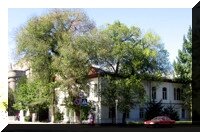
Terentiev's House on Erkindik/Abdumomunova which now houses the UNICEF offices in Bishkek
Little is known actually about his life. We do know that he was born in 1847 in Izhevsk in the Russian republic of Udmurtia, into the family of a local gunsmith. (During the Soviet period Izhevsk was a “closed” city – forbidden to access by foreigners – due the industrial production for the soviet military that took place in the town.) Terentiev came to province of Turkestan at the age of 37, and took part in the campaign against the Khanate of Kokand, eventually deciding to settle here. Serving in various official posts in the regional administration in Tokmak, (now Tokmok), including the district administration, the prison administration and as a district judge.
In 1894 he resigned his post with the administration and moved to Pishpek, (now Bishkek) and purchased a Hop plantation from Alexei Fetisov. The land was not particularly good – having been somewhat boggy – but under, firstly Fetisov’s care and then Terentiev’s, it became very productive – even winning a Silver Medal at the 1900 World’s Fair in Paris.
Within a year of leaving Tokmak, Terentiev was elected as the Head of the Pishpek town administration.
Some photographs of him and his family exist and there are some articles written by him for official journals and records. He was, by all accounts, a precise bureaucrat and statistician – with a penchant for counting things, and it is partly thanks to his efforts that we have some detail of life in the early days of the city’s development. He supported the opening of several schools, including the town’s first “Grammar School”.
He seems to have been an active and progressive personality – and apparently was a wealthy man, one of the city’s richest citizens. He is known to have owned a bookshop and private offices on what is now Prospekt Erkindik – but there are no further details.
One author says of him, that he arrived in Bishkek as a poor gunsmith, and died a rich man with mansions in his estate.
Two of his houses are still standing.
One is near Oak Park – a two storey building on the corner of Erkindik and Abdumomunova, and which now houses the offices of UNICEF in Bishkek.
The other is in Dietsky Park, on Sovietskaya – North (down – away from the mountains) of the intersection with Jibek Jolu. A small, ‘decrepit’, two storey wooden building which is notable if only because it is supposedly the oldest two storey structure in Bishkek – built sometime between 1870 and 1894, nobody knows the exact date – and the fact Michail Frunze holidayed there. The ground floor is made from brick walls, whilst the upper floor was constructed from wood – with an extensive terrace. It was possible to occupy it all year round, but its owner apparently considered it as a “country residence” – even though it is now clearly located well within the city boundaries. In 1933/4 the house and gardens were turned into a park, then in 1951 it became part of the “Pioneer Palace”- housing a children’s library.
Plans to restore the building and turn it into a museum were announced in 2002, but have yet to be realised due to a lack of finances, and more recently there has been some discussion about the possibility of demolishing the house although it seems more likely that it will be included in a redevelopment scheme which would see a new Cultural Complex built on the site.
In Oak Park – the four Bronze canons placed around the obelisk, which forms the memorial to the Matyrs of the Revolution – who died putting down the 1918 Belovodsk counter revolutionary uprising – were apparently cast in St. Petersburg for Terentyev’s tomb. They were later ”nationalized” and then “repatriated” to their current location.




 Bishkek