Marshrutka
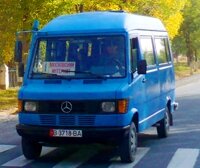
Marshrutka
Maxim had been invited to a birthday party and asked me if which Marchrutka would take him to the twelfth microdistict on the southern end of town. I looked at him askance … “How would I know?”, I asked, “I rarely ever travel by Marshrutka.”
Everywhere you go in the world there seems to be local means of transport for getting around: Rickshaws and Boda bodas, Tuk Tuks and Taxis, Hansom cabs and Hackney carriages, Jeepney and Minicabs, Trams and Trolley buses, Matutas and Marshrutkas.
Yellow cabs are a familiar feature in New York and London has its distinctive famous “Black Cabs” – incidentally, it was on December 6th, 1897, that London became the first city in the world to host licensed taxicabs.
I was intrigued to see a clip the other day of a red, “double decker”, open topped sightseeing bus in New York. I had thought that this particular means of transport was peculiar to London. Someone once suggested the idea of importing the idea here to Bishkek, but I said that I thought it was impractical. I pointed out that, even if there were enough tourists and the locals decided to take a sightseeing tour, in the summer the sun was too strong and it was too hot whilst tin the winter it would be too cold and the snow would ruin the upholstery.
We do have an open “tourist bus” – but it is just wagons pulled by a tractor decorated to look like a train … the sort of thing that you might see plying up and down the front at the seaside in Weston Super Mare or Blackpool.
Here in Bishkek we do have buses and also trolley busses, but the main form of public transport is the Marshrutka.
The word “marshrutka” is a portmanteau word and is derived from the Russian “marshrutniya taxi”, which literally means “routed taxi”. The system of routed taxis was introduced in Moscow in the 1930’s. They were a compromise between buses and trolley buses which sold tickets by fare zones and metered taxis. They were cheaper than the taxis but more expensive than the larger modes of transport, but they offered more flexibility and less crowded conditions.
A Marshrutka is a minibus – often a Mercedes Sprinter or a Ford Transit – which plies a set route like a more conventional bus service. It is easy to think that the difference between them is one of scale – the buses seat some 40 or 50 passengers but the minibuses are smaller with less than half that number of seats. There is another important difference, however, in that whereas passengers alight and board a bus at a designated ostanovka, (Bus Stop), it’s possible to flag down a marshrutka anywhere.
This can present problems. People can often be seen at the corner of major crossroads, hold out their hands in an attempt to flag down a passing minibus. The driver sees them and pulls over to the side of the road, and sometimes it seems as if he brakes rather hard and swerves somewhat erratically … over the years I have seen several newspaper articles where some official or other has said that this practice is dangerous and has to stop.
The marshrutka are licensed and the system is strictly controlled by the local authority. Some are owned by companies, but most are privately owned – although some people own several. The driver may be the owner of the vehicle or it may be driven by a subcontractor. There fares are set by the local authority and there is always a controversy when there is a proposal to raise them … the operators are always anxious about the ever increasing price of fuel, but the travelling public are keen to keep prices down.
There is no set timetable, so it’s a case of standing and waiting until one of the many passing minibuses happens to ply the appropriate route to take you where you want to go. The route is indicated by a placard a placard bearing the route number displayed on the front window and sometimes you need pretty good eyesight in order to see it as the vehicle approaches and flag it down.
Having flagged it down, the passenger boards the vehicle and pays the fare to the driver’s assistant, (at the moment 8 som in the city center – although for routes that go to the surrounding villages the fare is more), and then proceed into the body of the minibus and find a place, that is, if there is one. Unlike the original marshrutka, Bishkek’s are normally rather crowded – it is often a case of standing room only. Drivers will often encourage people to board until there isn’t, physically, any room for any more.
That’s one reason I rarely use them.




 Bishkek