Creating a new Republic
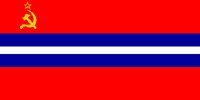
Flag of the KSSR
The Kyrgyz are an ancient people – the first historical reference to them is contained in Chinese Chronicles from the second century BC. For a time, they even formed a major power – carving out their own Khanate – but this came to an end with the Mongol invasion under Genghis Khan … and for a long time they were without their own state. There were attempts, such as that by Muhammed Kyrgyz in the 16th century, Orman Khan in the 18th century and Alymbek Datka (the husband of Kurmanjan Datka – Queen of the Alai) in the 19th century to unite the nation and carve out a state. Passing as a subject people of various masters, (the Mongols, Chinese – the Oirats, Bukhara, Kokand, the Russians …), they managed to maintain a separate existence based on nomadic traditions and tribal loyalties.
The Soviet Union at last gave them a Republic to call their own, which formed the basis of the present independent state of Kyrgyzstan – but it wasn’t “plain sailing”.
First came the Kara-Kirghiz Autonomous Oblast of the Russian Soviet Federative Socialist Republic, (RSFSR), established on 14 October 1924. This was transformed into the Kirghiz Autonomous Soviet Socialist Republic, (Kirghiz ASSR), on 1 February 1926, although it was still a part of the RSFSR. Then, on 5 December 1936, it became a separate constituent republic of the USSR as the Kirghiz Soviet Socialist Republic during the final stages of the “national delimitation” in the Soviet Union.
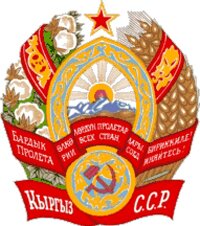
Seal (Gerp) of the KSSR
The “nationalities” question
This was to be a major concern in the early days of the Soviet Union. In a precarious political situation in which they found themselves, the authorities in Moscow sought to balance the need to overcome several threats by persuading the local populations to support them – whilst at the same time maintain a central authority and opposing national aspirations – especially those for establishing a pan-turkic republic, such as in the Basmachi revolt. Their attitudes seem to have fluctuated between encouragement and authoritarianism depending on how strong they felt their position to be.
One of the results was the creation of a number of separate republics … which have become nation states in their own right since the collapse of the Soviet Union.
Building the nations however, was not just a case of giving them each their own territory. Social and economic factors were also important.
The need to cultivate allies.
During the civil war the Kazakh-Kyrgyz nationalists fought first on the side of the “Whites” against the Bolsheviks – but declarations of the leadership of the counter revolutionaries that they would restore the Russian Empire did not go down well with them. Several influential leaders, influenced by the Bolshevik promises of self-determination for all nationalities, the practice of land redistribution operated by the Communists and forced requisition of supplies by the White (anti-Bolshevik) forces, threw their support behind Moscow.
The question of self-determination
This was to cause some problems for Stalin, who had been appointed by Lenin as Commissar for Nationalities, as it led to a fragmentation of the support into small factions based on nationalistic or religious lines … with demands for autonomy … and he was trying to retain a unified, centralized, state structure. In 1924, the Khorezem, Bukara and Turkestan republics underwent reorganization resulting in the fact that in none of them was there a single, dominant nationality. (It was a year later, in 1925, that the distinction between the Kazakhs and Kyrgyz when separate autonomous provinces were established within the RSFSR)
Lenin had taken the view that nationalism was a symptom of early forms of capitalism – as a response to national and social oppression caused by the system, whereas later, more developed, forms of capitalism favoured the development of “internationalism”. As the capitalist system was replaced by socialism, he thought that this “internationalism” would be replaced by class consciousness and class loyalties. Therefore, he considered that socialist policies would lead to elimination of nationalism – which came to be seen as a major deviation on the road to true socialism.
With Lenin’s death in 1924, however, Stalin came to power. He had a different point of view Although he supported Lenin’s premise, he also distinguished between a “nation” and a “people”. He considered a nationality as a stable and historically developed community based on four criteria:
- a common language;
- a united territory;
- a shared economic life, and
- a shared psychological outlook – a common culture.
1. A Common Language
As a result, the Soviet Union began to give each “nationality” a language and a territory. The work had already been started, for example, a written form of Kyrgyz, (using an Arabic script), had been introduced in 1922. (Later a Latin script was used before the present Cyrillic script was finally adopted.) The division of the region on ethno-linguistic lines had the advantage for Moscow in that helped weaken pan-nationalistic demands for a separate, Muslim, Turkestan.
2. A United Territory
In terms of territory, the Uzbeks already had a republic comprising of the largely sedentary population. To create a Tajik republic, he faced a problem in that the population was too small – it needed a million people. A solution was found by transferring the Khujand province to a new Soviet Socialist Republic of Tajikistan in 1929 (on the basis that there were a majority of Tajiks in the province). This ploy of adjusting boundaries and transferring territories was to be used again to create the “jigsaw” map of that exists in the Ferghana valley to this day.
It is, perhaps, ironic that in allocating territories, the term “united” was ignored. The borders were set to establish population ratios, rather than along recognizable, geographic, natural boundaries. One of the results was the system of enclaves which were created, transferring communities to neighbouring republics. In some cases there may have been some logic in this, for examples based on the nationalities of the people living there – but in that case there should have far more examples … one enclave in Kyrgyzstan, belonging to Uzbekistan, is said to have been assigned to the neighbouring republic because a high ranking party official (an Uzbek) was born there. On the other hand, there are stories about another one changing hands as the result of a card game. Whatever the reasons, these borders have left a troubling legacy in the region.
3. A Shared Economic Life
Further reforms were added to cement the nations into Socialism: campaigns against illiteracy; anti superstitious campaigns; promoting gender equality (hence attacking what was perceived as the inbuilt prejudice against women inherent in Islam); establishing a legal system and eliminating the traditional, religious, courts; collectivization (to break the influence of the kulaks: “rich farmers” – known throughout Central Asia as manaps, bai’s or beks. The programme of collectivization had a negative impact – especially amongst the nomadic Kyrgyz – in that it revived resistance and nationalist sentiments. The Basmachi revolt got a lease on life – and many Kyrgyz slaughtered their flocks – or fled across the border to China rather than have their livestock “collectivized”.
4. A Common Culture
The nomadic Kyrgyz had maintained their traditional way of life for centuries. However, this was not exactly what the Soviet Union had in mind. The educational and social programmes were designed to strengthen the Soviet culture rather than support the traditional nomadic culture, elements of which were sometimes suppressed. Those who seemed to support the idea of an independent existence for a separate Turkic or Kyrgyz state (such as Kasim and Syddykov) were denounced, purged and, in some cases, executed. Collectivization brought the nomads out of the mountains and into settled communities: villages, towns or collective farms – even of they were sent back up into the mountains to pasture their livestock in the summer months.
The “Creation” of a Kyrgyz Republic within the Soviet Union
Up until the early twentieth century there was considerable confusion about the Kazakhs and the Kyrgyz. Those whom we would today recognize as Kazakhs were actually referred to as “Kyrgyz”, whilst their nomadic cousins (whom we would today identify as Kyrgyz) were referred to as Kara-Kyrgyz (= “Black Kyrgyz”) to distinguish them. As another way of distinguishing the two groups, it is sometimes said that the difference was that the the Kazakhs were nomads who travelled “horizontally” across the Kazakh steppes, whereas the Kyrgyz were nomads who travelled “vertically” through the mountains of the Tien Shan and the Pamir ranges.
These two nomadic peoples in the region, (Kazakhs and Kyrgyz), had been separated, in 1925 when the Autonomous Republics within the RSFSR were created, but the Kyrgyz had to wait until December 5th,1936, when the process of collectivization of agriculture was almost complete, before being granted the status of full republics in the USSR.
|
Steps in building a new Kyrgyz Republic |
|
| 1917 | The Bolshevik Revolution |
| 1924 | The Kara-Kyrgyz Autonomous Region is established within the RSFSR |
| 1920’s | Many formerly nomadic Kyrgyz resettled as part of land reforms; improvements in literacy and education made. |
| 1920s and 1930s | Soviet land reforms |
| The Kyrgyz Communist Party is established as the sole legal party; many members of the Kyrgyz intelligentsia, including Communists, who express dissent are imprisoned or executed. | |
| 1920 | The Kyrgyz Autonomous Region is established in April. |
| 1921 | The area of present-day Kyrgyzstan becomes part of the Turkestan Autonomous Soviet Socialist Republic (ASSR) within the Russian Soviet Federated Socialist Republic (RSFSR). |
| 1922 | Creation of the USSR |
| 1924 | Kara-Kirgiz Autonomous Region formed, corresponding to the borders of present-day Kyrgyzstan, after the Soviet authorities delineate new territories in Central Asia along ethnic lines. |
| An Arabic based Kyrgyz alphabet is introduced for written Kyrgyz. | |
| 1925 | Kara-Kirgiz Autonomous Region is renamed The Kyrgyz Autonomous Oblast |
| First Kyrgyz language Newspaper – Erkin Too (=”Free Mountains”) was published in Tashkent. | |
| 1926 | The Autonomous Socialist Soviet Republic of Kyrgyzstan is established in February |
| Pishpek is renamed Frunze (for General Mikhail Frunze, 1885 – 1925) | |
| 1928 | The Arabic based alphabet for Kyrgyz is replaced by a Latin based alphabet |
| 1930 | Forced collectivization is introduced in agriculture. |
| 1934-1941 | The Basmachi rebellion |
| 1936 | The Kyrgyz Soviet Socialist Republic is established in December |
| 1940 | A Cyrillic based alphabet replaces the Latin based alphabet for the Kyrgyz language |



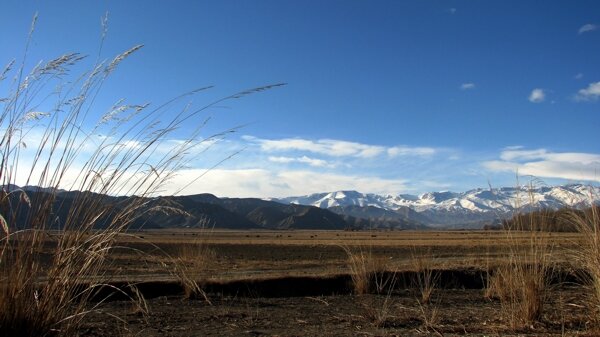


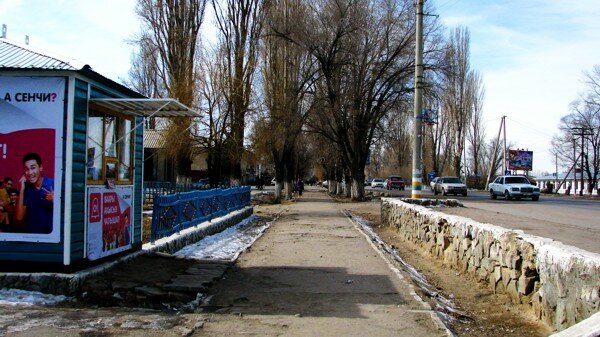
 Bishkek