Almazbek Sharshenovich Atambaev
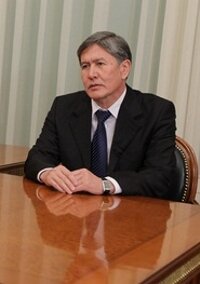
Photo: www.kremlin.ru.
On Sunday, Kyrgyzstan elected its fourth President, (if you don’t count shenbay Jushonbievich Kadyrbekov, who technically held the post overnight with Askar Akaev’s departure in 2005): Almazbek Sharshenovich Atambaev.
Although there are already a number of short biographies and résumés about him, I thought I would write a little character sketch of what I know about him. No doubt, over the next few weeks more information and opinion will be forthcoming.
His story falls into naturally into three distinct, (albeit overlapping), phases: his early life; his business experience and his life in politics. It is a story full of ups and down; trials and tribulations intermingled with moments of triumph and recognition. He certainl;y wasn’t born with a silver spoon in his mouth, nor has his path to the highest office in the land been smooth and without incident.
Almazbek was born on 17th September, 1956, in the village of Arashan, (in the Alamedin district of Chui oblast in Northern Kyrgyzstan), where his parents were workers on the Strelnokov State Farm. By his own admission, he was a late child and his parents were already relatively elderly; his elder brothers and sisters had already left home and gone to Moscow and Leningrad to study. In keeping with tradition a lot of work, housework and farm work, (reaping, sowing, weeding and looking after the cattle) fell to him. As a teenager at school he worked on irrigation projects.
He attended the local school which was located a few kilometers away through the village and he tells how his father used to take him there every day by horse.
At school he read a lot, quickly exhausting the stock in the school library and one of his teachers, (whom he cites as one of the major influences in his life), gave him other books to read. This interest in books was to be a major feature of his life, and to give him both a start and an interest in business. He began to write as well as translating the works of Kyrgyz writers into Russian and, apparently, publishing detective books. He became, and still is, a member of the Writers’ Union. It seems the royalties were quite good because he says that the honorariums he received paid for the construction of house he built for his parents when he was a student, (to replace the simple adobe brick house in which grew up, although his father died before it was completed), and his early entry into business.
He followed his siblings and went to Moscow to study in the Institute of Geological Survey, graduating in 1980 with a diploma as a Planning Engineer and Production Control. At this time he also married and started a family.
Returning to Kyrgyzstan he worked for a time as an engineer and economist at Ministry of Communications in the Kyrgyz SSR before becoming an Editor and Senior Advisor in the Presidium of the Supreme Soviet in 1983. Four years later he entered public service, being elected Chairman of Executive Committee of Pervomaisky District of the capital, (Frunze, as Bishkek was then called).
Then, in 1989, just before Independence, he entered business becoming the head of “Forum”, which he describes as a “scientific production company” and which even his critics admit was a successful cooperative, one of the first in Kyrgyzstan. He remained at that post until 1997.
Although during the 1980’s he had been a young communist party activist, following the abortive August Coup in Moscow in 1991, like many other entrepreneurial minded people, he cut his ties with the party, burning his membership card.
In the early years following Independence, as Kyrgyzstan began the transition from a Central Command Economy to a Free Market economy, he was able to acquire shares in a number of large broken down industrial enterprises. As he puts it himself, “nobody at that time understood securities and they cost peanuts.”
So, in 1997 he became Chairman of the Board of Directors of the Joint Stock Company “Kyrgyzavtomash”, which manufactures automobile parts, and steered it to becoming a successful company and a leading, award winning, exporter. At the same time he started a Kyrgyz-Chinese joint venture “Kyrgyz-Si-Yana”. He reorganized his business enterprises into the Forum Industrial Group. Although he claims that they still operate successful, some of his critics say that these have “sunk into oblivion … [or] sold as scrap to China”.
During this period, as he says, his business affairs began to attract the attention of certain influential and important people: “They tried to take away my business. I had to defend myself.” This, he says, is what prompted his entry into politics.
It began in 1993 with the founding of the Social Democratic Party of Kyrgyzstan, (SDPK), of which he became Chairman, a post which he holds to the present day – although, as President, he will have to resign from the party. Standing in parliamentary elections as a member of the SDPK, he was elected as a deputy of Jogorku Kenesh in 1995 and joined the Reform Movement.
Despite his entry into the political arena, he was still an active businessman, and in 1999 received the Dank Award, (one of Kyrgyzstan’s highest honours), for his contribution to the economic development of the country, and was named by one of the national newspapers in its list of the ten most eminent people in the country.
When the next round of parliamentary elections came round in March, 2000, he stood once more as a candidate and was duly elected. Within a month, however, his election was annulled and set aside by a court decision which claimed that he had not fully disclosed his business interests and his income. Afraid that the authorities planned to remove him from the political scene and incarcerate him, he says that he felt “compelled” to stand in the forthcoming Presidential elections. In an election which was criticized by international observers as not coming up to international standards, he came in third place with just over 6% of the votes, behind Tekebaev, (13%) and the incumbent President, Askar Akaev, (74%).
For a while he returned to concentrate on business affairs but was one of the organizers of the rally on March 24th, 2005, which led to the Tulip Revolution, when Akaev fled the country, and Atambaev once more came to the fore in politics. Having already been a Presidential candidate once, some supporters urged him to stand in the subsequent election, but he decided not to run in opposition to the “tandem” of Kurman Bakiev and Feliks Kulov.
He was appointed as Minister of Industry, Trade and Tourism in 2006 but resigned after just six months over policy differences with Bakiev. One of the ostensible reasons for the resignation was a requirement for ministers to leave their political parties, but Atambaev refused to do this, but he also accused Bakiev of blocking political reforms and supporting criminal elements and corruption.
With Tekebaev, he then established the For Reforms movement in opposition to the regime and the protest movement forced Bakiev to accept a new constitution. In some respects it was a hollow victory, because over the next few months the President was to force through yet further changes restoring many of the powers he had surrendered.
In 2007 Atambaev made what he admits was the most difficult and controversial decision of his political career, one that he thought might actually end it. The government headed by Prime Minister Feliks Kulov resigned as the provisions of the new constitution called for a new government to be formed. He was replaced by Aziz Isabekov, but his term of office lasted only a couple of months and the country was once again thrown into political turmoil and uncertainty. Faced with a divided society and power vacuum, Atambaev agreed to become Prime Minister, as he puts it to “avoid a split in the country”. He served in this role for eight months, from March until November, (the first Prime Minister in Central Asia, incidentally, to come from an opposition party).
His appointment was seen as a concession to the opposition and an attempt to broaden the government by bringing in a Northerner, but controversy continued. The opposition started to organize protest rallies once more within just a couple of weeks of his appointment. His “colourful” language describing some of the protestors of one particular rally caused considerable shock to a society not used to such outbursts from its leaders. There was also considerable controversy over the privatization of the “Crystal” semiconductor plant in Tash Kumyr, which was designed to produce silicon for the electronics industry. Originally built in the 1980’s but, apparently, by 2007 it had not yet started to work. It is thought that the President’s son, Maxim Bakiev, was one of the prime movers in the sale of the plant to a Kazakh company at far below the market value. The government planned to nationalize the plant again but a court decision upheld the sale as valid.
Shortly after this, Atambaev appeared to fall ill. Claiming that he had been threatened with violence over the plans to nationalize Crystal, he now said that he thought he had been poisoned in what was an assignation attempt and he went to Turkey for medical treatment. The authorities opened a criminal investigation, (which was dropped in November, after he had resigned, “for lack of evidence … suggestive of poisoning”.)
He finally left office in November; “fired” or “resigned”, that is the question? Following a referendum, Bakiev announced the resignation of his government, which would remain in office until new parliamentary elections in December, but Atambaev decided to submit his resignation early, at the end of November. Bakiev accepted the resignation, praising his erstwhile Prime Minister and awarding him the Danaker Award, (another of Kyrgyzstan’s honours), in recognition of his contribution to the socio-economic development of the country and the preservation of ethnic harmony.
The parliamentary elections also proved controversial with the exit polls and official results at odds with one another. One of his supporters claimed that Atambaev was forced out of office because he was an obstacle to alleged government interference in the parliamentary election. The opposition regrouped and formed the United People’s Movement with Atambaev once again at the forefront as one of its leaders.
He was selected as the candidate for the 2009 Presidential election, supposedly uniting all the opposition parties. He shocked the nation, and his supporters once more, by announcing on the eve of the election that he was withdrawing his candidacy with the statement, “Due to massive, unprecedented violations, we consider these elections illegitimate and a new election should be held.“ Despite this he still mustered 5% of the vote, as opposed to 89% of the ballots being cast for Bakiev.
He continued in opposition and emerged as one of the organizers of the protests on April 7th, 2010, which resulted in the eventual overthrow of the Bakiev regime. He was appointed as one of the members of the Interim or Transitional Government, as Vice Premier responsible for oversight of the judicial process.
Then in June came the riots in the south of the country which cost over 400 lives. There have been claims that a member of the transitional government he should bear some responsibility for the events, and in particular for failing to prevent it from happening and, perhaps more importantly, there have been claims that he met with the Uzbek leadership in Djalal Abad which has since been convicted of organizing the disorder and may have helped to encourage them in this. All of which he strenuously denies, saying that they are based on forgeries and misinterpretations.
In the December parliamentary elections, his SDPK party gained seats, but surprised many observers by not gaining more and being outperformed by the relatively new Ata Jurt party, which many saw as being simply a reincarnation of Bakiev’s Ak Jol party. He tried to form a coalition government, (comprising the SDPK, Republica and Ata Meken), but the parliament rejected the proposed coalition and so the task a form a new one was given to the Respublica Party. As a result of the subsequent negotiations a new coalition, (comprising the SDPK, Respublica and Ata Jurt), was formed and approved and he was appointed as Prime Minister.
Taking office in mid-December, he served through to mid-September, when he had to step down in order to contest Sunday’s Presidential election.
He was clearly the front runner from the first days of the campaign. His campaign was moderately quiet but, in keeping with earlier ones, relatively slick and professional. This may reflect the fact that he was also the “biggest spender”. Whereas some candidates used the same material over and over, often featuring just themselves speaking to camera, he was able to show a variety of images and included many of his supporters. He was one of the few candidates whose posters did not feature large portraits of himself.
The campaign was not without controversy, however, as claims were made about his business connections, (particularly carrying accusations of links with casinos, criminal gangs and even drug trafficking), and the use of “administrative resources”, (the unfair use of official resources in support of one or other candidate), neither of which, (as far as I can tell), have been substantiated, so far.
Much has also been made of his links with Russia, Turkey and China. There seems to be little doubt that he was Moscow’s preferred candidate in the election and he openly acknowledges that he has business connections with both Turkey and China.
No-one seems to challenge the fact that he a successful and astute businessman. Indeed, many of those who voted for him seem to value this and are relying on the application of that skill and expertise to be applied to the economy as a whole so that the country will develop their standard of living will improve.
He strikes me as a plain speaking and down to earth politician. This may cause some people to raise their eyebrows, but it may be just what is needed to draw people together if it is not seen as being too caustic or authoritarian..
Born in the Chui oblast, he is definitely a “Northerner” and this is an important factor in the country which is often perceived as divided, geographically and socially into two camps: Northern and Southern. Many commentators stress the importance of clan and tribal influences in Kyrgyz society where “who you are” and “to whom you are connected” is often seen as a vital component to success. Indeed, it was reported that in Sunday’s election, apparently his home village almost unanimously voted for him with just a handful of votes being cast for his chief rivals Madumarov and Tashiev.
It was pointed out in the lead up to the election that he hails from the Solto tribe, one of the larger, influential Northern tribes. (At the of the nineteenth century when this sort of information was collected, there were about 44,000 members of the tribe out of a total Kyrgyz population of 310,000; that is they represented about 15% of the Kyrgyz at that time).
One of the chief planks of his election campaign was that he could unite the country … that he accepted the role of Prime Minister under Kurmanbek Bakiev in order to help stave off the potential disintegration of the country; that in his second term as Prime Minister he headed a coalition which contained representatives from all over the country and representing many different political views; that he has experience of heading large teams of people selected on expertise and led them to success; that he listens to different points of view and is ready to reach compromises.
Well, time will tell if he will live up to this. It seems to me that this could be his biggest challenge.


 Bishkek