Tika yedish, dalshe budesh
There is a Russian phrase, “Tika yedish, dalshe budesh”, which roughly translates as “go slowly and go further”. I suppose the English equivalents might be something like “Take it Easy” – or just, “Slow down!”.
It is good advice and applies not just to driving. In English we also the phrase “Haste makes waste” – which encapsulates the idea of “what’s the hurry?” When you are in a hurry – you tend to make mistakes.
A few years ago I was involved in a near miss. I was being driven up to Naryn from Bishkek. It’s about 360 kilometres, through the Central Tien Shan mountain range. The road condition is quite good – asphalt paved road for most of the way, apart from one pass at just over 3000 meters a.s.l. – but even that is quite good. The surface isn’t smooth and even all the way – but apart from a few spots, (which I now know quite well – having travelled the road at least once a month for about five years), the journey is quite comfortable.
On this occasion, the driver was a young Russian – an experienced driver, but quite young and full of the confidence of youth. The “world was his oyster” – and he carried himself as if he was invincible. It had been snowing, although it had stopped, and there was about a foot (30 cms) of snow lying on the ground. We were making good time … perhaps we were doing too well, because we came over the crest of a hill and hit a spot of packed ice … the vehicle swerved: first right, then left, across the carriageway, (fortunately there weren’t any other vehicles anywhere in sight), then round and round. Cool, calm and collected, the young charioteer sitting behind the wheel threw the vehicle into the skid and slowed down until we came to a standstill.
Maybe the passengers were all used to this sort of occurrence, (I wasn’t!), but they all took it very well … there was no screaming, shouting, or panic … just a sharp intake of breath. Once the vehicle was safely “parked” we all caught our breath again … and set off again.
I took the opportunity to congratulate the young man on his driving skills … “Very impressive … Well Done” – and then added, “What a pity it was necessary in the first place.”
That was not the only such incident.
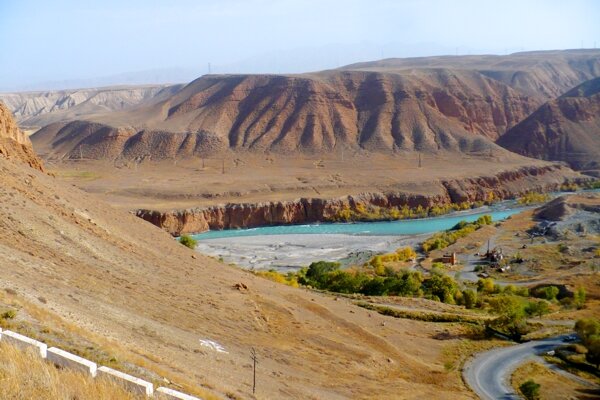
I remember on another occasion I did the same journey in a “local taxi”. After half an hour of what should be at least a four hour journey – but was obviously going to take under three this time – I asked the driver to slow down. We were driving through a gorge with a long, narrow and winding road with vehicles traveling in both directions … and occasionally livestock meandering along or across the highway. He looked at me aghast, horrified – as if I was challenging his manhood. It seems that he decided that it was easier not to understand my “Pigeon Russian” – and ignored me. So I said, as slowly and as clearly as I could: “You may be tired of living … but I’m not.”. He looked bemused … it was clear he understood me … but once again chose to ignore me. After a few more minutes I said “Stop the car – I am getting out!”.
“You can’t stop here,” he protested, “it’s the middle of nowhere.” Quite correct, but at least we had now established that he did understand me. He began to take me seriously. He slowed down for the next hour or so, but you could tell that he straining at the leash all the time – eager to step on the gas and show what his little Lada was capable of. Eventually, testosterone got the better of him and he threw caution to the wind … as his foot hit the floor, we were back up to breaking the speed limit once more. By that time, however, we were out of the mountains and into the plains where the roads are straight – and wide – designed for traveling at 90 kilometers an hour (about 56 mph) and I didn’t feel too worried about doing 120.
In one of the popular guides to Central Asia, there is a list of the author’s personal favourite highlights of the region. It includes the “cheap taxis in Kyrgyzstan”.
Now it is true that there are cheap taxis in Kyrgyzstan – but you run the risk of “getting what you pay for”. It has to be said that there are many very good, caring and obliging drivers who operate taxis … but …
There is system of local, shared, taxis operating between each of the major cities. The drivers wait at central points – usually outside the bus station – for potential clients. Once they have a carload, then they depart. A “carload” usually means four people. Three share the back seat, and the fourth sits up-front next to the driver – in what we, in Britain, euphemistically call the “death seat”. It is possible to take the taxi for yourself – by paying for the additional, unused, places.
Several embassies and foreign ministries (such as the British Foreign and Commonwealth Office) actually advise against using them. Why is this? Apart from the fact that you could be crammed up three to a seat for what could be a long journey … you take “pot-luck” with your fellow passengers, the driver and the vehicle.
There is no licensing of taxis in the Kyrgyz Republic. Buses, minibuses and vehicles owned by companies (like ours) used for carrying passengers have to receive a license – but not taxi drivers. The law actually explicitly excludes them from this requirement. Basically, anyone with a vehicle and a driver’s license can start working as taxi driver. Some of the drivers operate full time – as “professional” drivers, but others may simply be looking for paying passengers to help defray the costs of undertaking a journey to see friends and/or family. For example, I have one acquaintance, a Doctor who lives in the South of the country. During the summer he supplements his meager salary of about USD15 by taking his annual leave and shuttling backwards and forwards between Bishkek and Osh. When not on vacation, he still manages to make the journey once a month.
Please don’t misunderstand me … lots of people use these taxis everyday – and, sometimes, I also use them. For the traveler on a tight budget, especially, the use of buses, minibuses and local taxis offers a cheaper alternative to hiring a car and driver from a company like ours … but, it is a case of Caveat Preemptor – “Let the buyer beware”.
In the capital, Bishkek, there are a number of new taxi firms and they have a number of advantages:
- the vehicles have special lights and displays – and so are easy to identify;
- you can order a taxi by phone;
- drivers and vehicles are (supposed to be) checked and vetted;
- each one is numbered, so there is some control – for example: if you forget something in the back of the vehicle, it might be possible to trace the vehicle;
- there is a set system of tariffs – it might be a bit more expensive than simply flagging down a vehicle on the street, but is predictable and there is no argument;





 Bishkek