Village economics
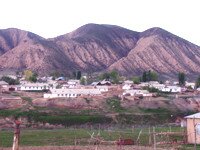
Ottuk
The end of March – the end of Winter and the start of Spring. Although we had experienced several days of bright, warm, sunshine, the weather had turned and it proved to be particularly chilly. Bright sunshine had been replaced by dark, overcast, skies which were divesting themselves of rain … at least it wasn’t snow … although that was always a possibility.
It’s the end of the month – which means that we have to make our regular journey from Bishkek to Naryn. As well as dealing with the regular end of month routines: accounts, tax reports and that sort of thing, this month we also knew that there were some technical problems and we had a lot of materials to take up to our guesthouse for the annual spring clean, repairs and renovations. There is too much for our ordinary van, and so we attach a trailer, and set off.
The distance between the two cities is just over 350 kilometres. On the whole, the road is quite good. Through the Chui valley we pass a number of villages and small towns. We climb over the … pass and descend to Kochkor. So far the journey has been uneventful. The trailer has slowed us down, but otherwise nothing untoward occurs.
For the last 115 kilometres from Kochkor to Naryn we have to climb to over 3000 meters above sea level and cross the Dolon Pass. On the way we pass marmots playing on the banks of the river, and three huge vultures fighting over a kill, only to have ravens sneak in and helping themselves to a snack whilst the larger birds are distracted. At the summit, itself, snow still lies on the ground – not a very thick layer, but snow all the same – and the wind blows a bitter cold. The road descends rapidly from the snow covered pass through a gorge with a fast flowing stream cascading over rocks to our right. The steep mountain slopes encroach close and closer as the gorge narrows.
| “Vulcanizatziya” |
Descending from the pass we feel something is wrong – and pull up. Sure enough, one of the tyres on the trailer has blown. We have spares for the vehicle itself, but the tyres on the trailer are a different size – and we are not carrying a spare. What to do? We really have no choice, and so we unhook the trailer and remove the wheel. Two of the party agree to stay with it while the rest will drive the five kilometres and get the tyre repaired.
The road emerges suddenly from the narrow gorge through a gap in the mountainside and opens out into a wide plain. Lying a short distance further on is a village of about 100 houses. We pass a shop and see a solitary, 3-storey, block of flats on the other side of the river.
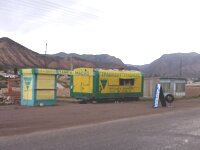
Ahead of us, at the side of the road, is a green painted wagon displaying the sign “Vulcanizatziya” – the tyre repair shop. We pull up in front of the wagon. Although it displays a sign indicating the hours it is open – and it should be open … it is well and truly locked – secured by a sturdy, heavy duty, padlock.
A moment of quiet desperation settles in as we think of our colleagues standing by the side of the road in the bitterly cold wind, practically in the middle of nowhere … what to do?
We needn’t have worried, however. Crossing the road, approaching us in a businesslike manner is a young man, dressed in layer upon layer of thick clothing topped with a green, military style parka. We prepare to ask him where we can find the owner – but it turns out to be him. He reaches into his pocket and retrieves a shaped piece of metal which serves as a key for the bulky padlock and opens the wagon. It is not clear if he returning to work after a lunch break, or simply lives over the roads and saw us arrive. The important thing is that he is here and able to help us in our hour of need.
We explain the situation and ask if he can sell us a spare tyre. Although we can see one or to lying around, he points out that they are the wrong size and so settles down to find the reason for the flat and repair it.
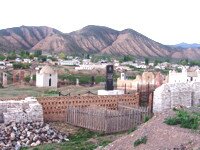
As the work progresses, I am not needed, so I take a short stroll away from the road towards a cemetery which lies about 10 or 20 meters away. Around the cemetery is a wall – cunningly built like a trellis with alternating gaps between each pair of bricks – presumably requiring about half the number bricks a solid wall would need. Inside the wall there are numerous mud-brick mausoleums mounds of earth and wire structures arranged to resemble the frame of a yurt are all crowded together. Most of the graves bear plaques with inscriptions in Cyrillic or Arabic, some with the hammer and sickle or five pointed Soviet Star and others with the crescent moon of Islam, and many with photographs of the deceased.
There’s obviously been a funeral recently. To one side there is a mound of freshly dug earth, piled high and topped with a large wreath.
| Ottuk cemetery |
Interestingly there is one mound of earth just outside the wall. This raises a question in my mind: Was it a suicide?, someone who converted? … or simply because there was no room left within?. I look around and cast my mind back to the drive into the village … and count four cemeteries. This one is the central cemetery and presumably carries a certain amount of status – so I conclude that it is probably just the last variant – “No room in the cemetery.”
Making my way back to the wagon – I learn that they have discovered a nail in the tyre – only about an inch long – but bent into a right angle and well and truly embedded into the rubber casing. It’s now been removed – the puncture hole discovered and repaired. Now the inner tube has been inflated for checking … and it appears that the nail managed to puncture it in more than one place. So it is deflated once more … another search commences, another hole is found and patched.
Meanwhile, we have visitors – or at least the owner of the repair shop has visitors. I don’t see what happens, but I am told later that they wanted to borrow money from him. Apparently he gave them 20 som – about 50 cents.
It seems that the nail managed to create several holes … more searches, more patches.
And also, more visitors. One group seems to have been at a party – they are very pleasant, but have obviously been drinking. They engage us in conversation and take me for a professor … I suppose I must have a distinguished, learned, appearance. It is all very pleasant … but they hang around for a while and one of their doesn’t want to leave … the others have to coax and cajole him. The last pair arrive in a car … park nearby and talk to the owner … then seem to wander off.
Finally after an hour, and six holes, it seems that the tyre is whole again. We pay the man for his work – 80 som – about two US dollars. As we drive off to rescue our colleagues from the bitter wind we see the last two visitors rush up to the wagon as the owner dismounts and reattaches the padlock.
How much of the 80 som he managed to keep, I don’t know … most of it, I hope.



 Bishkek