And the next word is … (ding!) … Pogonologist
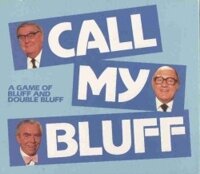
Call My Bluff
Yesterday, I wrote a postcard about the television programme called “Call my Bluff” and the word “googol”. Strictly speaking, it wasn’t about Kyrgyzstan, or the life of an ex-pat here in Kyrgyzstan – but I hope I will be forgiven for that.
Today’s postcard is also not strictly about Kyrgyzstan but another word taken from the Oxford English Dictionary. Although this word never appeared on the programme, as far as I am aware, it could easily have done so. In fact, it did make an appearance in a version of the game … but not on television. As I said yesterday, it was the sort of panel game that you easily play along with whilst sitting at home. It was also possible to play the game at home without worrying about the TV at all. All you needed was a dictionary and a fertile imagination.
One of my colleagues, when I was teacher, decided to do just that. She got together a small group of pupils and they arranged a special version of the game for the school’s Charity Week.
Each year, we set aside a week to raise funds for a charity. Each class was asked to organize a fund raising activity. Some decided to prepare food, (sandwiches or sweets of some sort), which they would then sell; others decided to offer to was the cars of members of staff during the lunch hour. Many organized a sponsored event: a sponsored walk, a sponsored read; or a sponsored silence, (my favourite), for example.
Some more enterprising classes decided to put on some sort of a show to which they would sell tickets, and Sarah’s class decided on a performance of “Call My Bluff”.
The school’s Drama Studio was booked – and, although not a massive crowd, it was filled with a respectable number of children and staff alike.
We went through several definitions, and then came the next word … (ding!) … Pogonologist. Well, we all laughed. It sounded so funny. What it could it be?
The three definition were duly offered … something to do with Pogo sticks – that craze for jumping up and down on a pole with springs which later game rise to the disco dance where people jump and down on the spot; something to do with a comic strip character, Pogo the Platipus; and something to do with beards.
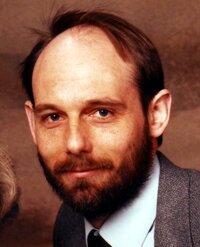
Me with my beard
I took an interest in that definition – not just because I sported a beard, a rather ragged beard, at that time … but because Simon, the pupil offering the definition, (and very much an extrovert), referred to me by name and pointed me out where I was sitting in the audience. ”A Pogonologist,” he informed us, “would have a particular interest in Mr. Claytor …”.
Oh, yes,” I thought to myself, “and what’s coming next?”
“As we all know,” but I am not sure that everyone in the Drama Studio were aware of this fact, “the ending -ologist implies an expert, a scholar. Well, a Pogonologist is a someone who studies Beards,” which was met by huge roars of laughter, “and Mr. Claytor has a very fine example which a pogonologist would be able to classify and tell you an awful lot about …”
And so it went on creating much mirth and merriment.
The other team chose the Pogo Stick definition … they were wrong … it was the expert who studied beards.
If you don’t believe me – google it, or should that be googol it?
.
So, why write a postcard today about “pogonolgy”?
It seems that in 1698, 313 years ago, today. Peter I, Tsar of Russia, (otherwise known as Peter the Great), decided to impose a new tax – on beards. It was all part of his campaign to Westernize, (and modernize), his empire – eventually turning it into a major European power.
He commanded all of his courtiers and officials, (the clergy and peasantry were exempt), to wear European clothing and cut off their long beards, which caused his Boyars, (who were very fond of their beards), great upset. Those who sought to retain their beards were required to pay an annual beard tax of one hundred roubles, which was no small sum. Those who paid the tax were required to carry a “beard token”, a copper or silver token with a Russian Eagle on one side and on the other, an effigy of the lower part of a face with nose, mouth, whiskers, and beard. The token was inscribed with two phrases: “The tax has been taken” and “A beard is a superfluous burden”.
For the record: Peter the Great wasn’t the only monarch to introduce this tax … Henry VIII of England also levied a beard tax. Oddly enough, unlike Peter the Great, who sported a long miry moustache, Henry is famous for his flowing beard. In Henry’s case, it was a graduated tax, varying with the wearer’s social position.
I’m not sure when it was abandoned, but his daughter, Elizabeth I, reintroduced the tax, and levied it on every beard of more than two-weeks growth.
I wonder if she employed a pogonologist to determine the age af grown on a man’s chin … now there’s a career opening for someone!
.
Tax is a perennial topic of conversation here. A few years ago we introduced a new tax code which reduced the number of different taxes in the country. Before, there used ot be a number of taxes that were loosely referred to as the “nuisance taxes”, that is they raised very little money for the budget but required a lot of administration and were little more a nuisance to businesses. I am told that one tax in particular never actually raised a single som in revenue.
Unfortunately, the government’s budget is in such a state, (it’s running a very large deficit budget – just like some other countries we could mention), there is a lot of pressure to see if there are ways and means to increase tax revenues. Some deputies have suggested reinstating some of those “nuisance taxes” but fortunately, so far, nothing has come of this.
After a newspaper headline some years ago, where the reporter was asking if soon the very air that we breathe wasn’t to be taxed, I used to joke with people that back in England we used to have a tax on windows – and suggested, (somewhat tongue in cheek, I have to add), that the government might want to consider something similar – a tax on tunduks, for example. In the same way that it used to be argued, I said, that more windows a man had in his house, the richer he was and more able to pay the tax … so, likewise, the more tunduks a man has, (the more yurts he has), the richer he is and the more able he is to pay the tax. In England, of course, the Window Tax led to many a window being bricked up – but it is not really possible to dodge the tunduk tax like that.
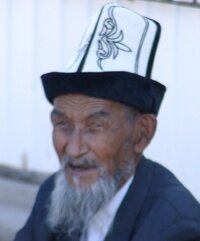
An Aksakal, complete with White Beard
It was all said tongue in cheek … it was a joke … I don’t believe that such a property tax is a good idea …
.
Another suggestion might well be a beard tax. After all, there are, apparently, good precedents for introducing such a tax. What’s more it would be a voluntary tax – easy enough to avoid if you didn’t want to pay it because all that would be necessary would be be to shave – on a regular basis.
However, I am not sure that it would be a welcome suggestion. Beards are not that popular here, which would limit the amount of the revenue raised by such a tax. On the other hand, those that do wear beards tend to be the older generation of Kyrgyz – after all, the title for respected elders is Aksakal – which means “white beard”.


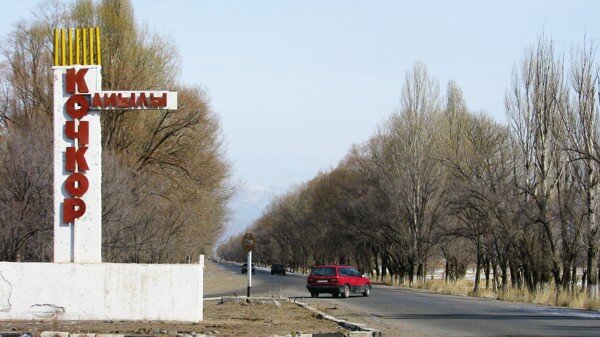


 Bishkek