And the next word is … (ding!) … Googol
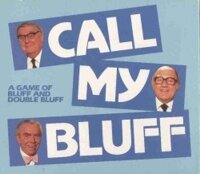
Call My Bluff
Back in the days of Black and White television, (yes, that long ago), there was a popular programme on the BBC2 channel called “Call my Bluff!”. It first appeared in 1965, (in black and white) and lasted until 1988, when it was seen in colour.
Call My Bluff was a panel game chaired by Robert Robinson and featured two teams of three people captained, originally, by Frank Muir and Robert Morely, who took turns in providing definitions for strange words taken from the Oxford English Dictionary, announced by the chairman with great flourish with the phrase: “And the next word is …”, ringing his little bell, “ding”. There in the set behind him the next word emerged.
Of course, unless you were the Cheshire Cat, (in which case means what you want it to mean – a recipe for anarchy and solipsism), most words have just one meaning. That meant that, as each of the three members of one team would, in turn, offer the members of the opposing team a definition of the chosen word, only one of the suggestions could be the true definition whilst the other two were “bluffs”. So, the opposing team had to listen to and weigh up the probability of each definition being the correct one. If they guessed correctly, they scored a point, but if they got it wrong, the other team got the point.
When I say it was “popular”, of course, everything is relative. BBC2 was the “elite” channel with intellectual and arts programmes. It tended to attract a smaller audience than the more mass orientated BBC1 or TV, (Independent Television), which relied on advertising for its funding. Even so, it was a well known programme and many features of the game were to pass quickly into popular culture.
Of course, it was a game you could easily play along with, whilst sitting at home. The words were obviously chosen to be obscure, words like: Queach, Strongle, Ablewhacket, Hickboo, Jargoon, Zurf, Morepork, and Jirble. For example, “Queach” was apparently defined as “a malicious caricature”, “a cross between a quince and a peach”, and “a mini-jungle of mixed vegetation”. (For the record, the true definition is the last one, the other two were “bluffs”.
Sometimes, however, just occasionally, a word cropped up which you might already know. I remember watching when the word “googol” was revealed as the chairman rang his little bell.
A googol is a very large number, a 1 followed by a googol of zeros. A google – oh, that’s easy, it’s also a very large number, a 1 followed by 100 zeros. so you have:
10 – ten
100 – hundred
1 000 – thousand
10 000 – ten thousand
100 000 – hundred thousand
1 000 000 – million
10 000 000 – ten million
… and so until
10 000 000 000 000 000 000 000 000 000 000 000 000 000 000 000 000 000 000 000 000 000 000 000 000 000 000 000 000 000 000 000 000 000 - that’s a googol
… and a googolplex, is a 1 with a googol of zeros after it.
The term was invented in 1938 by the 9 year old nephew of a mathematician who was trying to think of a way to talk about infinity in a book that he was writing. He asked his nephew what he would call a very large number: a 1 followed by a hundred zeros, and he came up with “googol”.
I have to say that I think this was a piece of genius … Googol is so much friendlier a name than the alternatives: ten duotrigintillion, ten thousand sexdecillion or ten sexdecilliard.
Although googol is indeed a large number, so large that it is difficult to imagine, it is a definite quantity and is not the same as infinity … and neither is a googolplex – the name the same little boy gave when he was asked what he would call a 1 followed by a googol of zeros.
.

Happy Birthday Google!
Incidentally: Google – yes, google as in “google it” when you enter a term in search engine on the internet – is actually a deliberate misspelling of “googol”.
And Google was founded thirteen years ago today … on September 4th, 1998.
Tomorrow, (today’s not a working day), we’ll have a cake in the office to mark the occasion.




 Bishkek