Fingers crossed

Crossed fingers - a sign of hoping for good luck
Although I have seen several different suggestions, I am not sure where the practice of crossing one’s fingers originated, but it is often used as a sign that people make when they are hoping for good luck.
Now, I don’t consider consider that I am particularly superstitious, but a news item yesterday, (it’s in Russian), caused me to cross my fingers.
In a surprise move, a real “bolt from the blue”, the headline announced that “the Ministry of Economic Regulation proposed to abolish the visa regime with 57 countries“.
The report was based on an announcement issued by the Ministry’s press service of the Ministry of Economic Regulation, which said that the Ministry has drafted a new regulation, “About a Visa-free regime for citizens of countries with high incomes“.
For the record:
Visitors to Kyrgyzstan from seventeen countries already enjoy a visa free regime:
- Armenia (under the CIS Agreement of 1992 “On the visa-free movement of citizens of CIS countries in the CIS”)
- Azerbaijan (under the CIS Agreement of 1992)
- Belarus (under an agreement between member states of EurAsEC, from 2000.)
- Cuba (under a bilateral agreement with the former Soviet Union)
- Georgia (under the CIS Agreement of 1992)
- Japan (granted unilaterally for an indefinite period)
- Kazakhstan (under an agreement between member states of EurAsEC, from 2000.)
- Malaysia (for a stay of up to 30 days) (under a bilateral agreement)
- Moldova (under the CIS Agreement of 1992)
- Mongolia (for a stay of up to 90 days) (under a bilateral agreement)
- North Korea (under a bilateral agreement with the former Soviet Union)
- Russia (under an agreement between member states of EurAsEC, from 2000.)
- Tajikistan (under an agreement between member states of EurAsEC, from 2000.)
- Turkey (for a stay of up to 30 Days) (under a bilateral agreement)
- Ukraine (for a stay of up to 90 Days) (under a bilateral agreement)
- Uzbekistan (for a stay of up to 60 Days) (under a bilateral agreement)
- Vietnam (under a bilateral agreement with the former Soviet Union)
In addition, it ought to be noted that the holders of diplomatic passports from several other countries also do not require a visa, but there aren’t that many people who can take advantage of this privilege.
It is now being proposed in this draft regulation to grant a visa-free regime for the citizens of the following countries for a stay in the country for a period of up to 90 days:
- Andorra
- Argentina
- Australia
- Austria
- Bahamas
- Barbados
- Belgium
- Bosnia and Herzegovina
- Botswana
- Brazil
- Canada
- Chile
- Costa Rica
- Croatia
- Cyprus
- Czech Republic
- Denmark
- Estonia
- Finland
- France
- Germany
- Greece
- Hungary
- Iceland
- Ireland
- Israel
- Italy
- Latvia
- Liechtenstein
- Lithuania
- Luxembourg
- Malaysia
- Malta
- Mauritius
- Mexico
- Monaco
- Netherlands
- New Zealand
- Norway
- Panama
- Poland
- Portugal
- San Marino
- Singapore
- Slovakia
- Slovenia
- South Africa
- South Korea
- Spain
- Sweden
- Switzerland
- Thailand
- Trinidad and Tobago
- United Kingdom
- United States of America
- Uruguay
- Vatican City
It should also be noted that at the moment, these countries are in the Simplified Visa Regime; although the citizens of these countries currently need a visa to enter the country, they can obtain one on the basis of a personal application at any consular office of the Kyrgyz Republic on the basis of a personal application – in other words, they don’t need a letter of invitation or “visa support”.
.
The suggestion to introduce a visa free regime for a range of countries is a move that many of us in the tourism industry have been advocating for some time – and I have written about in several postcards, in particular, back, in 2008, I wrote a postcard on this specific subject. Getting a visa to travel to countries is both an administrative and a financial barrier which can put potential tourists from considering a destination.
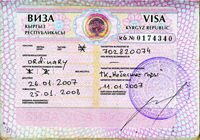
The all important visa
Apart from the fact that having to apply for a visa sends a discouraging signal to visitors, (tourists or potential investors), from a particular country that they are not wanted or not trusted, they then have to run the gauntlet of applying for and obtaining a visa. That also involves a cost – not just in terms of money, (the visa fee itself), but the time and inconvenience involved. Kyrgyzstan currently has diplomatic missions in only 30 countries, and tourists in other countries either have to use the consular services of Kazakhstan and Russia, (which involves more expense in both time and money in obtaining an invitation, or visa support), or travel to neighbouring countries where there is a Kyrgyz diplomatic presence. All of which increases the final cost, (in terms of both time and money), of obtaining a visa.
To be fair, it should also be noted that visitors may be able to obtain a visa on arrival at the consular department at Manas airport – but not everyone wants to fly into Bishkek – many want to travel overland along the Silk Road.
The introduction of visa-free regime, on the other hand, should contribute to a significant increase in the number of tourists who decide to visit the country. It is likely to act as a powerful signal which will attract the attention of both tourists and investors. There have been several examples which are often referred to, (Georgia and the Ukraine, for example), which illustrate this point.
There should be a very definite economic advantage to the country, especially when it is remembered that a tourist spends a lot more in the country for services than than the one-time cost of the visa fee. A well as creating a demand for goods and service, they also contribute to the country’s balance of payments as “inbound tourism” constitutes an export of services.
There always seems to be opposition which I liken to a blunderbuss approach – fire enough pellets and hope that some of them will do some damage, including:
- the risk of the national security of Kyrgyzstan – it has to be admitted that this is a valid and vital concern, but it is not the only instrument that the security services have at their disposal. I am aware, for example, of several people, (Norwegian and American – not our clients, I am pleased to say), who were turned back at the border, even though they were in possession of a valid visa, because their names appeared on a “stop list”. The lack of a visa didn’t prevent a Turks who were later accused of crimes, (and one of whom was later extradited to Turkey), from entering the country. Neither would the visa system have prevented the “murderers of Beslan” from entering the country.
- the risk of illegal migration – although it seems likely, (especially given recent statistics), that citizens of Kyrgyzstan are more interested in emigrating than foreign citizens from these countries are on immigrating here … (and I do appreciate the irony of my saying that)
- loss of money, (that is receipts from visa fees) – but a tourist spends a lot more in the country for services than than the one-time cost of the visa fee … so on balance, the country is likely to be far better off as a result of this measure
- … and, in particular, a loss of the funds used to cover costs of diplomatic missions – the cost of maintaining embassies and consular offices abroad, where it is deemed that they are necessary, can be met by the central budget – after all, how many visas are issued in Minsk (Belarus)? How is that embassy financed?
- the use of visas to provide statistics – in which case, visas should be required for everyone, or else the statistics will be severely skewed … the only statistic that they really give us is how many visas are being issued.
.
At the moment this measure is simply a draft proposal. It still has to undergo the usual interdepartmental scrutiny and receive final approval. It is still possible for the proposal to be amended or, even, turned down. However, it is still a hopeful sign and, although I am not yet “counting my chickens” – I, for one, will be keeping my fingers crossed in the hope that it will eventually be approved and implemented.
.
Unfortunately, back in the UK, crossed fingers are also used – especially by children – when making a promise as a “let-out”, indicating that you don’t really mean what you say and thus having the effect of nullifying the promise. Of course, you try not to let the person you are supposed to be making the promise to see that you have crossed your fingers … or else, that would give the game away.
Let’s hope that the politicians and civil servants haven’t got their fingers crossed behind their backs, whilst we keep our hands with their fingers crossed in full view.




 Bishkek