Genghis Khan – “God’s Punsihment for your sins!”
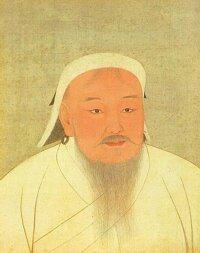
Genghis Khan
Today marks the anniversary of the death of one of history’s most enigmatic leaders: Genghis Khan, who rose from being a local warlord into the ruler of the greatest empire the world has ever known.
Temujin, (his given name), was born into the family of a local Mongolian chieftain. To be honest, we don’t know much about his early life, and what sources do exist often contradict each other Apparently he was third of four brothers and they had a sister. According to legend Temujin was born with a blood clot grasped in his fist and this was taken as a sign of that he was destined to become a great leader.
It wasn’t something that could be taken for granted, however. Much of his youth, after his father died when he was nine, was spent in hiding from rivals who wanted to exterminate his line of succession. He managed, however, to gather round him a collection of loyal clans and at the age of 39 was elected supreme Khan, uniting not just the Mongols, but other peoples under his leadership: Merkits, Naimans, Keraits, Tatars, Uighurs and other disparate smaller tribes.
Having already earned a reputation as a fierce some opponent in some local wars, he sent a trade mission to Otrar in current day Kazakhstan in 1218, where they were murdered. He set himself up at the head of a 200,000 strong army and marched off on a campaign of retaliation. Within a year the Mongol hordes had swept through Central Asia, (including the territory of Kyrgyzstan) to Bukhara, (where he made his famous declaration: “I am God’s punishment for your sins”), and beyond. Bloody and brutal methods were employed – cities that resisted the advancing armies were razed to the ground and whole populations massacred – women children and even domestic animals included. However, not every city met with the same fate – the brutality of the Mongol hordes tended to be directed with a purpose against those who resisted their advance. If a city surrendered they were well treated and there was virtually no change in their lifestyle.
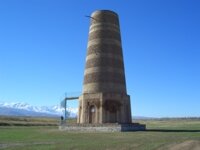
Burana Tower, all that remains of the ancient city of Balasagin
Although some of the Kyrgyz resisted the onslaught – and paid dearly with their lives, many surrendered and went on to serve as mercenaries in the further conquest of Central Asia. The city of Balasugin in Kyrgyzstan saw the writing on the wall and did not resist – and the city was spared destruction and even renamed Gobalik (=”good city”) by the conquerors. The city of Jul, (modern day Bishkek), was not so favoured – and razed to the ground. Osh suffered a similar fate.
His empire was based upon a loose confederation of Mongol and Turkic clans and a reputation for ruthlessness. They did, however, bring stability, law and order. Forts and staging posts were established throughout the empire – Genghis knew that if his empire was to function and last, that good communications were vital.
He died in 1227 and his empire was divided between his sons – and within a generation no longer existed as a separate entity.
One find that has so far eluded archaeologists is the grave of Genghis Khan. There is a legend that he decreed that when he died his burial place should be kept a secret. So a party of 40 attendants took his body to a secret location, buried him (along with a treasure of untold riches), and were then killed by their 40 guards, who in turn committed suicide – thus ensuring the Khan’s wishes were fulfilled. The site has never been found, and many Kyrgyz believe that it was somewhere around Lake Issyk Kul. The theory was taken seriously enough for the the Soviet government to stage an expedition to search for the grave in the 1970’s. There has, however, been much interest in a recent discovery of a mass grave in Mongolia, that some archaeologists think might be it – which will come as a surprise and disappointment to the Kyrgyz “believers”, if it can be proved.
.
Although he is often remembered more for the brutality of his campaigns, (particularly in places where the worst excesses of his campaigns were experienced), this probably represents an over simplification and there are conflicting views about Genghis Khan.
In Mongolia, of course, he has been generally revered, so much so that a monument was erected to him in his birthplace and a conference held to commemorate his 800th anniversary even though this led to criticism from the Soviet Union, (and eventually cost the Party General Secretary his job).
More generally, he is credited with bringing the Silk Road under one cohesive political environment which allowed increased communication and trade between the West, Middle East and Asia. He instituted a system of meritocracy and was tolerant of different religions.


 Bishkek
Here is an interesting article on Genghis Khan:
http://kanglaonline.com/2011/09/genghis-khan-the-great-mongol/