Wish you were here!
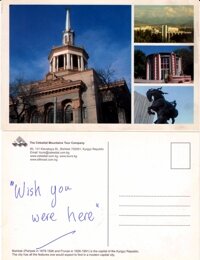
A postcard from Bishkek
Every now and again, a friend or client arrives in Bishkek and proudly hands me a copy of one of the latest newspapers from home, (for example, the complimentary papers they got on the flight out),. They always hand them over as if it was a “food parcel” sent abroad to POWs, (prisoners of war), during the Second World War. They appreciate that there are very few foreign newspapers and magazines available here in Bishkek, and although it would be possible to subscribe to them, they would take so much time to arrive, that they would be well out of date by the time they arrive. Some of the bars and cafes frequented by expats often keep a table where new arrivals are encourages to leave copies of any old newspapers, so that people can peruse them.
I hesitate to point out, when they hand over their precious cargo, that the newspapers are already at least two days old and that I have already scanned the paper’s website and read the articles in it that interested me … not to mention having surfed the sites of several more newspapers and news services so gaining the benefit of different points of view from a variety of sources.
There is something special, however, about folding the paper up, putting it under your arm as you walk to, (or from), a meeting, or perhaps sitting in a café and unfolding it, holding it in your hands, turning the pages and scanning the headlines, and it doesn’t need a computer or internet access … and it’s easier on the eyes.
So, despite what many people say, (and, for that matter, have said ever since the appearance of Radio, and then television and now the internet), I don’t think that the days of “print” are over. Newspapers and magazines have had to adapt to meet the challenges of the new media, and, so far, they have managed to do this somewhat successful. Whilst radio and TV have an immediacy, it is possible to ponder over a report in print, return and reread a sentence if something seems unclear or your attention is distracted by what is going on around you. You read it when you are ready and want to, not when it is broadcast. It’s possible to mark, highlight and make notes at the side of an article when something attracts your attention. It is possible to retain a copy, cut out and file away an article for later reference. And, as I said, there is something intrinsically pleasing about having a physical object in your hand.

Just some of the Newspapers available
Here in Kyrgyzstan, newspapers are an extremely important resource – especially here in Bishkek. We have radio, television and the internet, but we also have a myriad of print titles, and even though some of them have a very small circulation, they are bought up and devoured. Although we subscribe to a number of newspapers, which represent different points of view and constituencies, whenever I hear of an article of interest in another newspaper, we try to obtain a copy but, often, only to find that it has already sold out.
There are newspapers in Russian and Kyrgyz. Many also operate their own websites. The main newspaper is Vecherniye Bishkek (Evening Bishkek). Most of the newspapers are local, that is based in and read mainly by the people in a particular region, with local papers being published in the regions; in Karakol and Osh, for example.
There is one English language newspaper, The Times of Central Asia, which has seen off a number of competitors over the years.
As in the west, television is the main source of news for most people. In the rural areas, even TV reception can be difficult and radio is still popular but not quite as all pervasive as in “Radio Romance” by Garrison Keillor, (of Lake Wobegon fame).
Of course, there is also the internet, and I am often surprised at how many people do use the internet. It’s not as all pervasive as it in the West, it can be expensive and broadband is not universal, but I am often surprised how many people do surf the net for their information. As well as the fact that many newspapers publish their own websites, there is a burgeoning number of news agencies which publish information on the web. And then, of course, there is social media. Facebook and Twitter are used extensively. Rosa Otunbaeva and many of the leading politician have their own accounts with “friends” and “followers”. Not to mention Youtube and a number of local versions which are also extremely popular. Then there are the local forums, like Diesel. These are in exclusively in Russian and you have to be able to navigate your way around them, so I tend not to frequent them that often, but many of the local people that I know do. I am often asked something like “Have you seen on Deisel about …?” Not long ago, some politicians were so concerned about the material appearing there that they started talking about the need to monitor and hold people accountable for what they posted. That was, of course, taken as a threat signaling an attempt to close it down, but the politicians denied this.
.
During the week the press has been busy covering a wide range of stories … not all of them belonging to the “silly season” variety. Amongst those that caught my attention were:
- The hot spell broke shortly on Sunday night with thunder and lightning which continued on Monday morning. One clap of thunder seems to have exploded over our office … there was a deafening bang which shook the windows and for a moment we wondered if it was another “bomb”. Fortunately, it was no more than a clap of thunder. Naryn actually saw hailstones 1 cm in diameter.
- The number of candidates or the Presidential election has now reached 50, with the nomination period closing only on Tuesday. One political party, however, announced this week that it would NOT nominate a candidate. One bright spark has suggested that there will soon be a new Trade Union in Kyrgyzstan … The Association of Presidential Candidates.
- There was a protest rally in one of the “semi-informal” villages on the outskirts of the capital, (near the Dordoi market), with about 300 protestors blocking the main by-pass around the city. They are asking for water and electricity and to be allocated the land on which they have built their houses.
- According to the official statistics announced during the week, GDP has risen 6.5% n the first 7 months of the year when compared to last year and remittances from Russia has increased by one and a half times – on the other hand, the half year inflation rate stands at 6.5%, the average monthly salary rose by 23.5% but that excludes small businesses and the overall wage rate rose by just 12.6%. There are consideravle variations around the country, however, with the average salary in Osh being just 4576 soms whilst in Bishkek the equivalent figure is 10938 som.
- Import of vodka in Kyrgyzstan increased by 20% and beer by 25% since beginning of 2011
- Roza Otunbaeva has signed a law that requires all marriages conducted in Islamic, Christian, and other religious traditions to be officially registered in order to be valid. It also lowers the age limit for being able to marry to 17 – in extreme circumstances: pregnancy or illness of one of the partners requiring care and the enforced absence of one of the partners – e.g. by having to perform their military service,
- Land has been allocated in the south for homes for anyone from one of the Kyrgyz enclaves in Uzbekistan who wants to resettle.
- Bishkek isn’t the only Kyrgyz city to get new monuments. The Southern Capital, Osh, is to get three new ones (to Manas, Barsbek and Alymbek Baatyr) by the City Day, (October 5th). Work on them has already commenced and the total cost is supposed to be in the region of 83 million som – that’s about USD1,850,000 – or aboput USD615 each. That makes the 27 million for the two statues in Bishkek’s main Ala Too Square seem abstemious, but in Osh they are having to construct the whole complex surrounding each statue, not just the monument itself. (There’s already some information about Manas on www.ianbek.com – http://ianbek.kg/?p=1197 and http://ianbek.kg/?p=3808 – I’ll try and post some about the other two in the near future.)
- Apparently, HIV is on the rise in Kyrgyzstan – one of only 25 countries in the world where this is true. The rise is being blamed on “ignorance” – particularly amongst young people. One survey suggests that 70% of Kyrgyzstan’s youth show a very low awareness about the issue and exhibit either no knowledge, or just a very rudimentary level of knowledge
- The tourist season is underway… and, the south is suffering according to official statistics – but, as you may already be aware, no matter how interesting they are I tend to have doubts about official statistics):
- Early in the week it was announced that the Djalal Abad province has seen just under 9000 visitors in the first six months of the year – 194 from the former Soviet Union and just 128 from the rest of the world … all the rest were from other parts of Kyrgyzstan. Unfortunately I haven’t seen any figures to compare with a more normal year.
- At the end of the week there was a similar announcement for Osh which suggested that there were only 2233 tourists registered in the region for the same period which included “40 tourists from CIS countries and 10 climbers from other countries”. Why am I always suspicious about statistics like these?,
- However, a rise in the number of Russians coming to Issyk Kul for their vacations has led to a shortage of places on flights to and from Russia
- Talking of Issyk Kul, apparently 100,000 young fish have been released into the lake to help replenish stocks.
- A Kyrgyz citizen accused of spying is sentenced to 10 years of imprisonment in Iran, (apparently, originally it was claimed for the US, then for Kyrgyzstan) although it is said he was tried twice – one in the lower court where he was acquitted and then in the Supreme court, where he was convicted even though he wasn’t allowed to attend the hearings.
- Meanwhile, a Turkish citizen accused of terrorist activities has been extradited back to Turkey. Whilst he was in Kyrgyzstan he was applying for political asylum but had his case turned down by the courts. There seems to be a question, however, about whether the process was properly completed.
- The news from London is receiving a lot of attention … and comparisons with what happened here last year – most of it focusing on the chaos and mayhem but mistaking or ignoring the differences:
- Seen on Twitter, for example, was the comment: “Englishmen how to protect themselves from rioters. They simply need to write “Biz El Menen””. (A reference to the graffiti that many shop owners posted on their windows during the events of April last year and protected their properties from being raided by the looters – it means, “I’m with the people”)
- A tweet from London: “Interesting, I’ve had a number of emails this morning offering sympathy over events in London, from Bishkek, Damascus and Sana’a!”
.
In last Saturday’s postcard I wrote about the penchant for short, pithy eye-catching headlines in the British tabloid newspaper, The Sun. Recently, I also wrote a postcard about the demise of another British newspaper, The News of the World, following the hacking scandal that looks as if it has wiped millions off the balance sheet of the News International Corporation.
Last week, another British newspaper, the guardian, (it used to be The Guardian, but now, taking a lead from the poetry of ee cummings, it has now forsaken the use of capital letters in its masthead), had a piece which decried the demise of the art of writing postcards.

The Guardian - or the guardian
For the record: My “hero”, (Alistair Cooke, who is famous for his weekly “Letter from America” broadcast on the BBC), used to work for the Guardian, (it was called the Manchester Guardian in those days), and it is one of the “quality” papers, (known as “broadsheets” that I have a lot of time for. Maybe that’s because it used to be colloquially known by the nickname of “The Grauniad” in honour to the fact that it often included typographical errors and misprints.
The story goes that in the days of hot metal presses rather than computer typesetting, copies of the newspaper were printed in Manchester and then sent down to London on the train, and there wasn’t sufficient time for the copy to be properly proofread. It used to be said, and I’ve actually seen this reported on the internet, that they once printed a copy of the newspaper with this infamous mis-spelling. Apparently, however, the nickname was coined by the satirical magazine “Private Eye”, and just stuck.
The article caught my attention because, of course, this is meant to be a “Postcard from Bishkek”.
The author, Charles Simic, bemoaned the fact that so far this year he has received only one postcard, whereas in the past he might have expected to get several every week. As well as getting news from family and friends, there was always the delight of seeing what picture might be printed on the other side.
Many years, back in the UK I used to collect postcards, so I felt a great deal of sympathy with him. The postcards were a good reminder of the holiday, they often had better photographs than the ones I took, they were always in good weather, and sometimes were taken from vantage points that weren’t available to me. Family and friends would give me their old postcards and I often used them for classroom displays. I wasn’t as fanatical as a real collector in that I didn’t become fanatical about it, but if I went to an antique shop I would also peruse the basket of old postcards in case there was anything interesting there and I had accumulated several thousand before I left. Enough to fill a bookcase of albums.
Although they were useful, postcards were not without their problems. The major one, of course, was that you would often arrive home before the postcard did. If you were away for only a short time, then you had to make sent your postcards in the first part of your holiday to avoid this. These days, of course, people are able to avoid this by sending an email or an SMS to announce an arrival at a destination and that all is well.
Another problem that I always had was matching the picture to the recipient … As the wikihow page on how to write a postcard – yes, there really is such a page! I kid you not – says, this is the first step in the ritual – and I always felt it was important to make sure that the picture was appropriate: a scenic panorama for mother, a saucy jokey postcard for one colleague, a piece of architecture for another and something historical for a third … and so on.
Then we come to the message … what should I say? In some cases there wouldn’t be enough room available – you know how verbose I am … and I would have to squeeze everything up into really small handwriting. In other cases, particularly if I was just sitting on a beach – admittedly NOT my favourite activity, then I wouldn’t have much to write apart from the traditional, “Wish you were here!”.
The wikihow page offers some useful advice:
- Start by saying where you are;
- Write a sentence about what you are doing at this particular time;
- then something about the accommodation,
- and something you have done which you enjoyed
- followed by something particularly good, bad or funny that has happened
- finishing off with a standard formula like “wish you were” or “see you soon”
I was a bit surprised that they didn’t say anything about writing about the weather … which is something I would always comment on … but, anyway, that gives us something like
Dear …
We’re in Bishkek now, it’s great. I’m writing this in the hotel garden where I am drinking an iced-tea. The hotel is lovely, with a swimming pool and there’s a beautiful view of the mountains from our window. Yesterday we went on a trip into one of the local mountain valleys for a hike. I loved finding out about all the different sights in the city. I tried the local Kumys, (fermented mare’s milk), but it s not my cup of tea – very sour.
Wish you were here. Love …
On the other hand, as Simic pointed out i n the Guardian article, you could be unconventional and use the small space allotted for writing to have a little fun, something like:
Dear Mom and Dad,
We lost our last penny and maxed our credit cards in Las Vegas and have been hitchhiking ever since, spending a night in jail at times so we could avail ourselves of whatever local cuisine the law enforcement provides in Texas. A priest arrested for drunken driving who shared our cell recently told us that we look like a couple of early Christian martyrs, you’ll be happy to hear.
The Newlyweds
.
This week’s postcard has been a little different than usual – but that’s because I have taken off and am up at Issyk Kul with some of the kids; hopefully relaxing, if they will let me – and I wrote most of it in advance.
As they used to say on the television whenever there was a slight technical hitch: “Normal service will be resumed as soon as possible”




 Bishkek