Agriculture in Kyrgyzstan
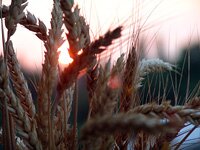
Bringing in the Harvest
It’s been announced that with something like 90% of the harvest completed, (from just over 198 thousand of the almost 223 hectares planted), Kyrgyzstan has collected over 770 tons of grain which is 40 tons than in the same period last year. Although gathering in the harvest is almost complete in the southern regions, it has only just started in the mountainous regions of Issyk Kul, Talas and Naryn. However, with some local variations, productivity per hectare is up.
Reading the report was interesting because it introduced a me to a new unit of measure; it kept referring to centners – the equivalent to a hundredweight in imperial units, (110 pounds or 50 kilograms) – which is apparently used in Germany and Scandinavia.
Agricultural production is the largest sector of the Kyrgyz economy accounting for something like 40% of the country’s GDP.
The Tien Shan and Pamir mountains that make up the territory of the modern Kyrgyz Republic have been home to nomads from ancient times – some archaeological evidence suggests for over half a million years. Animal breeding, hunting and gathering were their main activities of the early inhabitants of the region. Their lifestyle, culture, crafts and agriculture evolved from their annual migrations with their livestock – and remained largely unchanged over the centuries until collectivization under the Soviets.
Sheep and horses were the main animals husbanded. In the Soviet period, the country was apparently able to provide all the sheep-meat requirements for the whole of the Soviet Union. With the advent of economic liberalization, however, the number of animals declined sharply. It is said that “every cloud has a silver lining” – and in this case the decline in the herds was actually thought to be a positive element, in that it helped to limit the over population and over grazing that some say was common in the Soviet period. The decline in the number of animals also had, however, a detrimental effect on the quality of pedigree, with several “breeds” of sheep becoming “extinct”. There was also a shift from producing wool to producing meat.
Yaks, first domesticated somewhere over 4000 years ago, were also kept. Their adaptation to mountain life, and “semi-wild” nature, made them ideal for the nomads requiring little attention and providing meat, milk and hides. They were also useful as pack animals. Today yak meat is highly sort after as a delicacy.
Conventional cattle breeding became more important in the Soviet period and Kyrgyzstan now exports dairy product to its neighbours.
Goats are also an important form of livestock raised in the republic.
Before Independence, there were 16 operating chicken farms – but with the break-up of the soviet union, most of these were unable to compete and fell into disuse – or produced far less poultry meat and eggs than before – although some are now receiving investment and reopening.
Because the landscape of the country is mainly mountainous – only about 6% of the country is suitable for arable farming, whereas some 42% is suitable for pasture. Arable farming has long been practiced in the valleys and low lying plains of Central Asia – there is a large amount of archaeological evidence to show this. During the thousand years after 300 AD, irrigation was introduced expanding the amount of land brought under cultivation which not only allowed for an increase in the amount of crops grown, but also their variety. Now more than half the cultivated land is irrigated.
The main crops grown include: cotton, sugar-beet, tobacco, (apparently Stalin used to smoke Kyrgyz tobacco), grains, fruits, vegetables, rice and nuts. Wheat is probably the main crop which is grown – and the second most important crop is potatoes.
In recent years a number of farms have been established, dedicated to producing organic produce – with certification from American and Korean growers’ associations. Recent developments have included the cultivation of organic cotton.
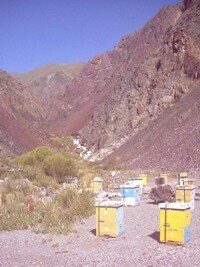
Honey is very popular and is harvested from both cultivated and wild bees and is thought to have curative properties. There is a lot of rivalry between the regions as to who produces the best honey. In the mountains it is possible to come across a wagon surrounded by hives in the fields by the roadside. The beekeepers have to pay to place their hives on particular plots and have to move them several times throughout the season. (Incidentally, in his book “Hunted through Central Asia – On the run from Lenin’s Secret Police”, Paul Nazaroff describes how, for a time during the Civil War, he worked as a bee keeper in the mountains.) For those wanting to buy honey direct from the beekeeper, it is best to have a jar to put it in. The first bees for commercial use were brought to the Prezhervalsky region (Karakol) from Verney (Almaty) as early as 1876, and were rapidly introduced throughout the country. A single hive can produce about 32 kilograms of honey in a season. Their importance is evidenced by the fact that they were included on the emblems of local authorities in both Pishpek and Prezhervalsk. During the Soviet period the beekeepers in the Republic produced enough honey to satisfy local demand and export 12500 tons a year, (for example to Europe and Japan), but the collapse of the Soviet Union led to a loss of markets and this has dwindled considerably. Regulations, particularly in Europe, have meant extensive product testing being necessary, which is not easily available – the nearest laboratories are in Germany, although there are plans to open one in Kyrgyzstan in the near future. Herbs grow and are harvested for culinary, medicinal and other purposes, (for example, as dyes), throughout the country .
Primitive tools such as the “omach” – a type of plough – were widely used right until the twentieth century and the soviet period, when industrialization brought many new types of implements. Kyrgyz factories produced many different types of farm machinery and they had the only baler plant in the whole of the Soviet Union. Unfortunately, much of the equipment is now showing signs of age and needs replacement.
“Collectivization” under the Soviets led to the creation of many large farms – but since independence Kyrgyzstan began to privatize collective farms. In 2000, Kyrgyzstan was the first Central Asian country to introduce private land ownership, and there is now a small market in buying and selling agricultural land. In 2003, only something like 2% of all produce came from state owned land. Private gardens, on the other hand, produced over 40% of the country’s produce.





 Bishkek