Oimo Festival

The Oimo Logo
I always find it funny when I see an event billed as “the first annual” something or other. It seems to me that even if it is planned to hold the event every year, that it is a bit pretentious to claim that it is an annual event until it has proved itself as such. Unfortunately, it seems to happen quite a bit, here.
Yesterday, I happened to visit the opening ceremony of the Sixth Annual festival “Oimo“. It’s been going for six years so I think it is fair to cay that it can properly be called an annual event.
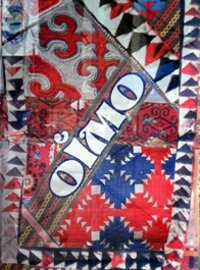
The Oimo Banner
I remember the first year, at the end of July 2006, when the very first “Oimo” crafts festival and exhibition was held in Tamchi, on the shores of Lake Issyk Kul in Kyrgyzstan.
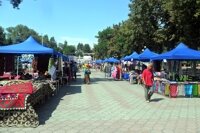
Stalls in the sun
I feel pretty honoured to have been in at the beginning of this festival. I was President of KATO, (the Kyrgyz Association of Tour Operators), at the time, and was approached by the organisers who were in need of sponsorship and also looking to publicise this new venture and increase the number of visitors. They were hoping that the festival might prove to be a suitable attraction to which tourists might want to visit.
I pointed out that, in some ways, it was already too late as many of the tour itineraries would already have been discussed and be “set in stone”, but we would try to publicise it and see if it would be possible to increase the number of visitors. I also pointed out that, if it really was going to be annual event then we could try to publicise it in future years and encourage groups of tourists to include a visit into their itinerary.

Amongst the Sponsors
I also agreed to act as one of the sponsors for that first year, and we have supported the festival ever since.
“Oimo 2006”, (“Patterns 2006”), was organized by the Central Asian Craft Support Association, (CACSA – for the record: I wrote a postcard about them last year), and the Kyrgyz Ministry of Culture as part of the programme “100 Cultural Activities”, brought together craftsmen and women from all over the Central Asian region to the small lakeside resort and provided a showcase for their products.
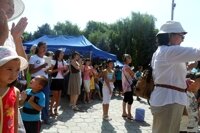
Watching the show
Master classes were held, explaining the various techniques and skills for different types of class, attended by visitors, participants and schoolchildren – the generation of master craftsmen. A full programme of events included concerts featuring local musicians, a fashion show, films and theatrical performance – including a “round table” on the subject of “An Ethno-Cultural Dialogue between the World and the Region”. Dishes of national and regional cuisine were available and, of course, there was the chance to simply relax on Tamchi’s tranquil beach.
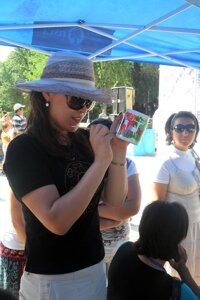
Mug Painting - one of the activities
In subsequent years, although the festival has established itself now as an annual event, it has evolved into a roving festival, with an opening ceremony here in Bishkek before travelling to Issyk Kul where events are held at various locations along the northern shore of the lake.
Participants are drawn from craftsmen and women from throughout the Central Asian region with examples as varied as jewellery from Kazakhstan, pottery from Rishtan in Uzbekistan, wood crafts from southern Kyrgyzstan as well as traditional carpets and textiles representing the various nationalities of Central Asia.
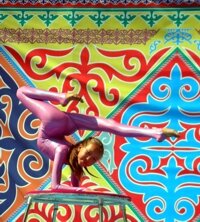
A young acrobat performing
This year, for example, there were representatives showing felt work and clothing, pottery, leatherwork and jewellery. There was even someone from Turkey showing some fine glasswork. In addition to the 50 or so stalls, there were “classes” in making felt souvenirs, decorations and tows, beadwork, and painting mugs.
There was a concert which mainly featured young children singing and dancing, and there were several acrobatic displays from the Circus school. Not all of the music used was traditional, there was a lot of modern music, including a performance by a well known local star, but there was also something more traditional. There was also a Fashion Show by local designers which showed how they manage to combine both traditional techniques with modern style. I have to be honest that not all that was on display was to my taste, (mainly because I am not convinced that haute coiture is all that practical), but even I have to admit that it did show a lot of talent and vision.

Traditional Dance routine
I have a lot of time for CACSA and for this festival, which I think a re great examples of sustainable efforts on the part of the talented team of people that put the whole thing together. The festival not only makes for a nice trip out of the office, but it helps the talented craftspeople of the region, (not just Kyrgyzstan), by providing a showcase for their work.
What’s more, I think we can honestly say that it has established itself as an annual event. I’m looking forward to next year.





 Bishkek