Urkuya Salieva and the Martyrs of the Revolution Monument
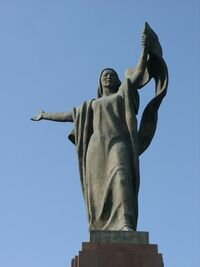
Urkuya Salieva
Located at the junction of Sovietskaya, (now called Abdrachmanova Street), and Prospect Chui – between Sovietskaya and Tynystanova – there is a large open space, surrounded on three sides by trees, that sometimes called Revolution Square. This is because in the center of the square there is a one of Bishkek’s largest and most imposing monuments; to the Martyrs of the Revolution.
The central figure of the monument is a massive statue in the likeness of Urkuya Salieva, (1910-1934), in national costume and holding aloft a banner.
For the record: Salieva was an early socialist organizer in Southern Kyrgyzstan. She was born into a peasant family in 1910 in the village of Kurkut, (it was later renamed “1st May”), in the Nookat region of Osh oblast in Southern Kyrgyzstan.
She is particularly remembered as “an activist of social change in southern Kyrgyzstan in the early years of socialism.”
Salieva was one of the first women to join the Communist Party and progressed through its ranks from Komsomol to full party membership. In the tradition of strong leadership amongst Kyrgyz women, she was elected as president of a rural Soviet in her home region in 1928, when she was just 18 years of age. She also organized the Kyzyl Asker, (Red Soldier), collective farm in the following year, 1929. (The name of the collective farm may be why one website suggests that she “organized a collective of soldiers for the Red Army.”)
In some respects she was what we might today call a “feminist” and was elected as President of the organization to protect the rights of women. In 1934, the same year in which she was killed, she became a member of the government of the Khirghiz ASSR.
As is often the case, with power and authority came powerful opponents. She, along with her husband was murdered in 1934. Some reports, (often quoted on the internet), suggests that this was the act of rich peasants, (bais ), but other reports suggests that it was the act of bandits, the Basmachi, who later ran off to Afghanistan.
The young couple left two children; a girl and a boy.
Streets were named in her honour in both Bishkek, (or Frunze as it was called in those days), and Osh. Several schools around the country were also named after her. She was upheld as an example of someone who believed and showed though her life that women could be the equals of men. Having said that, despite the examples set by Salieva, Kurmandjan Datka, (the queen of the Alai), and Roxa Otunbaeva, there are still many problems facing women who want to make their mark in society and, according to at least one analyst, “female leaders are still unpopular in Kyrgyzstan.”
Her life story was written by the famous Kyrgyz author, Beitemirov and also provided the basis for the 1978 film “Urkuya” by the renowned Kyrgyz director Okeev. The film was called “Worship to Fire” in English. It is said to be “an interesting combination of poetry and publicism, patriotism and folk epic features.” It won the state prize of Kyrgyzstan in 1973 and awarded the Diploma of Honour of the “Sovietsky Ekran”, (Soviet Window), magazine at the All Union Film Festival in Tbilisi in 1972.
At the beginning of 2010, the Jogorku Kenesh, (the parliament) passed a resolution about organizing events to commemorate the centenary of her birth, during the second half of the year. However, for “obvious reasons”, the commemorations were not held. One of the deputies said: “Urkuya Salieva made an enormous contribution to the establishment of Soviet power in the south.”
.
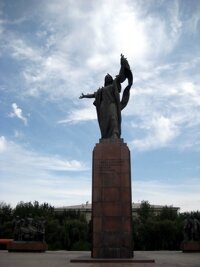
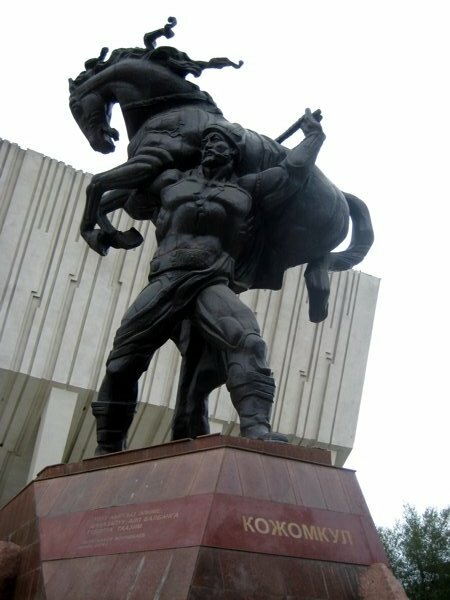
The central statue in the complex
However, although the central figure in the monument is a representation of one particular heroine, it is as much a symbolic representation of many such women; a figurehead. The banner in her hand which is being held high is sometimes likened to a “red flag”, the symbol of the revolution, but has also been taken as a symbol of the veil which the revolution swept away from the faces of Muslim women.
The statue of Salieva hovers over two smaller compositions which flank it to the revolutionary heroes, representing the awakening of social consciousness amongst the population and in the revolution, as well as over the entire square. They represent the richness of knowledge, history, traditions, character and life of the revolutionaries who are portrayed as romantic heroes, believing in a happy future; as representatives of the nomadic and semi nomadic peoples as they moved from their way of life to one of a settled civilization.
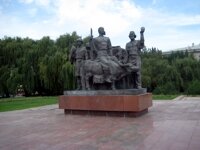
The "awakening" group
The group on the left represents the “Awakening”, the awakening of awareness in social justice, with traditional wisdom and unity with nature and the environment. Here, for example, is a character with an eagle – a berkytchi – and a man sitting astride a yak.
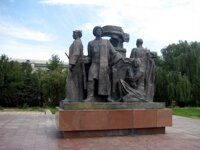
The group of "revolutionaries"
The composition on the right represents the “Revolutionaries”, for example young men armed for struggle in the Red Army and the future Kyrgyz Mother holding an infant, clinging to her.
In the new situation following independence, the monument has taken on a new interpretation – reflecting democratic principles and the “brotherhood of man”. The square at the foot of the monument, for example, was the scene of some of the demonstrations that led up to the Tulip Revolution of 2005 that led to the downfall of Kyrgyzstan’s first President, Askar Akaev. Protestors have met at the foot of the statue to stress the inequality still facing women in contemporary Kyrgyz society, and even Roza Otunbaeva has delivered a speech on Democracy and Liberty in the shadow of Salieva’s statue.
The monument was the result of a competitio0n organized by the Ministry of Culture of the USSR. The winners were the famous Kyrgyz sculptor Syydykov and the architect Pisarskoui, and some of the landscape work was contributed by another architect, Kutateladze. Sydykov was already well known as a creative sculptor; he was Chairman of the Union of Artists from 1968 until 1996 and established the republic’s Arts Academy in 1991.
The monument was made from granite and bronze and completed in 1978. It marked a new era in monumental art in Kyrgyzstan. It received high praise and a number of awards; in particular Sadykov, was awarded the All Union Lenin Prize “for the lofty ideo-artistic embodiment of the heroes of the revolution.”
.





 Bishkek