Where it’s at

The other day IO was talking to someone and we exchanged email addresses. Mine, for example, is and so I duly dictated it to him, in Russian: “ian claytor, (all one word), sobachka, gmail dotchka com”.
He asked me, “How do you say in English, ‘sobatchka’?” I answered, matter of factly, “at”. He smiled.
Although it may not be surprising that “dotchka” and “dot” are equivalents, after all, the words are very similar … but “sobatchka” is not so easy to understand – as, in Russian it means “little dog”.
Anyway, that smile brought out the former teacher in me. I sat and explained how nobody really knows where the symbol came from. There are lots of theories. Some scholars think that it comes from scribes in the 6th or 7th century trying to find a shorthand way to write the Latin word “ad” which means something like ‘at’, ‘to’ or ‘toward’, and so created a ligature – a sort of special character combining two others together.
It seems that the symbol was also used by merchants in the 16th century to stand for a unit of measure, the ‘amphora’ – which was a terrocotta jar used since ancient times for transporting wine or grain around the Mediterranean, and held about a thirtieth of a barrel. It’s been found in Florentine accounts dating from 1536 and also, (with a slightly different meaning), in Spanish and Portuguese texts.
It later came to take on the special meaning of “at” … as in “3 @ 1.5 = 4.5″, (3 at 1.5 which totals 4.5). This proved to be so useful that the symbol appeared on the keyboard of some of the early typewriters towards the end of the nineteenth century, although by no means all of the designers of these new fangled devices saw fit to incorporate it.
Its modern day use in email addresses dates back to the very first email messages ever sent. It was back in 1972 when a computer engineer called Ray Tomlinson was working on the ARPANet project, (which was precursor to what we now know and love – or hate – as the Internet). He was writing protocol for sending messages between computers connected to network; what we would come to know as e-mail programs. At first, it was easy to send messages to another computer in the immediate neighbourhood, with a direct connection, by simply referring to the computer name but, when they were some distance on the distributed network, then as well as the computer name it was necessary to say where it was located. So, Tomlinson says, he needed a symbol to separate the name and the location, and it needed to be one that wouldn’t be contained as part of a name. Given its meaning of “at”, the “@” symbol seemed an obvious choice.
Although we tend to call it simply, “at”, the symbol has several different names – even in English: technically it is still known as the “amphora” but is more commonly referred to as “commercial at” or simply the “at-sign“. It ios also sometimes known in certain specific contexts as “whirlpool“, “fetch“, “snail” and “snabel“. The last two are, in fact, borrowed from other languages, (snabel is Danish and basically means a letter ‘a’ with an elephant’s trunk). It might be relatively easy to see where whirlpool and snail come from.
In a few cases, the name has retained an earlier historical association, (such as amphora in English, arrova in Catalan andarroba in Spain and Portugal). In French it is sometimes called arobase, but no-one seems to know where this came from.
Many languages simply use the English word `at’, (possibly with some modification in pronunciation), when referring to the @ symbol. In some cases, the name used is a direct translation of English “at”, for example in Arabic, (fi), Greek (sto), Icelandic (hjá) and Romanian (la). The Japanese call it atto maaku (“at mark”).
In some languages, the name refers to the letter ‘a’ (or alpha): in Basque where it is called bildua (wrapped a), in Chinese quan A (circled a), in Danish alfa-tegn and alpha-sign, in Dutch een a met een slinger (an ‘a’ with a swing), in French a enroule (coiled a), in Greenlandic aajusaq (something like an a), in Norwegian Krollalfa (Curly a), in Turkish there atre several similar versions: güzel a (beautiful a), özel a (special a), kuyruklu a (a with a tail), çengelli a (a with hook) and in Vietnamese a còng (bent a) and a móc (hooked a). In Bosnian, Croatian and Serbian it is called ludo a, (“Crazy a”)
In many languages, the name of the symbol reflects some sort of imagery summoned up by the appearance of the character, often by associating it with some animal or object.
In many, for example, it is associated with a monkey, and in Kyrgyz it is known as maimylchka (monkey), although you are more likely to come across sobachka or et. There are several other languages where the word for monkey is used, such as in Polish (malpa), Serbian (majmun) and Friesian (aapke, little monkey) and in German (affenschwanz). Sometimes the name refers to a monkey swinging or hanging as in Dutch, (slingeraap, Swinging Monkey) and in German (klammeraffe, hanging monkey).
The snail seems to be a common image summoned up by the symbol. In French it is sometimes referred to as escargot , in Hebrew shablul, in Italian chiocciola and Korean, dalphaengi which all translate as “snail”.
It sometimes seems to be associated with a worm, for example, in Hungarian kukac and in Thai it is called ai tua yiukyiu, which means “the wiggling worm-like character”
If In Russian the @ symbol is called sobachka (Little dog), then Russian is not alone in this association. In Armenian it is called shnik which means little puppy.
In Poland the name kotek means little cat and the Swedes sometimes call the “@” symbol, Kattfot (cat-foot) or The Finns, on the other hand, use a variety of names connected with cats, such as miukumauku, (the sign of the meow)
Some images conjured up include a mouse, for example, in Mandarin Chinese, xiao lao-shu means little mouse and lao shu-hao means mouse sign.
In a few languages, it is associated with a bird, In Greek it is called papaki (duck) and in chaika (seagull)
Often the names may refer to a part of the body of an animal, such as the tail – for example, in Afrikaans and Dutch, (aapstert), Finnish (apinanhanta), Friesian (apesturtsje) the names all refer to monkeys’ tails. In Finnish, hiirenhanta likens the symbol to a mouse’s tail; in Norwegian, grisehale means “pig’s tail” and in Sweden, kattsvans, a cat’s tail.
Indeed, in Turkish the word tail (Ogon) is sometimes used without specifying which animal it belongs to.
It’s quite often to see an ear in the symbol. In Swedish, for example, the name Elefantora means Elephant’s ear, while the Poles refer to it as a pig’s ear (ucho s’wini) More generic names are to be found in Arabic (Uthun), German (Ohr) and Turkish (Kulak).
In Dutch, there is even name which associates the symbol with a monkey’s testicles (!), (apeklootje).
Not all the images are based on animals. In Danish zavinac translates as Rollmop and some people say that it refers to pickled herrings. The Turkish name gul refers to a rose and there are several that refer to cakes: Shtrudel in Israel, Pljushka (a Russian pastry) in Russia, kanelbulle (a cinnamon bun) and a kringla (a pretzel) in Sweden.
Perhaps one of the hardest associations to understand is the Slovenian afna which refers to “a woman who overdresses, applies too much make-up, etc.”
The Indonesians, on the other hand simply call it uh.
.
As it happens, however, the name for the symbol that is used in Russian sobachka is not necessarily derived from imagery. It just so happens that it dates from one of the early computer games which involved guiding a dog trough a maze, rather like a version of PacMan. It was in the days before elaborate computer graphics and all the elements ion the game had to be portrayed using straight forward ASCII characters.
It just so happens that the symbol chosen to represent the little dog as he wandered around the maze was … you’ve guessed it … @.





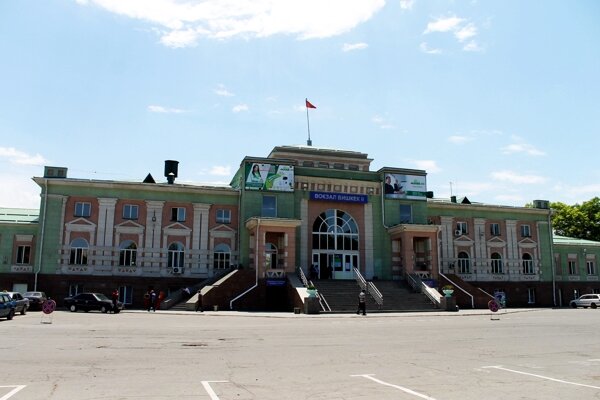

 Bishkek