Li Bo – The Immortal Poet
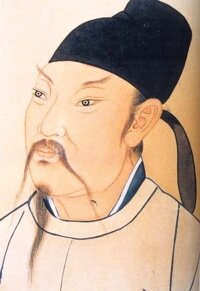
Li Bo, or Li Bai
I am not sure where it came from, but the other day I saw a tweet on Twitter between two twitterers “that the greatest Chinese poet Li Bo (Li Bai) was born near Tokmok in Kyrgyzstan?”
Li Bo is also known as Li Po or Li Bai – in fact, there are several other variations, and although Bai is commonly used, Bo is more literary and is possibly closer to the original pronunciation. He is often regarded as one of the greatest Chinese poets, (along with his contemporary, Du Fu, whom he met twice, and who wrote a number of poems about or dedicated to Li Bo), and he is thought to be one of the greatest Poets of the Chinese Tang dynasty, (which is considered to be the Golden Age of Chinese poetry).
Although it is known that he was born in 701 AD - during the Tang dynasty – there is some doubt about his actual place of birth. Some sources claim it was in the Chinese province of Sichuan – but one contender for the honour is, indeed, the ancient Silk Road city of Suyab – which was located near to Tokmok in present day Kyrgyzstan.
His family, however, hailed from south-eastern Gansu. When his mother was carrying him, she is supposed to have had a dream of a Great White Star, (which was often associated with Venus), falling from the sky and it is thought that this story may have contributed to the idea that he was a “banished immortal”, and hence the nickname, “The Poet Immortal” which is sometimes used by his fellow countrymen.
The family moved, when he was about five years old, to Jiangyou – modern day Chengdu in Sichuan.
In his youth he read widely and undertook a number of activities such as training wild birds and swordplay – he is supposed to have been a master of the martial arts and he is thought to have killed several men, (for “reasons of chivalry”), before he reached his twentieth birthday. Indeed, there is a quote from Li Bo: “When I was fifteen, I was fond of sword play, and with that art I challenged quite a few great men.”
He travelled widely, marrying the grand daughter of a retired Prime Minister, meeting people, exploring religion, becoming involved in politics and giving away most of his wealth. This no doubt helped to add to his reputation for wantonness; at one time he was known as one of the ”Six Idlers of the Bamboo Brook”; an informal group “dedicated to literature and wine” and of another group, the “Eight Immortals of the Wine Cup”.
His reputation as a poet was extensive and he was summoned by the emperor who gave him an official post and would often summon him to recite his work. He was a great hit at court, despite the fact, it is said, that he was often drunk during his appearances … but always “able to perform”. During his time there, he wrote some poems about the Emperor’s wife, and eventually she took offence and arranged for him to be sent away, despite her husband’s reluctance to do so.
This was followed more years of travelling, until he found himself on the wrong side, (the losing side), during a civil war when he became an advisor to a minor aristocrat. This almost cost him his life as he was sentenced to death, although the intervention of an old acquaintance, repaying a favour, managed to obtain him a reprieve.
There are about a thousand surviving poems attributed to him, although the attribution is not always certain. but many more have been lost. Many seem to be a reworking of traditional ballads.
He is particularly well known for the extravagant imagination and imagery in his poems. Many of the poems deal with the mountains, often being descriptions of ascents that switch half way through into journeys of the imagination; passing from actual mountain scenery to visions of nature deities, immortals, and ‘jade maidens’ of Taoist lore. There are descriptions and comments on nature, friendship, his acute observations of life, (some describe important people and court life but others contain his observations on the hardships and emotions felt by the common people), and not to forget his love of wine.
He was well known for his carefree style of living – out of keeping with the sensibilities of the day – and he is sometimes described as a Byronic figure in Chinese Poetry. Infamous for his wanton drinking and his poems in celebration of Wine, (one scholar has suggested that some poets may well have drunk more wine than him, but no-one wrote more verses in praise of it). As a result, his poetry is sometimes criticized on moral grounds.
He is said to have met his death by drowning after falling into a river in a drunken stupor, trying to embrace moon’s reflection in the water, although there are other, more prosaic, suggestions about he met his end as a result of his lifestyle.
Famous in his own lifetime, his influence in Chinese literature was to be extensive – and beyond into Japan and other cultures. It is said that his poems even inspired Chairman Mao Tse Tung. A particular favourite amongst the Chinese is “Quiet night thoughts”" which reflects the nostalgia of a traveller away from home.
Although he had been the subject of some scholarly interest from the West since the end of the eighteenth century, he first came to the wider attention of English speaking audiences through the translations of Ezra Pound, (dating from about 1915).
.
You can find a selection of some of his short poems on http://www.chinese-poems.com/lbe.html
..
As I said, it’s not clear where Li Po was born, but with his interest in training wild birds, his mastery of the martial arts, affinity with the mountains and nature in general, then it is not hard to imagine that he could really have been born in Tokmak, although, to be fair, his family left for Chengdu when he was still sufficiently young, that any memories he might have had for his distant birthplace must have been fairly faint.





 Bishkek