A Missed Opportunity
I am not fond of fashion shows. I can think of nothing more boring than watching tall, slim, young things, (male and/or female), strutting up and down a catwalk showing off what they are wearing to some loud music and possibly a fancy light show
They are quite popular here, however, and I have been to several functions where a fashion show has been part of the “entertainment” and I do understand that they represent one way for designers to show off their work. What’s more, I often feel frustrated because they seem to be simply a feast for the eyes, but I wonder how many people actually understand of appreciate what it is that they are seeing displayed in front of their eyes.
Many of the modern designers here in Kyrgyzstan try to incorporate elements of traditional design in their work, whether it be the use of felt, patchwork, (kurak), or embroidery, (saima), and I feel it is a pity that there is no opportunity to explain these elements and their traditional importance, meaning and significance.
As a result, I have to confess that they are just not “my cup of tea”.
I did, however, attend one “fashion show”, which was different and which I thoroughly enjoyed. It was organized by one of the CBT groups and rather than displaying new creations, the “models” wore traditional costumes whilst an announcer gave some details of the different costumes and their elements. We saw, for example, children in thick quilted jackets which had extremely long sleeves, and heard how this was a special feature of the design because they had no gloves and the hands were protected by the elongated sleeves. We saw how young people would be dressed, in summer and winter; examples of wedding attire; followed by how the fashion would change as they grew into mature adults and eventually into old age; there were specimens of summer attire and winter dress.
Although it was based on just one village, there was some attempt to show how costumes, colours and patterns would change in different regions of the country.
Unfortunately, as far as I am aware, this has only ever been staged once … I would love to see a repeat performance.
.
I find the subject of traditional costume fascinating. I have found a couple of books on the subject of traditional Kyrgyz Costume, and the best is probably the one by Clavdia Antipina.
The kalpak and the elechek, (the traditional male and female forms of headgear), are particularly unique to the Kyrgyz and there is a lot of tradition tied up with both of them. Other forms of dress, the chapan, (a sort of “wrap” or robe)), sheepskin coats and fur hats are less unique being found throughout Central Asia and the steppes, but are still interesting in their own right.
The costumes were adapted to the conditions of nomadic life, horse riding and a herding in the mountains. They were made from felt, leather, animal skins and coarse wool of domestic production. The upper garments were broad, long, with wraps. Lower garments would be girded with belts made from fabric or a leather strap. Some would have been made from purchased fabrics, purchased from the markets of the Ferghana valley, or Kashgar and, from the middle of the 19th century, from Russia.
Clothing in Kyrgyz society reflects social status, marital status and age – social historians and anthropologists like Antipina noted a sharp contrast in clothing between the poor and the nobility.
.
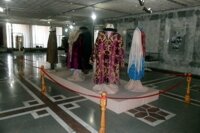
So, you will probably understand that I was particularly interested when the Historical Museum announced that, in June, they would be holding, throughout the summer, an exhibition of Traditional Kyrgyz Costume with specimens from the late 19th and early 20th centuries taken from their extensive collection.
I have been meaning to go all month, but never seemed to find the time. But, when I found that I had a gap between meetings, I decided to take the opportunity to call in as I passed the museum.
There were several manikins suitably robed, a number of fine items in glass cabinets, and a wide variety of photographs and illustrations. Perhaps the oddest exhibit was the specimen of chain mail in one of the glass cabinets. It seemed out of place because it probably came from an earlier age. Also, unfortunately the lighting was dark and the reflections off the glass, both of which inhibited the photo opportunity.
To be honest, however, I was a little disappointed. There was little descriptive material, just two large panels and most of the exhibits were accompanied by a label with just a single sentence, in Kyrgyz and Russian. It would have been nice to have some information, for example, about which part of Kyrgyzstan the different exhibits came from – that might have helped me to understand the design, such as the printed material which resembled Uzbek or Tajik influences.
.
Walking back to my office from the museum, a thought came into my mind.
I remembered a conversation I had the other day with a visitor who was complaining about being “ripped off” and the attitudes of “the locals” which seemed to him to be “We’re doing this because we can.” I should point out that it was his first night in Bishkek and he WASN’T talking about Kyrgyzstan, but about his experiences in another of the Central Asian countries.
On the other hand … I’ve met several foreign visitors who have also been upset at being seen as a “milche cow”, a walking wallet which some locals seem to want to empty. There was, for example, the blog entry written by a French tourist who complained about a museum exhibition which contained exhibits which he didn’t think belonged in a museum and wondered why he had been charged an (exorbitant) entry fee to see them.
I think that the exhibits were interesting … but, if the aim was to put inform the foreign visitor, (it was, after all, staged for the summer season), then it would have helped if some attempt had been made to include them – such as providing some information in foreign languages, (after all, they do pay a larger entry fee than the local citizens, and it would be nice if some of this had gone toward providing a modicum of information). If the exhibition was supposed to appeal and inform foreign visitors, then they would get little enlightenment as to what they were seeing. As it was, even though I know a little about the subject, I felt that I got little enlightenment about what I was seeing.
If, on the other hand, the aim was simply to provide an opportunity to get acquainted with the history of clothing, customs and traditions of the people for the younger generation, (children with their parents, visiting the museum during the summer holidays), then I am sure that they would also have found some additional explanation helpful.
All in all, I felt, that the exhibition was a great idea … but a missed opportunity.




 Bishkek