Flag Day
Back in Britain, the phrase “Flag Day” has a particular meaning. It refers to a charity fund raising activity. Volunteers stand at strategic points or going from door to door with collecting tins, soliciting donations from members of the public who are given in return a small badge, (or “flag”), to wear as a symbol of their support for the organization.
The phrase has a more general meaning, however, and is used to indicate a day designated in some way to a flag. Either a day for flying a particular flag, (such as a national flag), or to celebrate an historical event such as a nation’s adoption of a flag.
Here in Kyrgyzstan, the day is not a holiday. Independence Day, (August 31st) and Constitution Day, (May 5th), are designated as public holidays to commemorate respectively Kyrgyzstan declaring it’s independence from the Soviet Union and the adoption of a new Constitution. When it came to the adoption of the flag, however, on March 3rd, 1992, it seems as if it was felt that there were already enough public holidays, and this occasion was passed over. That’s not to say that the Kyrgyz don’t have a great respect for the flag, which symbolizes the country.
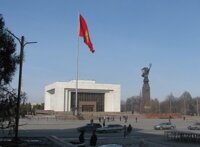
In 1998, under President Akaev, a special flagpole was erected in the main Ala Too Square in Bishkek to fly the flag. At the foot of the flagpole, two sentries stand as an honour guard each day from seven in the morning until six in the evening, in all weathers. The guard is changed every hour, on the hour, and the goose stepping soldiers make for a popular photo opportunity. They are not photo models, however, and although soldiers in other places around world might be used to having their photographs taken with tourists posing next to them in their ceremonial uniforms, (such as in Whitehall in London, or in Athens), and they and the flagpole are in a fenced off zone.
In 2009, the original flagpole was replaced by another, built specially to fly one of the world’s largest flags – which measures 30 square meters, purchased at some expense from specialist manufacturers in Turkey, and which needs several soldiers to carry. The idea was, apparently, to create a spectacle that would help to encourage a sense of civic and national pride amongst the population.
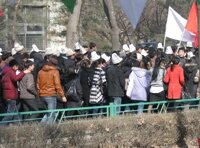
This year, the nineteenth anniversary was marked by many people flying flags and sporting the traditional national felt hat of the Kyrgyz, (the Ak Kalpak), and marching along Prospect Chui.
.
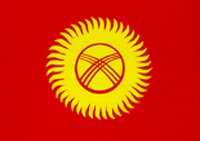
The current Kyrgyz flag was adopted on 3rd March, 1992. It has a red background – the colour represents courage and valour – with a yellow sun in the center with 40 flaming rays representing the 40 Kyrgyz tribes; on the obverse side the rays run counter clockwise, on the reverse, clockwise; in the center of the sun is a red ring crossed by two sets of three lines, a stylized representation of the tunduk of the traditional Kyrgyz yurt.
The dimensions of the flag are in the ratio 3:5
.
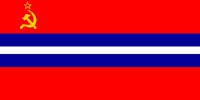
In Soviet times each republic of the union had its own flag. The Khirghiz SSR was divided into three horizontal sections. The top and bottom thirds were red; the middle section consisted of blue and white stripes. The Soviet “Hammer and Sickle” emblem was found in the top left hand corner.
The dimensions of the flag were in the ratio 1:2
You can still, sometimes, see examples of the old flag … espeically in displays in the Historical Museum.




 Bishkek
This year one of the deputies has suggested that the state symbols, (Flag, Gerp – the State Seal or Coat of Arms, and the National Anthem), should be replaced and a commission to consider alternatives has been established.
A comment on one of the news agency websites (AKIPress), included some additional information about the history of the adoption of the flag:
The commission for adopting new state symbols, has received several proposals of designs for a new flag which have been published. You can see them on:
• http://farido4ka.kloop.kg/archives/797 or
• http://kg.akipress.org/news:362771
Sorry, but the text is in Russian, however the designs speak for themselves. Needless to say, there has been a certain amount of discussion, not much of it in favour of any of the new designs.
If the colour of the current flag, Red, was the colour of the Battle Standard of the legendary Kyrgyz hero, Manas, then the colours Blue and White also have historical connections with the nomadic Kyrgyz. The colour blue, used in the original design of 1992 and several of the newly proposed designs represents the sky. Unfortunately, in the south, it is also the colour of morning. It was the colour of the standard used by of one of the Kanat, (“wings”), of the Kyrgyz tribes whilst white was the colour of the standard used by another.