Potential shocks to the system
This week has been a busy one with lots of distractions, hence I am a little late with the postcard this week.
Next week, however, should be quite quiet as Tuesday is a holiday, (International Women’s Day), and they have moved Monday to Saturday … that is most offices are open today but will take Monday off making a long weekend.
The debate about another holiday, (March 24th, commemorating the overthrow of the Akaev regime) has intensified. There is no clear consensus about whether it should be “celebrated”, ignored, replaced by one marking the revolution which took place on April 7th last year, or if there should be two holidays. Time passes and the day approaches, so if they don’t decide soon, then it will be too late. It shouldn’t surprise me, however, because it is usual here for things tend to be left minute.
We often get invitations at the last minute, for example, or letters asking for information with an impossibly short timescale. This week, for example, we got one faxed to us from the tax authority asking for some information the next day and sent Tatiana into a frenzy of activity to collect the data and complete the form. I wondered what all the fuss was about … why was it so urgent? … and when I looked at the letter, I saw that it was dated the week before, but they had only faxed it that day, so I told her not to worry unduly if she couldn’t complete it in time … they should have given us a week to do the job and not just one day, so if we were a day or two late it shouldn’t matter. As it happens, she was able to complete and deliver it in time.
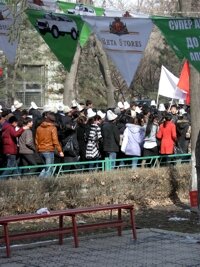
There have been a couple of other “special days” during the week. Thursday say large numbers of people walking through the town waving flags and wearing Kalpaks, the traditional Kyrgyz white felt hats and a march along the main street, Prospect Chui. It was easy to think that it was yet another demonstration, but it turned out to be something totally different and went off very peacefully. Once I realized that it wasn’t another demonstration, my first thought it was to mark Kalpak Day, (a special day which had been announced by one of the country’s filmmakers as part of a campaign to help foster national pride), but I was wrong. Kalpak Day was Saturday, March 5th, and that was another when lots of young Kyrgyz were to be seen walking around wearing what were obviously new hats which had probably been bought specially for the occasion and were richly decorated with traditional patterns sewn on them, and serve as a symbol of their nationality. The event on Wednesday was actually organized to commemorate the 19th anniversary of the adoption of the Kyrgyz Flag for the newly Independent Kyrgyz Republic on March 3rd, 1992.
Now, the Kyrgyz enjoy a good celebration as much as anyone, and the two occasions passed off peacefully, with good humour, but I have to admit that even I felt a little uneasy about them, even if they did pass off without problems. At least the first could have been an occasion for the whole population of the country to come together to celebrate something connected to the establishment of a modern state, whatever nationality they belonged to, the reality seemed to be that it was dominated by the Kyrgyz. The second, on the other hand, was clearly intended to emphasize and encourage pride in one particular national grouping. Technically, there is nothing wrong with that, but I did wonder if it was particularly wise given the events of last summer, down south.
I would like to be able to say that ethnic relations are improving and tensions reducing. Unfortunately, however, there are still outbursts and the murder of a tax official in Nookat, (south if Osh), proved to be a potential flashpoint when claims were made that it was a “contract killing” ordered by a leading Uzbek.
Another serious potential source of tension exists, however, in the rises in prices that were experiencing. This issue just won’t go away and both politicians and economists are not sure how to handle the situation.
Roza Otunbaeva has also been busy. She went to Belgium and France and has had a host of meetings with NATO, the European Union and different government ministries and departments – although, at the moment there is no formal government in Belgium. It must have reminded her about the situation in Kyrgyzstan last year when we had months under transitional arrangements.
Life has been going on as usual in her absence. The government has announced that they are planning to increase pensions as well as salaries for teachers, medical workers, etc. It is still not clear where the money to fund this is coming from, but it seems to be a commitment and, hopefully, it will help them cope with the ever increasing price rises that we are experiencing, even if it doesn’t lead to an improvement in standards of living.
The budget is proving to be a topic which is keeping th4e politicians busy … there are even some who are suggesting slapping another tax on the fuel supplies to the airbase, although both the Americans and the Prime Minister are reminding them of the international agreement which limits the taxes which can be imposed.
The politicians are also debating removing the ombudsman from office ahead of schedule. I am not sure what has led to this, but he is supposed to have a specially protected position according to the constitution, so it is quite a serious step.
A less serious step, perhaps, is the proposal tabled by one of the members of parliament to make men remove their hats during the playing of the National Anthem. There are already provisions that require people to stand and place their hand over their hearts whilst singing it, and this is seen as another sign of respect. I can follow the logic, but it seems odd that there are a whole host of exceptions that have been proposed which might make it difficult to interpret and enforce, which include: those wearing the national hat, the ak kalpak; in bad weather conditions; headgear worn for health reasons; as part of military uniform; or where headgear is requirement of someone’s religion.
I have mentioned before the various problems connected with the supply of electricity and the issue keeps raising its head. An international consulting company concluded that every second Kilowatt hour of electricity produced in the country was either lost or stolen – that’s right, 50% of the production. The head of one of the generating companies has taken exception to this and disputed the figure, although I haven’t seen his argument and he, himself, does seem to admit that it is a problem.
It was also reported that the new Karambata Ata power station on the Naryn River actually cost more than the rest of the electricity supply infrastructure put together – USD315 million as opposed to just under USD300 million. It was obviously needed because consumption of electricity in the country has tripled since independence, and this is based on an infrastructure designed and built in the Soviet period – as part of a regional network and to cope with a smaller market demand. As the head of one of the generating companies pointed out, “power companies have acted like a fire service during the last 20 years, only accidents were repaired, nothing new was built.” Now, over two thirds of the population uses electricity for all their energy needs, although 13% rely on coal. There is little gas or oil, especially outside the main cities. Bishkek, at least, is due to get an overhaul of its system 2013. At present six of the substations providing the capital with energy are hopelessly over burdened, especially during the winter as many households have switched to using electricity for heating rather than other sources of energy.
I was intrigued, however, so see a mention in the news reports that in 1990, something like 20% of the market was thermal power consumption. I am not sure what this means, because I thought that thermal energy played a very minor role here, (indeed, I have representatives of the ministry playing down any hope of receiving a major benefit from the potential here), and I can only presume that means that the energy was used to provide heating.
Another recurring theme this week has been the attention on Corruption. As well as the persistent rumblings over the fuel supply contract, Roza Otunbaeva has said that she hope the shake up in the power supply sector will help to root out corruption. It was also reported that Kyrgyzstan has reached a sufficient standard of compliance and “transparency” in the minerals industry. I am sure that the people who work in this industry will welcome this, but I am not sure if they yet feel confident about this as the review of licenses and permission still seems to underway. An interesting sidelight on this is that the government is pushing ahead with the planned disbandment of the Financial Police, despite the fact that over 200 cases have been referred to them and the Prosecutors’ Office for investigation.
One of the most interesting article I saw during the week was headlined: “Kyrgyzstan, the country where people with money feel impunity”. That was certainly the impression which people had under both the last two regimes … and there does seem to be a persistent impression held by people that there is still some truth in it, even in the new, post revolution Kyrgyzstan. It might be interesting to see what Maxim Bakiev thinks about it, because a wanted notice for him has now been posted on the Interpol website for embezzlement. I wonder what the Brits will do … after all, they arrested Pinochet and Assange in similar cases. It has to be noted, however, that yet another extradition request for someone in the Bakiev regime has turned down, this time by Latvia.
These “refugees” or “expatriates”, however, may be small in number when compared to the over half a million Kyrgyz currently in Russia. The economic migrants from Central Asia, (not just from Kyrgyzstan), in Russia face a number of difficulties and the death of another one hit the headlines with her parents convinced that she was murdered on a train. Still there are advantages to living and working in Russia, and remittances from abroad are still an important contribution to the Kyrgyz economy. Those who can claim a pension from the Russians as a result of their service under the Soviet Union, however, are able to receive far more than they would here, even if they can’t afford to buy similar housing to that which they enjoyed in Kyrgyzstan.
I wonder what they would make of the recent IMF announcement about the Kyrgyz economy which is recovering, so they say, faster than expected. When I first saw an article about this I was somewhat surprised, but as I read it I had to admit that there was some justification for the conclusion that the economy has performed well given what we experienced last year, especially given the amount of aid that Kyrgyzstan has received. The catch came, however, in the final paragraph of the report: “This does not represent a panacea for Kyrgyzstan’s economic ills. Apart from addressing the pressing issues of inflation and unemployment, the government is yet to improve the protection of property rights, combat widespread corruption, and promote reforms to stimulate further economic growth and alleviate the lives of the country’s poor.” I hope that the author is correct when he says, “But, the gains thus far raise the possibility that Kyrgyzstan is on a more comprehensive, albeit still fragile, economic and political recovery track.”




 Bishkek