Al Biruni
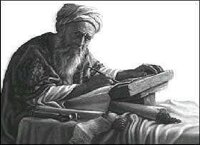
To be honest, the name of Al Biruni didn’t mean that much to me until, not long ago, I listened to a podcast about him, which aroused my interest. In the past have more or less ignored references to him mainly because he was not from Kyrgyzstan, but I now have to admit that this was a mistake.
It seems that it didn’t mean all that much for quite a lot of other people over the centuries, even though he appears to have been quite an interesting character. It was only m the nineteenth century that the British became interested in him, or rather in the book that he wrote about tenth century India, it people, their beliefs and their practices
Born in 973 in Khorzem, which is now in Uzbekistan, he was a talented youth who received a wide and varied education. At seventeen he was already known as a skilled Mathematician, but his interests ranged lot wider than the Queen of the Sciences. He also studied and write about Astronomy, (and Astrology, which at that time was seen as a related “science”), Mineralogy, Languages, (one of his books is littered with texts in something like twenty different languages), Law, Pharmacy, Philosophy and (as you would expect for a Muslim scholar of the time), the Koran.
He was a contemporary of, although a little younger than, the great philosopher and expert on Aristotle, Avicenna, and there is a record of a dialogue between them where Al Biruni poses a series of eighteen questions to the master philosopher … and, by all accounts, manages to cause him some difficulty and discomfort in answering them. So much so that when Al Biruni poses the master a further set of fifteen questions, they are passed to one of his pupils to answer.
During his life, Al Biruni wrote about 140 books, and about a quarter of them survive. The first was about the measurement of time. Being an Astronomer didn’t just involve the observation of the skies, but also the task of fixing dates in the calendar. In ancient Egypt, for example, the priesthood kept firm control over the science as the ability to predict the seasons, and in particular the flood season of the River Nile, gave them immense political power. In his book, Al Biruni looked at how any different cultures, (and religions), tried to fix the dates of their major festivals: Persian Zoroastrians, the Sogdians and the Christians, as well as the Muslims. His interest in other religions and willingness to consider them as having an alternative worldview, (albeit insufficient and erroneous in the eyes of Islam), was not necessarily uncommon in his own day, it sometimes seems a little out of sync with the ideas of many modern Muslims. It was to be an important feature in his treatment of the Indians … but more of that later.
There is little known about his personal life, particularly his early life, and so much of the picture we have of him is drawn from his works and supposition based on “reading between the lines” and interloping information about what we know about his world at that time,
At that time, Central Asia was a conglomerate of small city states, and the rulers of each would vie with the other, as in Europe, by collecting around them scholars of different disciplines. Al Biruni was one such scholar. Each was a centre of learning with scholars and libraries and he was in such a position that he would have been exposed to the learning and teaching of both the Greek school and the Arabic schools of learning. As a Mathematician and Astronomer he would also have been aware of Indian advances in these sciences.
As a young man he had become a scholar at the court of Mahmud of Ghanzi, who ascended to the throne in the kingdom which bordered Afghanistan and India. On Mahmud’s death, when he apparently had the chance to return home, he chose to stay in the court of Mahmuds son and rose to the position as a learned counsellor and companion, and may even have acted as an ambassador for him.
His book on India, for which he is probably most famous, was probably written during the closing period of Mahmud’s life and published under the reign of the new king. The English translation of this book on India is divided into 80 chapters and runs to some 600 pages, so it is clearly not a lightweight tome. The original idea behind the book seems to have been to serve as a tool to aid Muslim scholars to enter into discussion and debate with Hindus, starting with a description of Hindu beliefs and philosophy before entering into analysis of the same. As it’s main theme is concerned with ideas, it lacks a lot of detail that you might expect from a book written by a traveller, that you find in the works of people like Marco Polo and Ibn Battuta: geographical features, architecture, what the people wore and so, (although, apparently, there is something about how people shaved!). As a result, there is some doubt if he actually went to India himself and it seems to be based on interviews, perhaps with Brahmin captives, hostages or even perhaps Indian soldiers in Mahmud’s army. Apparently, however, there is a reference in his writings to a visit to the Swat in Northern Pakistan, where he calculated the diameter of the earth based on observations of a mountain in the valley.
.
As I said, his connection with Kyrgyzstan is fairly minimal and incidental, but I found that learning about him helped to fill in some gaps in my understanding of the region, especially during a period of history about which I was, (and still am), fairly ignorant.
Over the centuries, little attention has been paid to him and his work, but, fortunately, he hasn’t remained in totally obscurity and even achieve sufficient fame that there are two universities and a crater on the moon named after him and Iran, in particular, have adopted him as a leading light of the ancient Greater Iran. I hope that this snapshot will help to convey a little of the importance of both and the interest that a podcast aroused in me.




 Bishkek