The first day of Spring
Welcome to the first day of Spring. Here, March 1st is reckoned to be the first day of Spring. If that surprises or confuses you, then, don’t worry … you are not alone!
For a start, it’s all relative. If you happen to be in the Southern Hemisphere, then Summer is coming to an end, and Autumn is about to start, rather than Spring, and even here, in the Northern half of the globe, there seems to be some confusion over exactly when is “the first day of Spring”.
As I child, back in the UK, I was taught that the first day of Spring fell on the Vernal Equinox, March 21st … but things seem to have changed, especially in the US where Astronomers, Almanacs and calendars say that it falls on March 20th. ”What’s that?”, do I hear you say, “how can the first day of Spring change?” It is certainly a question I asked myself.
I am told that it is all to do with the vagaries of the calendar and the definition of a season as a quarter of the year. A year, of course, is defined as the time taken by the earth to orbit the sun. The Astronomers tell me that they need a bit more precision and so they define a season as being the time taken for the earth to complete a quarter of it orbit – and that is further defined as the time taken for it to travel through an arc subtended by a 90° angle from the centre of the sun.
Now, even at the simplest definition, (“a quarter of a year”), we have problems … unfortunately, the number of days in a year, (365), isn’t even, and isn’t divisible by four, so the length of a season isn’t going to be an exact number of days. To underline the point, the time it takes for the earth to orbit the sun isn’t an exact number of days, anyway, AND to make matters worse, is constantly changing. The path taken by the earth is not circular, but elliptical, (like an oval – squashed along one axis and elongated along the other), and constantly varying as our planet is subjected to complex gravitational forces from other heavenly bodies – especially the planets, (so maybe there is yet some sort of basis to the ancient “science” of Astrology, after all).
As a result, the “astronomical season”, defined as the time taken by the earth to travel that 90 degree arc, varies not only from year to year, but also between the seasons. It turns out that when measured in days Spring and Summer are actually just over seven day longer than Autumn and Winter … Summer is the longest month, and Winter the shortest … in the Northern hemisphere, that is. Sorry, but on the other hand, if you happen to be in the Southern hemisphere, then Spring and Summer are just over seven days shorter than Autumn and Winter … Summer is the shortest season, and Winter the longest.
But that’s not all.
Whilst there is logic to the astronomer’s definition, it is complex and doesn’t fit well with everyday life. People prefer the certainty offered by simpler, more easily understandable and recognizable systems, and so different systems for defining the seasons exist. Meteorologists, for example, tend to define the seasons by weather patterns and farmers by the cycle of agricultural activities.
Generally, however, people think of the seasons as extending over three months. In the case of Spring, (in the Northern hemisphere), this usually means March, April and May, hence the identification of March 1st as the first day of Spring. However, this can vary according to local climatic conditions and culture.
In some cultures, (for example, according to the Celtic calendar), the Vernal equinox is not associated with the first day of Spring, but with the middle of Spring, which would mean that the first day of spring falls in the middle of February.
Incidentally, this helps to explain, (at least in part), the curious fact that always intrigued me in my childhood, that whereas June 21st was considered to be the first day of summer, Midsummers Day was celebrated on June 24th which would make Summer, far from being the longest season but the shortest, at just six or seven days long.
There is another interesting anomaly associated with the vernal equinox. We were taught that on the Equinoxes, the length of both day and night were equal – 12 hours each. However, that’s not the case. Because the earth’s atmosphere acts as a lens, bending the light of the sun’s rays, daylight actually starts some time before the sun actually rises and it ends some time after the sun sets, which means that daylight is actually several minutes longer than the nighttime.
…
When I was growing up, I remember that there was a popular record with the sonorous voice of Harry Secombe intoning … “If I ruled the world, … every day would be the first day of Spring …”
That seems a strange idea … why would anyone want the same day to be repeated everyday of the day year. It sounds pretty monotonous. On the other hand it’s not meant to be taken literally, but as expressing something about hope, new life and new beginnings.
Spring is the season that is associated with rebirth, renewal and regrowth. The days get longer and warmer and the long, cold, dark nights of winter are banished to the past, plants blossom with bright colours and many animals give birth to their young. Layers of heavy, drab winter clothing, (designed for warmth rather than style or comfort), are discarded in favour of more fashionable, lighter garb, (lighter in terms of, both, weight and colour).
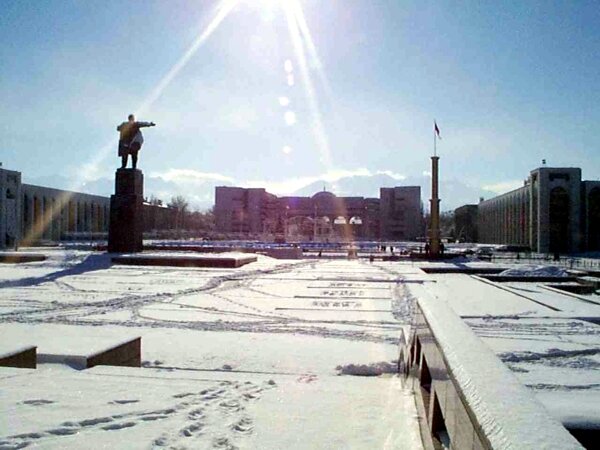
Well, here, winter has yet to give up its grip and we are still hanging on to our winter coats. The days may be getting longer, but it is still pretty cold, there’s snow on the ground and more cold weather is predicted for the immediate future. It’s minus 14 degrees as I write this and we’ve had a week or so such bitterly cold weather.
So much for Spring!
However, it is a time of hope and looking forward in anticipation … of new beginnings and new prosperity. Perhaps that’s why. as one commentator put it, there seems to be a tradition of unrest in the Spring in Kyrgyzstan … protests are arranged, governments are challenged and fall, as the people take the opportunity to give vent to their feelings which have been welling up inside them throughout the long, cold, dark winter.
This year, we are all hoping that the energy, enthusiasm and hope can be directed to positive and constructive channels rather than giving vent to negative events.
.
So, here’s to the first day of Spring … and all the hope and regeneration that it symbolizes.



 Bishkek