What can Kyrgyzstan learn from Wales?
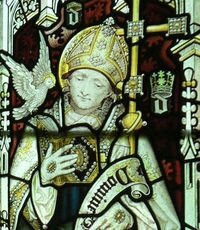
Tuesday, (March 1st), was Saint David’s Day. It went, more or less unnoticed here in Kyrgyzstan … but then, there isn’t a large Welsh community here.
If I am asked about my nationality, then I usually say that I am pure English, but that it is hard to justify saying that with any confidence as we are hybrid nation with a mix of blood from the Angles, Saxons, Norse (the Vikings), Romans, Normans, German and goodness knows what other nationalities. It’s possible, for example that I have a smattering of Welsh blood coursing through my veins but, frankly, I just don’t know. My mother’s maiden name was Jones … (it’s all right, I never use that as my “Secret Question” when it comes to password reminders, etc.) … which is a good welsh name and her family were supposed to have relatives in Swansea, but I have never met them and have no information about that possible branch of the family.
I do know one Welshman here in Bishkek, Nigel, and although he is proud of his heritage, (flying the Welsh standard outside his hotel in Issyk Kul – yeah … honest!), he is usually a solitary voice cheering for the Reds whenever England play Wales in the Six Nations … and takes a lot of ribbing for it. I didn’t see him on Tuesday, but I did send him a belated “Happy Saint David’s Day” message with John, yesterday.
I thought about writing a postcard about St. David’s Day in Bishkek to mark the occasion … but as I said, it more or less went unnoticed here and as March 1st is also reckoned to be the first day of Spring here in Bishkek, I chose to write about that instead. I also knew that a couple of days later, (today, March 3rd), there was another important day in Welsh history and the thoughts that I was thinking of including in that postcard could be postponed for a couple of days.
.
So, a little bit of background:
St. David is the Patron Saint of Wales who lived in the sixth century and, unlike a lot of Saints and other people or events of the period, we actually know quite a bit about him – or at least we have a lot of knowledge about what people said about him. One of the main sources of information about him, however, was written about five hundred years later and historians have doubts about many of the claims contained in it.
There are suggestions that he was born into one of the Royal families of Wales, the offspring of a violent assault on his mother, (who was canonized as a also a Saint), and was born on a cliff top during a violent storm. This violence, however, did not shape his life and character. He was educated and entered into a monastic life, eventually rising in the church hierarchy to become a Bishop and writing an order prescribing how monks should live. He is associated with the foundation of several important churches, and even, in one tradition, with Glastonbury Abbey.
Although he was born, raised, died, (being buried in the cathedral in St. David’s – Britain’s smallest city), and spent most of his life in Wales, he actually travelled quite a bit, even going on a pilgrimage to Jerusalem.
To become a Saint in the Catholic tradition, one is supposed to be the cause of miracles. There were several miracles associated with him, both during his life and achieved by prayer afterwards. The best known is probably when he was giving a sermon and many at the back of the crowd were getting restless because they could neither see nor hear him, and in a scene reminiscent of the cartoon Avatar, the land rose underneath him raising him high above the congregation so that they could, and a dove alighted on his shoulder as a sign of God’s grace. He is often depicted in art with a dove on his shoulder.
My favourite piece of “trivia” associated with David is a quote from one of his sermons which is now a “proverb” in Wales: “Do the little things in life.” That strikes me as a fairly good motto, especially when you remember what Hugh Coulter, (of the Karakol Orphanage), always says: “A little goes a long way!”
Although we are not sure of his exact dates, there are several suggestions which have him being born sometime between 462 and 512, we are fairly sure that he died in 589 and tradition has it that it was on Tuesday March 1st, and hence that was the day chosen for his Saint’s Day when he was canonized by the Pope in 1120.
Although it’s not an official holiday in Britain, there have been several attempts to make it one and it has long been celebrated by the Welsh whether they are home or around the world. They often wear a leek or a daffodil as symbols of Wales. Here, although the days are noticeably beginning to draw out, it is still a bit early for daffodils and leeks are rarely seen, so Nigel, or any other Welshman, might have trouble finding one, but they could fly the Welsh flag, or the flag of Saint David, which are also regular features of celebrations.
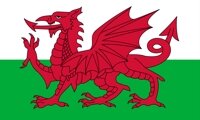
Incidentally, the flag is a point of contention in that the Welsh flag depicts the Dragon of Wales on a green and white background. The green and white may be a representation of the leek and the dragon is a an ancient symbol, possibly brought to Wales by the Romans.
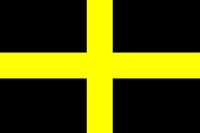
Members of the Christian Church often complain that the dragon is a symbol of the devil and they prefer to associate the country with the flag of St. David, a yellow cross on a black background.
There is another point of contention in that the British standard, (the Union Jack) was designed to incorporate the elements from the flags of the constituent parts of the United Kingdom: the flag of St. George of England, St. Patrick of Ireland and St. Andrew of Scotland. There is, however, no element representing Wales, or St, David.
The reason for this is tied in with today’s other anniversary associated with Wales. The Statute of Rhuddlan was enacted on March 3rd in 1284 after the English conquest of the Principality of Wales, incorporating the principality into the possessions of the King of England, King Edward I. He set about pacifying and brining order to his new domain. Although some aspects of Welsh law remained in use, particularly in the case of civil law, and some parts of the land continued under the old system of administration, but effectively the country ceased to exist as a separate entity. The Statute remained in force for some 250 years until the Laws in Wales Act of 1536, (which created a single unified legal system and realm known as England and Wales), was passed under King Henry VIII, (who, himself, hailed from a Welsh dynasty).
.
When I was considering writing a postcard about Saint David’s Day, I thought about how the United Kingdom is a complex mix of at least four different countries, which together with the Crown Dependencies, British Overseas Territories, and not forgetting the Commonwealth, go to make up a family of nations sharing a common heritage. Like any family, we have our disputes, squabbles and difficulties, but on the whole we manage cope with these tensions and recognize that we live together in a “great big melting pot”, as the old pop song put it.
You’ll understand from this that I am giving away the fact that I grew in the “Swinging Sixties”, under the influence of “Flower Power” and the Hippy Movement, and that, frankly, I don’t agree with the likes of Angela Merkle, who, (if it’s not taking her out of context), has apparently said that “multiculturalism is dead”.
Likewise, I have never been keen on Nationalism, of any sort. I don’t sympathize with the various Nationalist parties of any country and although I used to like the catchy music of the American folk song, “This land is your land, this land is my land …”, I always had problems with the sentiment that it encapsulated. In my more religious days I would say to people, “This isn’t your land, and it isn’t my land … it’s God’s land and we are just looking after it”. We don’t “own” it, we are just tenants.
Personally, I like the view of the native American Indians and the Australian Aborigines who held that, “the land does not belong to us … we belong to the land”.
This view seems to have become more prevalent in society as we try to cope with environmental problems, pollution, the extinction of species and climate change. The Green Movement points out that we hold the earth in trust for future generations and should be held responsible for what we do with it.
.
Now, in some ways Kyrgyzstan is like Britain, especially in respect to the ethnic diversity in the population. As a result of its geographical position and history, (the Great Silk Road, the rise and fall of empires, the migrations of the Soviet period), it has an eclectic mix of nationalities within its borders, each with their own history, culture and traditions. I have a lot of sympathy with the slogan which you saw everywhere in Akaev’s Kyrgyzstan: “Kyrgyzstan, nash obshe dom” – “Kyrgyzstan, our common home”.
Most of them the people in Kyrgyzstan are Kyrgyz citizens if not of Kyrgyz nationality. They need to find ways in which they can celebrate their differences rather than breaking out into bouts of ethnic violence and dispute.
Although Britain may not be a prime example of racial harmony, perhaps there is something that we in Kyrgyzstan can learn from it, and other countries with mixed populations, such as South Africa, about “living together”.
Let’s see if we can learn something from the poor, downtrodden, Welsh.
.
Incidentally, for anyone who is interested, there is a clip on youtube explaining the differences between the United Kingdom, Great Britain and England, which is well worth watching, even if the commentary is delivered at a frenetic pace.
http://www.youtube.com/watch?v=rNu8XDBSn10




 Bishkek