The sword of Damocles
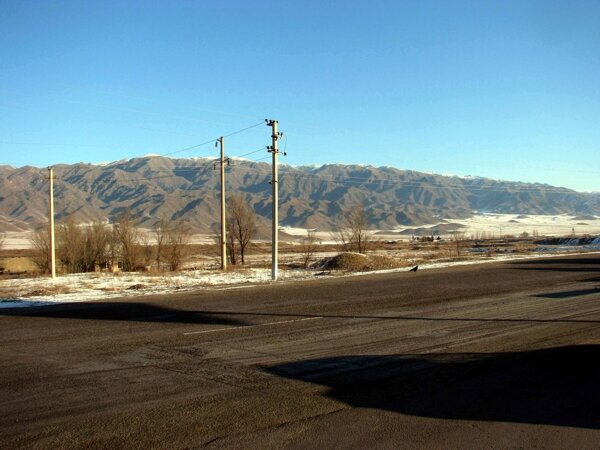
The postcard is shorter this week and a little late because I have been up to Naryn to deal with the end of year routines, (tax returns and so on). Surprisingly, it wasn’t as cold up there as I had anticipated, indeed Bishkek is colder.
The prospect of a “third revolution” has taken on mammoth proportions, both in terms of general conversation and in the media. It’s like the sword of Damocles hanging over the country. As one press report put it: “Spring is the traditional time for protest in Kyrgyzstan”
After a long and wide ranging discussion between the participants, one of the journalists posed the question … “and what would happen in the event the rumoured “third revolution” takes place?”
There have been several pronouncements that there will not be such a revolution … whether from political unrest or problems like rising food prices. For example, having been called upon, last week, to explain her public comments about social cohesion and tensions, this week Roza Otunbaeva made sure to announce that there would be no such disturbances leading to social upheaval and revolution. Others, (politicians, economists and commentators, not forgetting the head of th Security Services), have echoed her comments. To be frank, however, such news items simply serve to remind me of Mandy Rice Davis’ observation: “Well, they would say, wouldn’t they?” and I am not sure whether or not I detected sarcasm in the voice of one man I heard quoting the President’s announcement … his words seemed to express an implicit belief in the efficacy of the word and say: “she said it won’t happen, so it won’t happen”, but I wasn’t sure that was what he really thought.
Although everyone seems to be talking about it, nobody seems to want it: Kyrgyz, Russian, foreigner.
I am not sure who would finance such a revolution, who could assume power after it. (Some of the political parties who didn’t get elected to the parliament, however, have established a shadow government, and are issuing statements about the state of affairs in the country.) Mind you, I, amongst others, were caught unawares by the way that the other two evolved, (as I have said before, I don’t like making predictions but will happily answer I you ask me “what happenend?” or “how was it?”), and, as official pronouncements keep reminding us, there is always the threat of militant Islamic elements.
A lot of hope, both locally and in the international community, is being placed in the Presidential elections tabled for the summer. Roza Otunbaeva has declared that she will not renege on the interim agreement which prevents her from standing again. Ata Jurt, the largest part represented in Parliament has declared that they will participate and there are signs from several other politicians that they will also consider their candidacy.
Perhaps, however, the most pertinent comment I have seen during the week was a tweet to the effect that “it’s only in Kyrgyzstan that the news is that there rumours about rumours …”.
Prices, especially food prices, have been in the news again. The Minister of Agriculture assure us that there are sufficient supplies of food stocks in the country, but his counterpart at the ministry Economic Regulation admits that the government is concerned about the current sharp rise in prices that we are experiencing and the likely effect they will have on inflation and they are looking at introducing certain price controls to help control the situation. Certainly, the lack of action from the government in order to control food prices is one of the recurring themes that I hear in my small circle of acquaintances. So, it looks like it might be popular measure, but, (and I’m no expert), I’m not certain what they can actually do. There have been comments about “monopolies”, collusion and “cartels” and being “fleeced” by “middlemen” who are profiteering from the situation, but it strikes me as a tightrope which could lead to abandoning the principles of the market economy and putting the clock back to a command economy. It’s also been pointed out, by some politicians, that although this might pacify the consumers in the markets, it is not necessarily good news for the farmers who are already operating under great stress. Indeed, the government are trying to find.other ways to relieve these stresses with, for example, access to “cheap” forms of finance.
There have been a number of interesting reports during the week.
One of my favourites was a report about the reconstruction of roads in the capital. Apparently there are three different sources of funding for this work: a grant from the Chinese, the Republican and the city budget. Some bright spark looked at the figures and spotted something interesting … there is a discrepancy between the cost of repairing a kilometre of road depending upon whose footing the bill. I haven’t seen the details of the analysis, but I can think of reasons, (good reasons) why this might happen but the response from an astonished official when asked about the discrepancy was simply: “That can’t be …”.
The question of internet censorship and control has been resurrected with reports that certain sites, particularly some proxy sites which hide the users internet address and make blocked sites available, have stopped working in the republic. Comparisons have been made with similar difficulties experienced in the final days of the Bakiev regime, although, to be fair, it’s not clear if the source of the difficulty is here in Kyrgyzstan or if it originates in one of our neighbours.
Another is the news that Roza Otunbaeva has signed an order on the organization of events to commemorate those of last April. As I pointed out a few weeks ago, the public holiday established by Bakiev to commemorate the Tulip Revolution in 2005, on March 24th, is till in the calendar of Public Holidays. One politician has spotted this and started a public debate about it, eventually tabling a motion in parliament to cancel it. The result of the debate was by no means clear cut … and although a slight majority seemed to in favour of cancelling it, there were some people who felt that 2005 did mark an important landmark in the history of modern Kyrgyzstan and so it should be kept. Although there were some people who thought that it should be moved to April 7th, no-one seemed inclined to organize “celebrations.
Talking of holidays, Wednesday was a holiday: Defenders of the Fatherland Day, otherwise known as Army Day or simply, Men’s Day. Although it was still a low key event in the calendar – basically a day off work for many people, there seems to have been more made of it this year than in the past, especially in schools. On the other hand, it may just be that I know more families with children of school age and simply noticed it more than in the past.
I worked on Wednesday, but took a day off last Sunday to take a day trip to the Ala Archa and Alamedin valleys in the mountains to the South of the city. Tatiana, my accountant, had a visitor from Russia and wanted to take her out somewhere and so we decided to make a day of it, gathering together a minibus load. I have written a postcard about the tip and posted some photographs on www.iabek.kg and also posted te photos on my Facebook page.
I have also posted a link to a video posted on youtube taken by Alicia, Philippa and Sebastian from the What Took You So Long Foundation – the Camel Crew. They were here last year researching for a project on cheese made from camel’s milk and took an interview with me that they turned into a short clip, (about two and a half minutes). They are currently in Africa having been in Egypt just efore the troubles started there. Check out their website to see what they are currently up to.
This week looks as if it might be busy. John is on his way back from Afghanistan, en route for Astana, and Tim is here from London, as well as the usual round of meetings, admin work and preparations for the season not to mention what the news might have in store for us.





 Bishkek