What a difference a day makes …
They say that you can experience all four seasons in one day in Kyrgyzstan. I have come across this myself in the past. The mountainous nature of the terrain creates plenty of scope for microclimates in different valleys, varying with altitude, aspect, (North, South East or West facing), different soils creating habitats for differing types of vegetation and so on.
On my recent trip to Naryn over the weekend we certainly experienced two seasons.
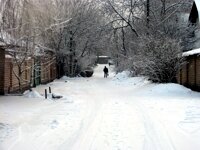
The day began, as usual, early, before the sun had even risen. The overnight temperature was about -15 degrees Celsius, although the Weather Channel told me it was -17, but that was the temperature at Manas Airport, about 40 kilometres to the North of the city, where it is regularly a couple of degrees colder than the city centre in Winter.
Here had been sow and it had settled, although it wasn’t thick. I was glad that I had decided to dress up warm, with several layers in the “Onion Principle”, although here they talk about the “Cabbage Principle”. The idea is that the air trapped between the different layers acts as additional insulation.
Even so, my toes felt cold and I wished I had put on a couple of extra pairs of socks. As it happens, my feet soon warmed up and it wasn’t a problem.
It was so cold that we actually had trouble opening the car doors when we stopped to pick up Tatiana, the accountant. The diver, on the inside of the vehicle, was pushing whilst I and Tatiana on the outside were pulling as hard as we could. In the end the lock mechanism gave way and settled down for the journey.
I noticed that ice quickly formed on the inside of the windows and I started thinking about what might happen if we got stuck in the mountains, (for example, if the car broke down or an avalanche blocked the road … however the vehicle had just been checked for the journey and it is not the season for avalanches – not yet – so I put my mind to rest.)
One of the attractions of travelling in this sort of weather is the beauty of the scenery as the snow covers the landscapes. On this particular occasion, I noticed hw the branches of the bare trees, bereft of their leaves, stuck out like white fingers pointing into the sky, and there were also moments where the sunlight caught on the snow creating a sparkling, glittering effect.
Although the snow lay across the countryside on both sides of the road, the carriageway itself was more or less clear where the weight of passing traffic had not allowed it to settle. For us, travelling in the middle of the day, it made for easier going, but I could imagine that early morning and late evening, when frost settled in, the surface would be slippery and treacherous.
As we approached Boom Gorge, about 150 kilometres from Bishkek, the snow seemed to disappear. The landscape was clear, almost as if it was just another Spring day. It was still pretty cold outside, however, because the valley acts as a natural chimney for funnelling strong winds down from the Issyk Kul basn to the Chui valley below.
It was as we driving through the gorge that I saw another of those strange, esoteric, surreal moments. There at the side of the road, in the middle of nowhere, (no houses around, no vehicles parked nearby), were three young people, two boys and a girl, in the middle of the Islamic prayer ritual. Where they came from and what they were doing there, (as I said, in the idle of nowhere), I have no idea.
The landscape remained clear of snow for the next hundred kilometres or so. Of course, we didn’t expect to see snow on the ground in Kochkor, legend has it that it never snows in Kochkor – some locals claim that it is to do with the abundance of salt in the neighbourhood soils that lowers the freezing point of water and helps to ensure that snow melts almost as soon as it hits the ground. I have to point out, however, that I have seen snow settled on the ground in Kochkor, and even won two bottles of Cognac on the basis of my scepticism of the local legend.
The bright sunshine almost turned the day from Spring into Summer as far as we were concerned, warm and snug in the vehicle. However, the ice on the surface of the Orto Tokoi reservoir and the Sary Bulak River gave the lie to this misleading impression.
In fact, the bright sunshine wasn’t everywhere. As we drov along the bottom of some the narrow valleys, we seemed to descend into the depths of the earth as the sun disappeared over the crest of the hills and we were plunged into deep, dark shad … as if we had suddenly entered a tunnel. Then we would turn a corner, or crest a ridge, and the sun would re-emerge and we would be bathed once more in its bright rays.
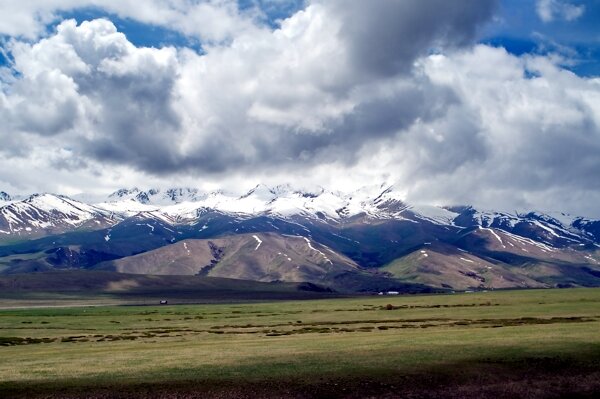
Finally, as we approached the highest point of journey, the Dolon Pass at 3025 metres above sea level, the snow, (and Winter), returned and stayed with us all the way to Naryn. The snow wasn’t too thick, however, and didn’t really hold us up.
I took the GAI to do that. The GAI are te local traffic police and one of them, standing by the side of the road, waived his baton to us as a signal to pull over. He approached the car and asked to see the documents, (the driver’s license and the registration documents for the vehicle). Once those formalities were out of the way he held up the Radar gun that he had in his hand and showed the reading to the driver. Apparently he had been caught speeding. Only, he didn’t think he had been speeding … and then he noticed that the time displayed on the gun was different, so he wasn’t going to pay an “on-the-spot” fine. It took a long while to sort out the formalities before we could proceed on our way. (That’s a problem waiting for him to face when he returns to Bishkek).
Thatdelay was one reason why it took us longer than usual to get to Naryn, but careful driving to take account of the weather and road conditions was another. Anyway, we eventually arrived and decamped from the vehicle, ready to set about work, preparing the annual returns – but that’s another story.
The skies above Naryn were covered in cloud. It covered the tops of the mountains that surround the town and the sun was visible only as a large, bright spot through the haze. Oddly enough, for the town known as the coldest town in Kyrgyzstan, it was relatively warm – just minus eight degrees Celcius.
I wasn’t going to need those extra socks.
In fact the guesthouse was quite warm. A light snow was falling outside, but inside we felt comfortable and snug. What was odd was that the radiators were just luke warm – not piping hot and certainly not too hot to the touch … so although the staff had stoked the boiler the warmth wasn’t just down to the central heating. To be honest, it was probably the most comfortable and snug that I have felt up there in winter ever since we opened in 1998.
That night the light snow kept falling. The news in the morning told us that the overnight temperature in Naryn was minus eight, whilst in Bishkek it was minus eighteen. I was glad that we were in Naryn.
When it came time to leave we could see the new snow lying on the ground … there was a brilliant whiteness all around. In fact the snow continued all the way over the Dolon pass, down through Sary Bulak all the way to Kochkor. The driver chose to take the by-pass and not drive into the village, which was a pity because there was so much snow on the ground all the way up to the outskirts and I was looking forward to the possibility of being able to claim another bottle of cognac.
Once past Kochkor, however, the snow disappeared and in Boom Gorge there was none to be seen. It was still pretty cold, however, as a result of the strong bitter winds that were blowing. The roads were clear of snow all the way back to Bishkek and we made good time.
It was definitely colder in Bishkek, however, and, once again, my toes began to tingle. Perhaps I was going to need those extra socks after all.


 Bishkek