Ibn Battuta – unfortunately, he never made it to Kyrgyzstan
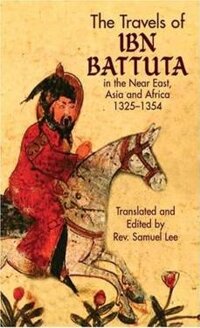
One of the books on my bookshelf which gets taken down every now and again in order for me to dip into and read a short section. It’s a 2004 reprint, of an 1829 translation from the original Arabic, of a fourteenth century account of his journeys around the then known world, written by Ibn Battuta, the Rihla.
This medieval scholar seems to have taken to heart the exhortation of the prophet Mohammed, who is supposed to have said, “Don’t tell me how much you know, tell me how much you have travelled”, and he became one of the world’s greatest travelers.
In the West, nearly everyone has heard of Marco Polo, yet few will recognize the name of Ibn Battuta. Although some scholars have expressed doubt about whether Marco Polo really undertook the journeys that he described in his published account, “Il Milone - Le divisament du monde”, (“The description of the world”, but better known in English as “The Travels of Marco Polo”), there seems no doubt that Ibn Battuta actually did complete the odyssey that he describes, although some Western Orientalists think he may not have visited everywhere he mentions and may have relied on hearsay from other travellers for some of the details. Indeed, there is no indication that he made any notes during his almost thirty years of travelling, so, when he came to dictate an account of his adventures, he had to rely on his memory and to make use of manuscripts produced by earlier travellers.
From reading his account, it seems that Marco Polo, having crossed Afghanistan, made it as far north as Kashgar before turning East. Despite several claims to the contrary, he probably never made it to Kyrgyzstan. Likewise, Ibn Battuta never made it to Kyrgyzstan although he did visit Bukhara and Samarkand in what is now Uzbekistan before turning south to Balkh in Afghanistan.
Born on February 24th, 1304, (or February 25th, there seems to some doubt as to the exact date and I have seen both dates quoted), into a family of highly respected religious judges, Ibn Battuta followed the family tradition and was educated as a theologian.
As a young man of 21 in 1325, (or 1326, again, I have seen both dates in the literature), he set out from his native Tangiers in Morocco on the Hajj, the traditional Islamic pilgrimage to Mecca. It’s quite a way from Tangiers to Mecca, and st the time the round trip would have typically taken just 16 months and it is doubtful that when he set out, even he had any idea that he would not see his home again for another 24 years or that in the next 27 years he would travel over 75,000 miles, marrying several times, visit the lands of every Muslim ruler of his time: across North Africa; down East Africa; through the Arabian peninsula; through the Byzantium Empire and parts of Eastern Europe including southern Russia; through Central Asia and into South Asia, (Pakistan, India, Sri Lanka and Bangladesh); then into Burma, the Maldives, The Malay Peninsula, Indonesia, the Philippines and China; before returning home and crossing the Straits of Gibraltar to Spain and then down into the hinterland of Western Africa crossing the Sahara Dessert.
His account is full of details of architecture, maritime customs and agricultural practices and other social mores in far off lands, as well as stories of royal courts that he visited where he was welcomed him as a scholar and adviser at one point being appointed as an ambassador and at others treated with suspicion of being a spy and traitor. His account gives, for example, some idea of the extent of slavery at that time and what he considered the lax ways of some f these far flung parts of the Muslim world, as well as details of Chinese cuisine and its use of exotic animals such as frogs.
Basically, all that we know about him comes from the autobiographical details which are contained in the Rihla. For centuries it remained an obscure text, even within the Muslim world, but in the early 19th century extracts were published in German and English based on manuscripts discovered in the Middle East.
It’s a pity that he never made it here … as I skim through the various passages in the book, I often wonder what he would have made of the nomadic Kyrgyz and the other inhabitants of what is today Kyrgyzstan if he had ever made it to the Chui valley, Issyk Kul or the Ferghana. I don’t think he would have complained about the dress codes amongst the Kyrgyz, (as he did in the Maldives), but, as amongst other Turkish peoples, he might have found the relative freedom of women to speak their minds in front of their husbands disturbing, and I am sure he would have had something to say about the lax way in which they approached their religious duties in view of his story about the Uzbek Khan who arrived late for prayers and was given short shrift by the imam.
It would have made for some interesting insights to life in Kyrgyzstan during that period of history.



 Bishkek