Adopt a Babushka – or Dedushka
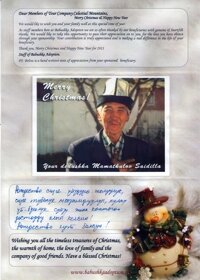
In the middle of December I started to receive the usual collection of Christmas and New Year cards bearing greetings and best wishes for the approaching holiday and the coming year. This year, two of the early greetings I received were particularly interesting ones, not cards but sheets of A4 paper with photographs pasted onto them. As usual there was a printed message and a handwritten one. The photographs and handwritten message was from people I haven’t met but with whom I have a relationship, of sorts. They are “adoptees”, pensioners whom we support through the good offices of the charity Babushka Adoption.
Babushka Adoption is one of my favourite charities and I have mentioned them before in some of my postcards.
It was born out of an initiative of a Swiss consultant working in Kyrgyzstan. He noted that the collapse of the Soviet Union had caused an economic and social crisis for many people and that elderly people were among the most heavily affected.
It is a tradition amongst the peoples of Central Asia that the elderly are the responsibility of the children. Whereas the older children would marry and leave the family home in order to set one up for themselves, the youngest son would live with their parents, bring his wife to live with them, raise their children in the grandparental home and then inherit the yurt or house when his parents passed away. This concern for the care of the elderly within the family setting is even built in as a provision in the Kyrgyz constitution. Many of the elderly people in modern Kyrgyzstan, however, were alone having either been “abandoned” by their children who had emigrated to seek employment abroad, or they didn’t have any children of their own.
Vulnerable, lonely people could not make ends meet and to pay for their rent, food and heating costs, and had taken to begging on the streets.
Not many of these elderly “beggars” would actually summon up the courage to approach a passerby and ask for cash. This was not necessarily because they were afraid of the likely reaction, but a shyness brought out of “stidna”, (shame).
Instead, although you don’t see this as much as you used to, it is still possible to see a lonely character standing, or sitting, by the roadside with their heads bowed and their hands held out clutching a few low denomination banknotes. It used to be small green 10 or blue 50 tiyin banknotes but, although they still exist very few people use them as they are practically worthless.
(For the record: tiyin is an old Turkic word that originally meant something like “small change”. When the Central Asian countries of the former Soviet Union adopted their own national currencies they used the word instead of cents, or pence, for the small subdivisions of the basic unit. So, in Kyrgyzstan, the som comprises 100 tiyin. The current exchange rate is about 46 som to the dollar, or just over 70 to the pound, so 50 tiyin is the equivalent of just over 1 cent, or just under 1 penny).
Some, however, are more enterprising. They may, for example, have a set of bathroom scales and have a little handwritten placard saying “Usnai svoi ves”, “Know your own weight”. It used to cost one som to stand on the scales, then inflation pushed that up to three som. Others spread out on a mat or wall some household goods, (a couple of plates, some shoes, or half a dozen books) and sell them to passersby. When I first came here over fifteen years ago, one of the first of the English language guidebooks suggested that you could pick up some real bargains, but urged readers not to bargain too hard as the items were “going for a song” in terms of what they would cost at home and probably represented something that may well have been a treasured item at one being sold by someone who fallen on hard times.
Of course, these options are not available everywhere and I have seen them only in Bishkek.
I always feel very sorry for these pensioners. They grew up in a society where they were taught that the system would take care of them in their old age and simply asked that they work to help build up and maintain that system. Then, when they reached that stage of their life when they would need the support that they had been promised, the system collapsed, the social benefits that formed the safety net that they had been promised were either withdrawn or turned out to be of little actual value. Then they were hit a double whammy by currency crises and inflation.
The basic pension in Kyrgyzstan is very low. Now, I know that this is true for almost every country of the world, somewhere about 1000 som a month, roughly equivalent to just twenty five US dollars. A month.
What’s more, whereas in most Western countries the basic “state pension” is supplemented by private pension funds, but they didn’t have the opportunity to invest in such schemes. Even in the West few people would do so unless they are compelled to by “the system”, and even then they often resent it as they see part of their hard earned salary disappear from their pay packets. Retirement is seen as a long way off, and the benefits of a good pension scheme rather academic and remote. The great temptation is to take the cash and “let tomorrow look after itself”. As a Trade Union branch official, some of the most important meetings we arranged were about retirement and how to maximize your income, and your opportunities, in retirement. Nearly all the time, the people who turned up and attended those meetings were already close to retirement and so were not able to take full benefit of what the various schemes had to offer.
Anyway, life can be pretty hard for a pensioner here. That’s one reason why I like Babushka Adoption, because they help this vulnerable, disadvantaged and often overlooked group in society.
What’s more, the idea is simple and direct. Each sponsor “adopts” an elderly person and and makes a donation of Euro120, plus a small donation to cover administration costs. Their contributions, (EUR120), are then dispersed to the adoptee at regular intervals, once every two months, in cash. That amounts to 10 Euro a month, about 650 som, which is a little less than the regular month pension. It doesn’t seem much, but it’s better than nothing and, here in Kyrgyzstan, “a little can go a long way”.
The beneficiaries are selected by the charity’s staff, who compile a biography which the sponsor can use to chose whom they want to support. Although many come from the North of the country, Babushka Adoption also operates in the regions. The two people that we support, for example, are in Batken, in the extreme South Western corner of the country. A region that is remote from the capital, Bishkek, and, (like the elderly themselves), often overlooked.
The Babushka Adoption system is also transparent. They say up-front, so that sponsors know how much of their contribution is spent on administration and how much goes direct to helping an individual. What’s more, each year, sponsors are sent a “statement” which outlines how and when the money has been dispersed. It’s even possible to actually go and meet the adoptees, and I have seen one blog where a tourist who had subscribed on a previous visit to Kyrgyzstan to support an “adoptee”, did just that. There is a supervisory board which monitors the work of the charity and acts as a sort of “guarantee” that it fulfills its mission and that the funds donated by sponsors are spent properly.
But the charity does even more than just disperse funds. Volunteers and social workers also arrange home visits and help to clean, do the laundry, shopping and give personal care. They organize meeting points and events where the elderly can talk and meet each other. They help facilitate communication between beneficiaries and sponsors, such as translating and delivering letters. They support locally run “Self Help” groups – especially in Bishkek and the Leilek region of Batken, especially when it comes to taking part in community development projects and governance. In this, they help people to help themselves.
Recently they helped a Student group at one of the universities to undertake an oral history project, (which I featured in another postdard).
Well, it’s that time of year when I need to renew our sponsorship, and so this week I went to the offices of Babushka Adoption to complete the necessary paperwork.
If anybody reading this is interested and would like to do a little to help, then you can find out more on the Babushka Adoption website: http://www.babushkaadoption.org.



 Bishkek