Three new Panoramas
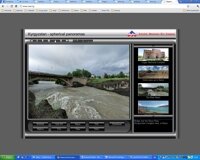
We’ve added three new spherical panoramas to our website www.see.kg …
- The entrance chamber to the Kan-i-Gut caves in Batken
- A beach at Bosteri on the Norther shore at Lake Issyk Kul
- The square outside the Philharmonia in Central Bishkek at nighttime
1. The entrance chamber to the Kan-i-Gut caves in Batken:
The mysterious and legendary cave of Kan-i-gut lies some eighteen kilometers from the settlement of Samarkandyk, in the Batken oblast, on the slopes of a spur of the Turkestan ridge of mountains.
The entrance is approximately 5 meters high, and the “black hole” is so deep it sometimes appears to be bottomless. appears The earliest references to this massive cave are in the works of Avicenna and over time it has served as a mine for precious metals and a prison.
From as early as the 10th and 11th centuries silver and other minerals were extracted from the caves … and at one time the cave was known as the “Mine of Death”. In the days of the Kokhand Khanate, criminals sentenced to execution, political enemies of the authorities and others were sent here to work in the mines. They were turned loose in the labyrinth of caves, which stretches for over three kilometers, and if they returned without ore of the precious metals, they were either killed or sent back to look again. Once they entered the caves – there was no way to emerge again. Many invented tales to astound their goalers - and hopefully earn themselves a release – including stories about a sleeping camel with jewels as eyes, a mysterious green plant that grew underground, walls made of silver bricks, and terrible creatures which acted as guardians protecting the caves treasures. The mines are now all but exhausted.
In 1896 two Russian amateur geologists were sent to the explore the cave by the then governor of Turkestan. Their account of their visit includes a description of what they encountered. The expedition wasn’t exactly well equipped by modern standards with just one rope, some candles, a primitive lantern, a shovel and some smoked fish. They negotiated with some local shepherds who agreed to show them the caves – but warned them of the dangers of getting lost, or confused, in the labyrinthine maze of which the cave consisted. They were told stories of how a party of five once descended … never to return … their skeletons still adorning one of the cave’s galleries. The shepherds also told them of the ancient accounts of magical forces which protected the many treasures which lay within.
The explorers said that the entrance to the cave reminded them of a gothic temple, or cathedral. They proceeded onwards, into the darkness. Although remembering that many individuals had been lost in these caves before them, they carried on and penetrated deep into the system.
During the Soviet period, further explorations were carried out, including an expedition in 1920 which lasted some 20 days, and hich discovered a second entrance to the system. Several maps of the system were created … and various caverns were given picturesque names: “Red Water Pool”; Skeleton Hall; “Bridge of Sighs”; “Bottom of the second Precipice”; “Camel Grotto”; Dragon’s Labyrinth” … and so on.
In 1972, 1976 and1984 further expeditions took place, and although the mines may have been worked out the caves still managed to reveal many treasures. A horde of 23 square coins from the 18th and 19th centuries was discovered.
The caves have not yet revealed their full extent … although more 30km of tunnels have been explored, it is thought that many more remain to be discovered.
2. A beach at Bosteri on the Norther shore at Lake Issyk Kul
Lake Issyk Kul lies at the bottom of a drainage hollow, or depression and has no outflow.
Mountains ring the lake and there are several valleys worth visiting, Gregorievka and Simeonevka on the North, Barskoon on the South and numerous others around Karakol. To the North are the Kungei (“Sunny”) Ala-Too mountains and are criss-crossed by trekking routes including ones that connect the lake with Almaty – while to the South lie the Teskei (“Shady”) Ala- Too mountains. These mountain ranges protect the Issyk Kul hollow from winds bringing either extreme cold – or extremely hot – winds.
Issyk Kul is Kyrgyzstan’s largest Lake and at about 180 km long by 70 km wide and 668 meters deep at the deepest point, (the average depth is about 300 meters), it is the world’s second largest mountain lake – and the fifth deepest lake in the world.
The lake has been held in high regard by the Kyrgyz – it is known as the “pearl of the Tien Shan” – and in 2004, the government declared the lake as the “property of the nation”. One source even suggests that, at one time, it was even forbidden to swim in the lake.
Due to its size it sometimes appears like an inland sea, and it has a fair number of beaches. Most of these are on the Northern shore and have long acted as a magnet for tourists. There are a large number of sanatoria, holiday camps and hotels on the Northern shore and these were very popular in Soviet times. Cosmonauts, after they returned to earth were brought to the lake to rest and recuperate and Brezhnev had a Dacha on the shores of the lake. In 1999 there was an accident where a lorry carrying cyanide fell off a bridge and poisoned the river water and this led to a dramatic decline in the number of tourists to the region, although numbers are beginning to rise again.
The tourist season usually runs from June until September – but the peak season is from about 25th July until 25th August – and it may be difficult to find places and prices are at a premium. A number of the sanatoria, hotels, guesthouses and homestays around the lake operate all year round – although some are open only during the summer season.
Bosteri is a village on the Northern shore of the lake, to the East of Cholpon Ata. There are a number of Sanatoria and resorts such as, Kyrgyskoe Vzmoriye, (or “Kyrgyz Seaside”), which is one of the largest and most famous of the sanatoria, with a wide variety of facilities.
Nearby, archaeologists have discovered evidence of the oldest human habitation on the northern shore of the lake.
3. The square outside the Philharmonia in Central Bishkek at nighttime
The Philharmonia is one of the most striking and easily recognisable, marble-faced, buildings in downtown Bishkek, at the crossroads of prospects Chui and Manas. Although it is known simply as “The Philharmonia”, it’s full title is “The Philharmonia Concert Hall, (named after Toktogul Satylganova)”.
This is, in fact, the third such home of the Philharmonic Society – which was established in 1936, based on the orchestra of the Kyrgyz State Theatre. The first home of the society was in the building now occupied by the Metro Pub, (on the corner of Prospect Chui and Turusbekova) and the second the Kyrgyz Promstroi Bank on the other side of Prospect Chui from the present building.
The present concert hall was built in 1980 and the Manas Sculptural Complex which stands in front of it, was erected in 1981. The complex comprises of a statue depicting the legendary Manas in a pose resembling St. George slaying the dragon. He is riding his horse, Akula, with a dragon, (or winged snake), entwined around them. The plinth on which he stands is flanked by statues of his wife, Kanykei, and his friend and advisor, Bakai, and busts of various famious Manaschi (Balykov, Dzapiev, Orozbakov, Karaliev) .
Inside there are two concert halls, one large with capacity for an audience of 1200 and, on the third floor, a smaller one with 300 seats. On the ground floor there is a large restaurant – and the building also houses two night clubs. The spacious lobby with displays, and busts of some famous Kyrgyz musicians. There are are some large stained glass windows, displaying Kyrgyz motifs which make an interesting sight when lit up at night.
The ticket office is on the Western side of the building.
Concerts include performances of both classical (western) and traditional Kyrgyz music as well as by local popular artists (pop music – Kyrgyz “Estrada”).




 Bishkek