Even the tiniest little chapel has its Saint – French Proverb
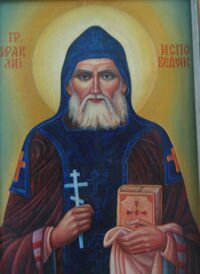
In a postcard a few days ago I mentioned the fact that the Orthodox Cathedral of the Resurrection here in Bishkek has the tomb of St. Irakily – Kyrgyzstan’s only Saint. Actually, I was a bit unfair, because Kyrgyzstan may also be the final resting place of another Saint, with a much more grandiose claim to the title. What’s more, Kyrgyzstan was also home to several Muslim holy men who are often equated with Saints, particularly those associated with the Sufi tradition – but more about those another time.
Let me start with the Kyrgyz Saint – Irakily. That’s not a name that runs easily off the tongue and few people will recognize it. He’s not one of the Catholic Calendar of Saints … but belongs to the Orthodox tradition. Of course not, he belongs to the Orthodox tradition: a priest and a monk.
In 1905, Father Irakliy became a monk at the Sacred Trinity Missionary Monastery in Svetly Mys on the Northern shores of Lake Issyk Kul.
Following the events of 1916 – when the monastery was ransacked by a group of marauding nomads – two monks survived, (although one report says three: Irakiliy, Serafim and Pheognost). They fled to Kazakhstan and although the other (or others) remained in Almaty, the Reverend Confessor Irakliy returned to the Kungey Ala Too Mountains which run along the North shore of the lake, (and now forms the border with neighbouring Kazakhstan), to be nearer to the site of the monastery.
After the revolution, some of the inhabitants of Ananyevo built a secret cell for him, and he finally died in 1937. In 1975, some 38 years later, when burying one of his parishioners, the townspeople were amazed to discover that the remains of the monk had not decayed.
In 2000 Irakliy was canonized as a saint by the Higher Clergy of the Russian Orthodox Church in Moscow, and in 2004, (following a special commission which exhumed his body in Ananyevo and confirmed the intactness of his relics), his remains were transferred to the Voskresenskiy Orthodox Cathedral in Bishkek. It is planned to construct a shrine to house Irakliy’s relics in the Cathedral to the right of the main altar, and September 13th will be celebrated as the day of translation of the relics of the Reverend Confessor monk Irakliy to Bishkek.
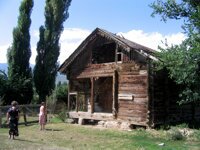
Now, Svetly Mys is famous for another reason, not just because it was the home of Irakily, the Kyrgyz Saint, but also because it may well have been the place where the Evangelist, Saint Matthew, was buried.
Having been a tax collector, Matthew was called to be a disciple of Jesus. According to tradition, he later wrote the Gospel of Saint Matthew for his fellow countrymen in Palestine – but about the time of the persecution of Herod Agrippa in AD42, he left for other lands. Of his subsequent life and career we have only inaccurate or legendary information. Ancient writers are far from unanimous about his travels, but almost all mention the land of Ethiopia – South of the Caspian Sea, not the one in Africa! – and some mention Persia, the kingdom of the Parthians, Macedonia, and Syria. There is little information about his death and at least one author maintains that he did not die as a martyr – although others disagree. Is it possible that he made it as far into Central Asia as Issyk Kul – and died here(?)
In 1875 the famous Russian explorer found a Catalan map dated 1375 on which the cartographer had marked “Issicol” and added the note: “Here is the cloister of Armenian brothers – Nestorians, body of Holy Matfey, Apostle and evangelist, is placed here”.
It is thought that he arrived in Kyrgyzstan on his way to India.
Whether he is buried here, or not, this site has attracted pilgrims for centuries, and it is thought that various religious communities (Nestorian, Armenian, Orthodox) have been based here.
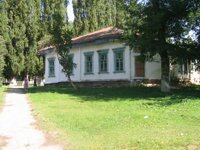
In 1888 the Tsar ordered that an orthodox monastery be founded here – some of the wooden buildings still remain – and the roads were set out in the form of an orthodox cross. In the uprising of 1916 the monastery was attacked and most of the monks were killed. One of the icons of the Virgin Mary was said to have shed tears and blood – and was later placed in the cathedral church in Karakol, where it can still be seen.
The site has recently been the subject of archaeological investigation, including the use of “underground radar” – allowing scientists to see objects buried deep in the ground. A network of catacombs and caves has been discovered under the cloister. Plans are already afoot for a film and book about the Apostle, and the excavations.




 Bishkek