Guide books go out of date
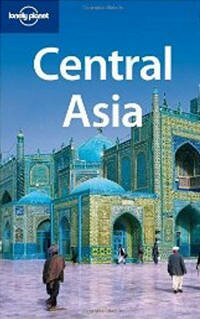
A couple of days ago the postwoman arrived and plonked a small packet onto my desk.
Now, we don’t get that much post, so it there is usually a sense of excitement when we do get a letter. Usually it is a formal notification of something, like a summons to appear in court as a witness … in which case it will be in a small envelope and be Recorded Delivery – requiring a signature as proof that it has been delivered.
This time, however, it was clearly a small packet rather than a small envelope, addressed to me in English, and so I had an idea of what the packet contained before I opened it. Sure enough, there inside was a copy of the latest edition of the Lonely Planet Guide to Central Asia.
This is the fifth edition of the book, published in 2010. In the past the arrival of such a packet would have been greeted with great excitement and anticipation. In fact, we had already seen a copy of it because one of our clients was clutching their copy a couple of weeks ago, (they must have bought it in the first few days after publication), so instead of putting all else aside and devouring every word, I simply scanned a few sections to see if there was anything particularly new, and then passed it to Svetlana to review.
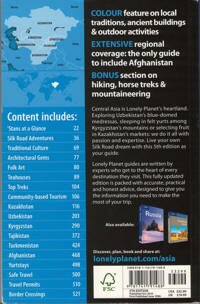
I well remember when the first edition was published back in 1996. At that time there was very little information published about Central Asia, and Kyrgyzstan in particular, as the region had only recently opened up to tourism after seventy years as a Soviet backwater. The publication even made front page news here in Bishkek, and the fact that the frontispiece carried a illustration from the Herzen lithographs of the Manas epic, immediately won over the Kyrgyz public who received the publication with acclaim.
As new editions emerged, however, the excitement has been more subdued.
Of course, everyone – well almost everyone – wants to meet the author when he comes and does his research, hoping for a good mention … forgetting the fact that book runs to almost 600 pages, only about 170 of which are dedicated to Kyrgyzstan – and the most that will be written about any one firm or establishment is likely to only three of four lines. A mention, however, means that people visiting the country may have, at least, heard of you … and not just pass you by because they didn’t know you were there.
One of things I noticed on my quick scan was the on inside of the front cover: under the heading “Quick Reference”, the first section was entitled “How to use this book“. That’s a good start I thought, but unfortunately it did not include what I consider to be the most important point … what I call the “health warning”: “This book is a guide – not a Bible, nor a handbook … things change and may well have changed since our author visited the destination to do their research.”
I have written before about some of the problems of such guide books … especially the fact that they go out of date so quickly – in fact they are probably out of date the day they go to print, yet alone the day they are actually published. This was one of the major criticisms of that first edition and, unfortunately, this one hasn’t escaped that fate … for example, two of the restaurants that it lists in Bishkek have already closed their doors.
Another problem is that a guide book is always the product of one person’s experience. The role, attitude and approach of the author can be critical for travellers making their plans to visit far away places about which they have little, or no, knowledge. In the first edition, for example, Michael King reports that he had heard of Ece Naryn, but hadn’t had the time to visit it and so couldn’t comment. At least he was up front about it, and did give the place a mention, but it does raise the question of how many other places worth a mention missed out simply because the author didn’t have the time available to do the research – or the hotel owner just happened to be out on the day they called to see if they could have a look around. Michael Kohn, who wrote the Kyrgyzstan section for this edition, did at least visit the country, spent some considerable time here and did his utmost to visit as much of the country as possible in the time that he had available – and even revisiting some places where he felt that it was appropriate to get the necessary detailed information. There are stories of less scrupulous authors.
Now there are some people who love the Lonely Planet (LP) books and there are those who think they are overrated. I don’t think that I fit into either category, They are are useful if you remember that they are, and if you use them as, guides and not treat them Bibles. They are useful for research but they are not handbooks. They give information and advice, but they are not infallible.
It’s also important to remember who these guides are aimed at – who are the intended readers. Originally they were not necessarily for everyone but were really aimed at independent travellers. That’s not to say, however, that the information wasn’t, and isn’t, useful for those who decide on taking a package tour especially as they have now broadened their horizons to reach a wider audience.
LP was established by Tony and Maureen Wheeler over thirty years ago. For their honeymoon they undertook a trip that, at time, few people thought was possible – a trip from London, overland across Europe and Asia to Australia. They made it, but it took all their resources and at the end of it they were “flat broke”. As the official LP account puts it: “It was too amazing an experience to keep to themselves. Urged on by their friends, they stayed up nights at their kitchen table writing, typing and stapling together their very first travel guide, Across Asia on the Cheap. Within a week they’d sold 1500 copies and Lonely Planet was born. Two years later, their second journey led to South-East Asia on a shoestring, which led to books on Nepal, Australia, Africa, and India, which led to… you get the picture.”
It will be interesting to see how the current rise in popularity of social media, with its ever increasing functionality and capability for instant updates, will impact on the more traditional media of guide books such as those that Lonely Planet produces. I am not convinced that the predictions that the days of the bulky printed guide book are numbered, but I do think that their publishers have new and exciting challenges to face up to and to meet.
LP, long ago, took on these challenges, in particular with the introduction of their “thorn tree”. The empire now runs to over 500 books … but it’s not just books as there are websites, blogs, newsletters, magazines, social media, TV … and so on. Their arrangement with the BBC (British Broadcasting Corporation – in 2007, BBC Worldwide, the main commercial arm and a wholly owned subsidiary of the BBC, took a 75% stake in Lonely Planet), gives them another outlet for their material.
Even with all these qualifications, I am glad to see and I welcome the publication of this new edition. In my opinion, although there is a lot of information about Kyrgyzstan available for those who are interested in the country, it is not always in a readily available and recognizable format and one thing in particular that Lonely Planet has, is its name which well known, easily recognizable, has a well established track record and is, (generally), trusted as independent and reliable – at least up to a point.


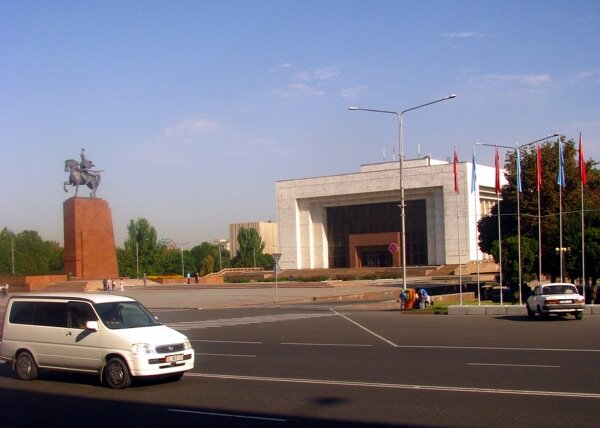




 Bishkek