Transparency
The word of the week for this week seems to be “Transparency”.
This is the result of two international reports that have been issued: The Open budget survey issued by the International Budget Partnership and the Corruption Perceptions Index issued by Transparency International.
The word “Transparent” can have several meanings. The obvious one is that you can see through something, but it also means that something is obvious, open, frank or candid, or that something operates in such a way that it is not perceived by users – and in a social sciences it is used to convey openness, communication, and accountability.
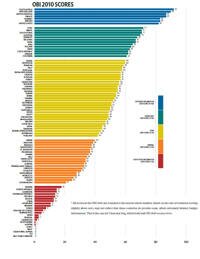
Last week I mentioned that Kyrgyzstan had apparently occupied the bottom place, (along with Cambodia), in an international survey into Budget Transparency, and this seems to have ruffled a few feathers here in Bishkek. So much so that on Tuesday there was a Press Conference when a spokesman for the Ministry of Finance apparently stated that “Statements that Kyrgyzstan ranks one of the last places according to the budget transparency index are incorrect and biased …”.
Now I wasn’t at the press conference, but the news reports went on to point out that Kyrgyzstan had improved its ratings score, almost doubling it from a mere 8 to 15; that Kyrgyzstan has only just started to cooperate with the organization that operates the survey; that it is one of only to Central Asian countries that participated in the survey and that the Ministry of Finance has done much in the recent past to address the issue of Budgetary Transparency.
Now, that all may be true, but I wasn’t sure how it justified the conclusion that the “statements that Kyrgyzstan ranks one of the last places according to the budget transparency index are incorrect and biased” … but we’ll let that pass, shall we? It is possible that the spokesman said more and the reporters just omitted the details.
It happens!
For example, when the initial news reports emerged the headline news was that Kyrgyzstan was at the bottom of the table – but some important details were missing. We weren’t told, for example,
- that there only 94 countries assessed (an that includes several Central Asian countries), or
- that the average score of those 94 countries was only 42 out of 100. Now, whilst it is true that 42 is a lot higher than the score of 15 that Kyrgyzstan apparently was apparently given, it is still considered to be “far less than what is required to obtain a clear understanding of the budget and to provide a check on the executive.” Indeed, only 20 of the 94 countries had scores which indicated that the government published adequate data to enable citizens “to develop a comprehensive analysis and understanding of their national budgets”.
Neither did they highlight the fact that according to the report, changes in scores between 2006 and 2010, “significant improvements are happening” – for example, Kyrgyzstan managed to almost double it’s score – although Afghanistan, (who don’t even publish their budget proposals), managed to increase their score by two and a half times, Angola managed to increase theirs by a factor of six, and Rwanda – elevenfold.
Most important of all … it wasn’t made clear – at least not to me – that Kyrgyzstan did not actually come bottom of the table. In fact, there were nineteen countries that scored less than Kyrgyzstan and Cambodia – including five that apparently scored zero. (Three seem to have scored an “absolute” zero, whereas two scored less than half a point which were then rounded down to zero.)
It seems to me that, maybe, the spokesman from the Ministry of Finance, even if he overstated the case, may have had a point.
I only discovered all of this because I was more than just a bit confused by the reports, and so I went and had a look at the report. In fact I found it and the website, (http://www.internationalbudget.org), although I was still left with a lot of questions.
To begin with, I wasn’t sure what the authors meant by “Budgetary Transparency” but apparently the survey assesses:
- the availability in each country of eight key budget documents: Pre-Budget Statement, Executive’s Budget Proposal, Enacted Budget, In-Year Reports, Mid-Year Review, Year-End Report, Audit Report and a Citizens Budget – interestingly, apparently not one of the 94 countries publishes all eight.
- the comprehensiveness of the data contained in these documents,
- the extent of effective oversight provided by legislatures and supreme audit institutions, and
- the opportunities available to the public to participate in national budget decision-making processes.
In conducting the survey, a questionnaire completed by independent budget experts, (who are not associated with the national government) which is then independently reviewed by two other, anonymous, experts who also have no association to government. During the analysis of the data, scores are assigned to certain Open Budget Survey questions are used to compile an objective scores for each country’s relative transparency – which are then ranked.
As I said, I am still left with a lot of questions. I do know that a lot of information is published about the state budget and the budgetary process – even if it doesn’t seem to meet the survey requirements for some reason – and that committees have been set up including members of the business community to help “scrutinize” the spending of public money – but that at least one ministry has responded to questions on the topic that they are the proper body for scrutinizing and overseeing the conduct of public finances is the Accounts Chamber – the official Kyrgyz version of an Audit Commission – and so they wouldn’t answer Business Associations questions on the topic of how public funds were spent.
The second report is the annual Corruption Perceptions Index issued by Transparency International.
The survey has been carried every year since 1995, the organization Transparency International has conducted surveys to asses the extent of corruption around the world. The Corruption Perception Index (CPI) is a benchmark which combines the results from a number of different surveys, (in 2010 there were 13 such components), to obtain a Index of how corrupt a country is perceived as being. A score of 10 represents a “highly clean” society whereas a score of 0 indicates a highly corrupt one. In some countries, it not possible to apply all the surveys and so a minimum of three is required for the country to be included in the annual survey’s published results. For several years the Kyrgyz Republic were omitted from the table of rankings, but in 2005 the country occupied joint 130th place in the CPI with a “score” of 2.3, (on a basis of 5 surveys) along with Burundi, Cambodia, The Republic of Congo, Papua New Guinea and Venezuela. Although this represented a slight improvement on the score obtained in 2004, (2.2), the country slipped from joint 122nd place in the overall table of rankings.
In this year’s survey Kyrgyzstan occupied the 164th place, out of 178 countries, (together with the Democratic Republic of Congo, Guinea and Venezuela), with an overall score of 2, (on a scale of 0 to 10).
This is almost the same as in previous years and shows that little seems to have changed over the years.
The report comments that: “With such level and volumes of corruption, Kyrgyzstan cannot progress, can make neither economic, nor scientific, nor technological, nor social breakthrough. Corruption, remaining as it is now, will continue eating up the resources that could be invested in the future of the country.”
It also comments: “This year has become a year of a serious test for Kyrgyzstan. The country is at the transitional stage, and everybody perceives the complicacy of the task before Kyrgyzstan, when the counteraction to corruption in the country should be not one of the regular reforms, but a real war for the present and the future, … society has already made its choice. Now it is highly important that the Kyrgyz state institutions, certain officials, law enforcement bodies, judges and prosecutors realize whose side they are on: on the side of Kyrgyzstan or on the side of their personal interests.”
As an aside: the report also points out that about three quarters of the countries included in the survey scored less than 5 points, which indicates the serious of the problem on a worldwide scale.

|
Now, There are many definitions of the word “corruption”. To many people, the word is synonymous with “bribery”, but in fact this is only one aspect of corruption. Corruption can involves doing something, (or not doing something), with a view to private gain – especially using a public office to influence events in favour of one party in return for some advantage – not necessarily financial.
Corruption can take several forms, such as: the public official (traffic policeman, tax inspector, etc.) pretending to find an infringement of some rule (which is not necessarily that difficult given the way some laws and regulations are phrased) and then accepting a payment (bribe) to overlook the offence; or the public official expecting, (demanding), and accepting payment for signing a particular document (license, permission, etc.), or to decide a question in favour of the person making the payment; the official who uses information gathered in the course of his employment for other purposes; the official using the power and prestige of their office to obtain favours, property etc. that would not others be given to them … and so on.
There is a general impression that corruption is rife in Kyrgyzstan. An article on the subject in one of the local (government), newspapers, (Slovo Kyrgyzstana – the Word of Kyrgyzstan), ran under the headline “When was the last time you took a bribe?, … or paid one?” It has been said that court decisions can be bought, that official posts (tax and customs posts, even governors of oblasts) are “sold” by those in authority. It was allegations such as these, amongst other things, which helped to bring the regime of President Akaev into disrepute and led to the Tulip Revolution which overthrew his government in 2005 – and also to the demise of President Bakiev in 2010.
As it happens, there have been other surveys and attempts to identify the scale of corruption in the country. For example, several non-governmental organizations have organized various activities and surveys within the country. A World Bank report issued in 2006 found that corruption had increased in the period 2002-2005. About half the firms surveyed said that bribes were common.
Measures being undertaken to combat corruption – especially in public life. Public officials – and members of their immediate family – have to report on the level and sources of their income. Laws are in place under which officials who act inappropriately to their official duties can be prosecuted – but the World Bank survey reported that there had been no such prosecutions – although there have been some very high ranking cases and Feliks Kulov was convicted and imprisoned for corruption but when he became the Prime Minister, the conviction was quashed. The local press sometimes reports cases being investigated and individuals either resigning or being dismissed.
The emphasis, however, seems to have been on establishing a legal framework rather than the implementation of measures to combat corruption. However, in 2006 a new “coalition” against corruption was established by the government and a number of Associations have joined with it, committing themselves to providing information, running information and educational campaigns and other measures.





 Bishkek