No news is good news … or is it?
Those of you that know me will know that one of my favourite pastimes used to be playing “Trivial Pursuits”. I have that sort of mind that “collects” trivia … I loved the Geography questions but I also enjoyed History ones as well.
Although I am interested in History, my knowledge of the subject is fairly limited and episodic. At school, although we spent about six weeks looking at the opening of the American West, (and the only thing I remember about that is having to write an essay about the Louisiana Purchase – I have no idea what I wrote), this was very much the exception and virtually all of our lessons were really about British history – and by British, I mean the history of England. What’s more we basically stopped at the Glorious Revolution of 1668, (otherwise known as the Bloodless Revolution), when King James II was overthrown in favour of of William and Mary
James I of England, (and Sixth of Scotland), came within the period but, to be honest, I was never really keen on him – he always struck me as a somewhat dour person. It came as a surprise, however, when I recently discovered that it is thought that he originated the phrase, “No news is good news“, back in 1616. (What he actually wrote – although the spelling was different – was “No news is better than evil news“. Something closer to the modern phrase appeared in James Howell’s ‘Familiar Letters’ sometime around 1645: ‘I am of the Italians mind that said ‘no news, good news‘.”)
I am not sure why he wrote it, what the circumstances were that led to this historic epithet, but there is an anecdote that he was particularly annoyed with the court jester who loved to make puns, so much so that the king, in disgust, ordered him hanged. But one of the king’s ministers prevailed on him to grant the joker a reprieve. Upon learning about this, the joker immediately said, “Well, no noose is good noose.” So the king decided to hang him anyway.
The situation we are in at the moment feels like a case of: “no news” … the Election Commission is still busy verifying the returns from the polling stations and has yet to announce the results of the election almost three weeks after it took place.
To be fair, it’s not really a case of “no news” – there has been some snippets of news dribbling out from various sources, official and unofficial. Rather it’s been a case of “no results”.
The Election Commission have identified a number of problems with the protocols – mainly to do with the “additional lists” of voters who weren’t on the original electoral roll but were supposed to provide proof of their residence of the district in order to be allowed to vote – and they are blaming the fact that they have to deal with these for the delay. The results from several polling stations abroad have also been declared invalid. They hope to have definitive results ready by the end of the week – but weren’t making any promises – as they are still considering the multitude of complaints received after the election. At the time of writing this, however, there was still no sign of an official announcement. Maybe it will come over the weekend.
The Parliament is supposed to gather and begin its work at the start of next week.
Even if it were a case of “no news”, I’m not sure that means it is a case of “good news” in that it hasn’t helped ease tensions. The Financial Times put it like this: “Kyrgyzstan was braced for more unrest …”
One of the parties is talking about suing the Chairman of the commission and several have been planning to hold protest meetings. I say “planning” because although some have been held, other have been cancelled. Those that have taken place have been quiet and peaceful – well, compared to what we’ve witnessed in recent times – possibly because there have been lots of police in evidence. All the police on on “High Alert” according to one announcement – and I spoke to the uchiskovic – the local “beat officer” – who said that he hadn’t had a day off for some time and had, in fact, spent over a month down in the South.
Some of the rallies have been in support of Kamchibek Tashiev, the leader of Ata Jurt whose home was attacked over the weekend – and who apparently injured in the incident. What has really upset the applecart is that during the melee his security people managed to wrestle some weapons from the assailants, and an identity card from a senior officer in the State Security Service – the SNB, (who are still often referred to by their former name: the KGB). The security services claim that they had been conducting anti-drugs raids in the area and one spilled over into this incident. At the moment it is all as “clear as mud”.
(Incidentally, it has been announced that the security services have recently dismissed some 50 employees for a variety of infringements or offences.)
Since the beginning of the year we’ve seen over 200 rallies and pickets – that’s almost one a day. The residents of Bishkek in particular are expressing complaints about the number and frequency of meetings and rallies.
Adding to the tensions and uncertainties is the fact that several cases have been sent to court involving members of the Bakiev entourage concerning economic crimes. One of the banks closely associated with the Bakiev family has filed for bankruptcy with losses of over four and a half billion som (about one hundred million dollars – it is claimed that the family managed to withdraw over two hundred million dollars from the bank back in April). The cases against some of the people accused of being involved in inciting various riots continue and Bakiev has been accused of being behind the killing of six protesters in the Aksu incident back in 2002, when he was Prime Minister.
Despite all of this, the authorities are making comments that they don’t expect any “disruptions”. Hmmm – no comment.
There has been some news elsewhere, but it hasn’t been particularly good – especially when it comes to surveys.
I mentioned last week that that Kyrgyzstan had apparently occupied the bottom place, (along with Cambodia), in an international survey into Budget Transparency, and this seems to have ruffled a few feathers here in Bishkek. So much so that on Tuesday there was a Press Conference when a spokesman for the Ministry of Finance apparently stated that “Statements that Kyrgyzstan ranks one of the last places according to the budget transparency index are incorrect and biased …”. Now I wasn’t at the press conference, but the news reports did go on to point out that Kyrgyzstan had improved its ratings score, almost doubling it from a mere 8 to 15; that Kyrgyzstan has only just started to cooperate with the organization that operates the survey; that it is one of only to Central Asian countries that participated in the survey and that the Ministry of Finance has done much in the recent past to address the issue of Budgetary Transparency. Now, that all may be true, but I wasn’t sure how it justified the conclusion that the “statements that Kyrgyzstan ranks one of the last places according to the budget transparency index are incorrect and biased”, so I went and had a look – and I think, even if he overstated his case, (I don’t know – I wasn’t there), he may have had a point.
Then, during the week, Transparency International issued it’s annual “Corruption Perceptions Index” in which Kyrgyzstan scored a mere 2 out of 10 – indicating a high level of corruption – and occupied the 164th place, out of 178 countries, (together with the Democratic Republic of Congo, Guinea and Venezuela). This is almost the same as in previous years and shows that little seems to have changed over the years. The report commented that: “With such level and volumes of corruption, Kyrgyzstan cannot progress, can make neither economic, nor scientific, nor technological, nor social breakthrough. Corruption, remaining as it is now, will continue eating up the resources that could be invested in the future of the country.“ It also said: “This year has become a year of a serious test for Kyrgyzstan. The country is at the transitional stage, and everybody perceives the complicacy of the task before Kyrgyzstan, when the counteraction to corruption in the country should be not one of the regular reforms, but a real war for the present and the future, … society has already made its choice. Now it is highly important that the Kyrgyz state institutions, certain officials, law enforcement bodies, judges and prosecutors realize whose side they are on: on the side of Kyrgyzstan or on the side of their personal interests.”
Last year Kyrgyzstan amazed practically everyone when it emerged in the World Bank’s “Doing Business” Survey as one of the best countries in terms of making improvements in the business environment, catapulting itself from way down the rankings into the top 50 countries. It’s probably the only time Kyrgyzstan has done really well in such an international survey. At the time, I remember, I wasn’t that impressed. It is true that several initiatives had been undertaken with a view to improving the country’s position in the ratings – but I wasn’t sure how important it really was or what difference these initiatives would make in reality. as There are many such surveys and at roughly the same time as this impressive result was being announced we were told that Kyrgyzstan had still performed badly in the Competitiveness Index. I was taken aback, therefore, when I was told by a friend in the mining industry a few months later, that potential investors were interested in the results. He’ll be a bit disappointed this week, however, as one particular piece of news that emerged during the week was an announcement that the problems the country has been experiencing is discouraging potential investors from investing in the mining industry. How surprising!
Despite that, however, there are some encouraging signs concerning, in particular: a large cable factory; in the railway from Kashgar in China through Kyrgyzstan into Tajikistan and Uzbekistan and developments in the mobile telephone market. President Otunbaeva has met with investors representing various groups - notably the Japanese and given assurances that the government are doing their utmost to ensure stability for investors … whilst other members of the government have been speaking of “grand plans” to develop Kyrgyzstan’s export capabilities and talking of road construction projects. We’ll see.
Perhaps the highlight of my week came on Tuesday. It was the regular, monthly, open meeting of the International Business Council, (IBC). I can’t say that I was particularly looking towards this particular meeting as I didn’t think that the subject was particularly inspiring: “Kyrgyzstan and the Customs Union”. As it turned out, however, I felt that it was one of the best public meetings that we have had for some time. At first I had been dismayed to see so many speakers listed on the agenda but, as it turned out, this wasn’t a problem. The initial speeches were short(ish), to the point and surprisingly detailed. The main speakers were well prepared – too well prepared for they had far too much material to present in the time available and the chairman had to interrupt two of the speakers and ask them to cut their presentations short. In a way, I was reminded about the debate in Britain back in the 1960′s and 70′s about whether we should give up our “little islander” ways and join the Common Market – as we then called what is now the European Community. Apart from the language difference, (Russian as opposed from English), I felt that I could have just emerged from Dr. Who’s Tardis into a rally for the referendum.
The results of that particular plebiscite were finalized and published within a matter of days. We didn’t spend three weeks waiting for news of the final, definitive, official result.
As I said, I am not sure that in this case – “no news” really does mean “good news”. I tend to side with that dour Scot who found himself on the English throne back in 1603 – “no news is better than evil news”. Let’s hope and trust that when the news is finally announced, that it will eventually be “good news”.


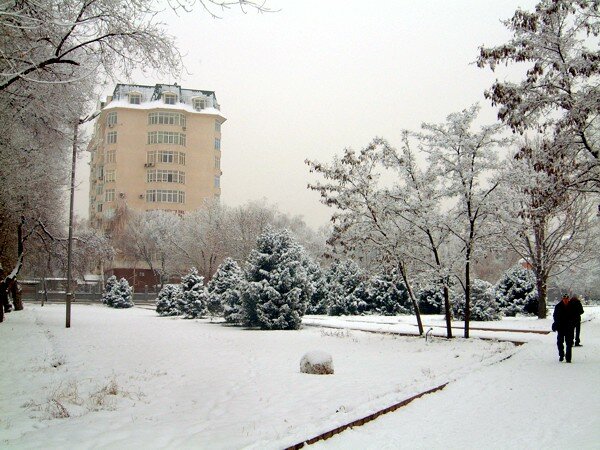

 Bishkek
Unlucky jester!