Accepting Repsonsibility

Hey, face up and accept responsibility!
The theme for Travel Talk on Twitter, (#TTOT), this week was Responsible Tourism.
I have mentioned TTOT before – it was organized by a number of people connected with tourism to enable people to hold “conversations” on Twitter. Twice a day on Tuesdays, (at 3pm and 9pm GMT – twice so that they can reach all parts of the world, no matter time zone people are in). It takes a question and answer format – each week they announce a theme for the next session and people are invited to submit questions … five are chosen and during the hour, at ten minute intervals, one gets posted and then they sit back and wait for the replies …
It can be quite an interesting time … and it’s surprising what comes up from time to time … hints and suggestions, little stories, photos, links to appropriate sites and so on.
Anyway, as I said, this week’s theme was Responsible Tourism – and the five questions chosen for discussion were:
- Q1. What are your best tips for being a responsible traveller?
- Q2. What extra precautions do you take while traveling abroad?
- Q3. What is your best responsible travel experience and why?
- Q4. What do you research about a country before travelling there to ensure you travel responsibly?
- Q5. How has a holiday inspired you to make a difference to the lives of people where you visited?

The logo for the “Responsible Tourism – Buy it” campaign
For the record: The term Responsible Tourism is not like most of the others you come across in Tourism, (such as Adventure Tourism, Beach Tourism, Community Based Tourism, Cultural Tourism, Disaster Tourism, EcoTourism, Educational Tourism, Health Tourism, Historical Tourism, Mass Tourism, Medical Tourism, Mountain Tourism, Recreational Tourism, Religious Tourism, Space Tourism, Sports Tourism, Sustainable Tourism, Winter Tourism … and the list goes on … and on … and …), which tend to describe a niche in the market – a market segment – or a trend in the industry … in other words they tend to be about the “product”.
Responsible Tourism, on the other hand, is all about the people, (be it the tourists themselves, those in the industry from the travel agent, tour operator, local businesses and service providers), their attitudes and behaviour and emphasizes behaving in a responsible way.
This, of course, begs a question … what do we mean by “responsibly”?, different people, different groups will interpret it differently – indeed, some pundits suggest that different my be appropriate in different contexts – in different locations with different communities.
Generally, Responsible Tourism is understood as creating better places … “better places for people to live in, and better places to visit”.
It is sometime referred to as “guilt free tourism“, because it aims to provide an enjoyable experience for the tourist, whilst both maximizing the positive aspects that tourism can bring to the local community but also minimizing the negative ones.
On the positive side: deepening their understanding of local cultures and environments, especially through interaction with local people and communities; increasing the benefits of tourism to those local communities – paying fair prices, and providing local communities with much needed income which will help to improving working conditions and their quality of life; allowing and facilitating the involvement of members of the local communities in decisions that will affect their livelihoods and well being.
On the negative side; impacts, (economic, environmental or social), which the development of tourism might bring – for example by making positive contributions to local or global initiative at, say, preserving the environment – for example, on the local scale, by supporting a local charity or, on the global scale, by calculating and attempting to minimize the carbon footprint, by buying local produce rather than imported … and so on.
There’s a lot more to say about this … and I had it penciled in my diary as a possible theme for a postcard in November – when there is going to be another Responsible Tourism Day at the World Travel Market trade exhibition in London – the second largest such exhibition in the world.
However, several things occurred this have week that have brought the whole question of accepting responsibility to the forefront of my mind.
The first was that second question on TTOT – “What extra precautions do you take while traveling abroad?” It wasn’t the question itself but one of the replies … “‘precautions’ – I didn’t even know how to spell that word until a few minutes ago.” No doubt the author was attempting to be humourous … but it struck me that it highlighted a sad fact … that many (most?, all?) people often act without thinking – heedless to the possible effect or consequences of their actions.
.
The second was an article published the same day on the website of the British Foreign and Commonwealth Office (FCO) which underlined this fact: a press release entitled: Young Brits putting family finances at risk overseas. The aim was to remind young people of the importance of taking out travel insurance – pointing out that “travelling abroad uninsured can cost thousands if a trip goes wrong”. Of course, everyone hopes that nothing will go wrong – and, of course, if that hope is fulfilled, (as, indeed, it is for the vast majority of travelers), then it is easy to think of the money spent on the policy as being being wasted – or, as they say here a case of “dengi na veter“, casting money into the wind.
The trouble is that, sometimes something does go wrong – and the consequences can be crippling – financially if not physically … but possibly, unfortunately, both financially and physically.
Young people were being targeted by thin campaign because research has shown that more than a third of young people don’t bother to take out travel insurance … I am sure some of them don’t bother because they haven’t thought about it, or even heard about it, and some of them may have been deterred because they see it as an additional unwanted cost … “dengi na veter” – but over half of them saying that they were simply “willing to take the risk”.
As the article pointed out, however, medical costs incurred abroad resulting from an accident can be significant … maybe running into thousands of pounds … and lead to a substantial bill that has to be paid later … contrary to what they may think, the costs are not going to be met by their government nor will their national health scheme cover them abroad in the same way as at home … neither of these commonly held expectations is true … and in some cases, the report said (admittedly it did say that they were “extreme cases”) that families have “had to sell their home” in order to pay the bills.
Silly when it is relatively easy and comparatively cheap to get cover … as the FCO used to put it on their website: “If you can’t afford the insurance – you can’t afford to go.”
.
Then there was an incident at work … someone made a mistake – it was a very simple, (if stupid), mistake and one that was understandable and easily made, (but, likewise, one that should have been easily avoidable). Fortunately, thanks to someone’s quick thinking, the results were not serious … although they could have been.
When I heard about it three days later … I was confused. I received a phone call from a client who was, unusually for them, a little curt – asking what seemed to be inexplicable questions until, eventually, the story unfolded and I began to get a picture of what had happened – not a complete compicture, nor an explanations of why it had happened …
I felt a flood of emotions – confusion, embarrassment, anger …
One of the reasons I felt so emotional was that this was the first I was hearing about it … some three days after the event! I can understand why someone didn’t want to disturb me early on a Saturday morning when the mistake first came to light … but we are a tour company with hotels and as a result we work 24/7/365 – and, anyway, there was always the rest of the day. I can also understand (perhaps) that as Sunday is a non-working day nobody wanted to disturb me … but – well, it’s the same as above: 24/7/365 and so on … and, anyway, isn’t it something that I ought to be told? What I found most galling was that nobody told me on Monday morning either … even though I had seen and spoken with the person responsible for the mistake.
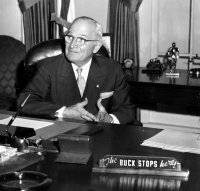
Harry Truman poses for a photograph at the recreation of the Truman Oval Office at the Truman Library in 1959.
As I explained to him when debriefing him about what had happened, and why, was that we couldn’t alter the past … the mistake was simple one, easy to understand (but a stupid one – and easily avoidable – all of which he admitted) … but it had happened and so the least that I could do, (MUST do), was to apologize and compensate the client for any losses and inconvenience that OUR mistake had caused them. WE had to take responsibility for OUR actions and OUR mistakes – both him and me … he was, after all working for me and as the placard on President Harry S. Truman’s desk put it” “The Buck Stops Here“.
We are, after all, happy enough to take the credit (and rewards) when things go well … so we must be prepared to accept the responsibility (and consequences) when things things don’t go well – especially if it is down to our mistake.
.
There was an awful lot more in that conversation … but the important thing in respect to this postcard was the importance of accepting responsibility.
The problem that I saw then, as I have seen several times in other circumstances, is that nobody wants to admit to a mistake …
- it could be damaged pride, (no-one wants to admit that they are less than perfect);
- it could be a case that they were embarrassed, (it was a pretty stupid mistake);
- it could have been because he thought he had “got away with it”, (although, as I pointed out, it is almost impossible to keep a secret and it was only reasonable to expect that the client would complain); or
- it could have been fear of reprisals, (would I, for example, sack him? – and I must admit that it did cross my mind – but not so much for the original mistake [which was simple and easily understandable - albeit stupid] but more for the fact that he hadn’t accepted responsibility for his actions).
.
It’s one of the things I keep to trying to tell the kids … for example, if you break something, tell me up-front, don’t try to hide it away or wait for me to find out. By owning up you:
- show that you are a responsible person – albeit someone who is fallible – Hey, who isn’t?
- show that you are honest and have integrity – especially if don’t try to squirm out of the responsibility and shift the blame … I always think this should be a couplet from Rudyard Kipling’s If :- If you can admit your mistakes and accept responsibility without trying to shift the blame …;
- stop the problem from “blowing up in your face” at some unpredictable time in the future – you just can’t expect to keep everything secret;
- stop the problem from growing and becoming unmanageable;
- earn the respect of others (unless, I suppose, you make a habit of it) and strengthen your relationship with them;
- gain the opportunity of learning from your mistake … one of the best, most effective, ways of learning any lesson;
- may become part of the solution as well as, or instead of simply, being the cause of the problem;
- “clear the air”, enabling everyone to “move on”.





 Bishkek