Small talk

Small talk
I was talking with someone the other day and the topic of conversation turned to the differences between trying to do business here and in the west.
For example, the tendency here for things to happen “at the drop of the hat” … and at very fast pace. Even of something like an event or festival has been in the planning for months, unless you are in on the planning, you only really get to hear about it about it at the last moment.
On a more mundane level, People often drop into the office to see me and, true to Asian Custom and Practice, I have to stop what I am doing and spend time “shooting the breeze” with them … wondering if this is simply a social call or if there is a serious business item on the agenda.
Andy, for example, will often call me and ask, “What are you doing now?, do you have time?”, and experience has taught me that this probably means he is sitting in a coffee shop with Calvin or one of his other friends and he wants me to join them. Sometimes it is a case of, “OK - where are you?” but more often than not I breach local tradition and say, “sorry, I am busy at the moment.”
On one particular occasion, shortly after I arrived here, someone telephoned me in the office and I was in the middle of doing something – I forget exactly what, but I do remember that involved some complicated spreadsheet calculations which required my complete concentration. He wasn’t calling about anything particularly important, and I remember that my answers to his comments and questions were obviously vague and distracted because he asked : “Sorry, am I disturbing you?” and when I replied “Actually, I am quite busy at the moment” he curtly drew the conversation to a close and hung up. One of my colleagues in the office, who had heard only my side of the conversation, looked at me askance and with horror … “What’s wrong I asked?, that wasn’t rude was it?” … “Actually, it as … a little” he said. Knowing his penchant for understatement I took the hint and made a note to myself to try and find a better way of drawing the conversation to a close in future.
Here in Asia, it is considered important for people to spend time “socializing”, getting to know each other better and either building or strengthening a personal relationship, (and personal relationships are very important here); showing respect for each other, their experience and opinions; only turning to the main business at, as it were, the eleventh hour as a meeting is drawing to a close. Things are then are quickly resolved … at least in theory.
I remember one particular occasion, a few years ago, when I was facing a difficult problem … a bureaucratic issue which looked as if it would be a barrier to further progress on a particular planned project.
Even though the regulations looked as if we stood much chance of achieving our our aim, we decided that the only approach that stood much chance of success was for me to go to the relevant Ministry and see if we could talk through the dilemma in order to find a solution. The guy we met with was a functionary, not at the top of the ladder but one with sufficient authority to make a decision, give instructions to other functionaries if that would help us resolve the issue, or tell us what steps we had to take in order to do so.
We sat for an hour … (I presume it was a slow day in his office) … the first fifty minutes of which were taken up with a general discussion about tourism and how it could be developed. It was only in the last five minutes that we turned to the reason for my visit. I outlined, as briefly as possible, the background to the situation, the stumbling block that we had come across, and asked for his advice about the regulations and the next step we should take.
That was probably the “worst” example I have encountered … fifty minutes of small talk … and although he advised us on what we could do next, he couldn’t offer any guarantees – his hands were tied by the regulations, which were such that we were unlikely to be able to achieve our desired aim … which we sort of knew already.
Even though the meeting could be considered a failure in that we didn’t get what we wanted, in another way it was a resounding success. We met and talked … we got to know each other and built a relationship which helped us understand each other and that we were not “enemies”.
All this time spent on “small talk” can be frustrating – especially for me as I am not good at small talk. To be fair, we do it in the West as well, but the small talk only takes a few minutes whereas here it can take up the bulk of a meeting and seem as if it is the main topic of business. The actual business appears almost incidental.
In a “networking” situation, it is sometimes interesting to see how some people “work the room”, handing out their business card to a new acquaintance and then spend time chatting before saying something that can easily be interpreted as “sorry, got to go …” as they reach for their business cards and move on to the next encounter, having given you their five minutes to impress them, and for them to impress you.
Even if a meeting has an Agenda, with timing allocated to particular topics, that timetable can be easily jettisoned. It may be that the discussion gets bogged down on a small point of detail, especially if someone is following their own personal “hobbyhorse”. In theory, the chairman and the “reglament” is supposed to prevent this, but it’s not always easy to tell someone that it’s time to stop talking and let someone else have a say …
As I said, it can be very frustrating.
I have a couple of colleagues and friends, (one Russian and the other Kyrgyz) who also find it frustrating – even though they are experts at it themselves when they consider it appropriate. They will ask, “what is it we are supposed to be discussing?”, call for the reglament to be adhered to and will shamelessly call on the speaker to “get to the point”.
As well as having a problem with “small talk” in itself, I always have a problem judging when it is time to draw it to a close and get down to business at hand, and the best way to do it.


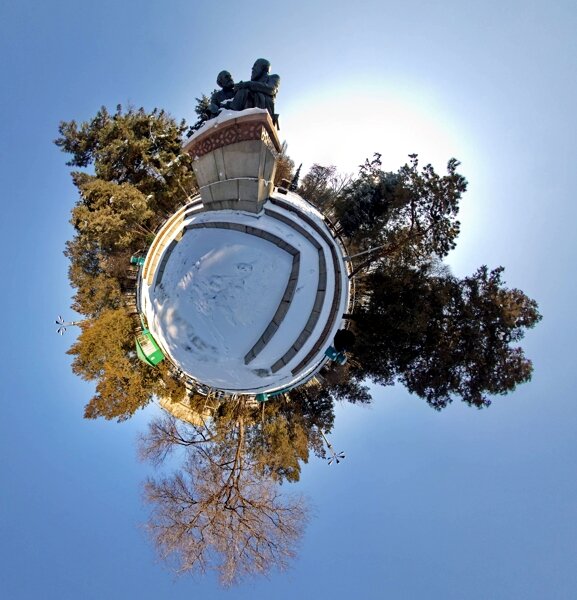


 Bishkek