Take a minute to think of the plight of refugees …
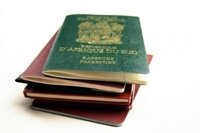
Passports – Travel Documents
I think it was back in 2001 when I first came across a “Stateless Person” …
We had been asked by one of our partners abroad to arrange a visit to Kyrgyzstan for one of their clients, and the passport details that they sent us in order to arrange the Visa and OVIR registration said:
- NAME: John Doe – OK, I admit it, I made that up for this postcard – to be honest, I can’t remember.
- CITIZENSHIP: Stateless - OK, it wasn’t in red but I did that here to make it stand out … in the same that it “jumped of the page” at me when I first saw it.
There followed the usual items personal data: Sex, Date and Place of Birth, (which, incidentally, was Frunze, USSR – which was now Bishkek, Kyrgyz Republic), and then the “passport” data: No, Dates of Issue and Expiry and Issuing authority or Place of Issue, (which, interestingly, was the Passport office of the United States).
There was no details as to why the bearer of this document was stateless … and as they had been born here in Kyrgyzstan, I was expecting some trouble when we submitted the application for a Visa. To be fair, however, the staff at the Consular Service “didn’t bat an eyelid” … they simply took the application and said to come back in a week’s time for the decision of the Commission. There was nothing unusual in that, it was the usual turn around time aback then, but I thought to myself, “that’s when we’ll have problems”. I was anticipating, if not an outright rejection, at least a further delay, (as for some countries which were designated as “Countries of Risk“, when the process normally took two weeks … but could, and often did, take longer – the worst case I ever encountered was 72 days – for a Chinese citizen.
A week later however, to my surprise, (and delight), once again, they “didn’t bat an eye-lid” but gave us the all important Reference Number to quote when applying for the visa at the Kyrgyz Embassy in Washington,
I was still worried, however, thinking “Maybe that’s where the problem will come”, but, no … to my amazement and delight I heard shortly afterwards that they had applied and got their visa … and would be arriving as planned.
So maybe the problems will come at the border, I told myself.
After all, the presence of a visa in a passport is only permission to enter the country … but it is not necessarily a guarantee. I have come across a couple of cases where people got to the Passport Control Desk at Manas Airport only to be told that they wouldn’t be allowed into the country … even though they both had valid visas and had been here before. Indeed one was a working here in Bishkek and was returning after a trip home, back to the States for a holiday. It seems that both had been placed on a “Black List” by one of the other former Soviet Republics … but the official who told them that shouldn’t have done so – they don’t have to give reasons – and they certainly weren’t going to say which of the former Soviet republics was responsible.
But … No … once again I was amazed, and delighted, when they emerged from behind the sliding doors which separates “air side” from “land side” and entered the land of the birth – if not the land of their citizenship.
I was beginning to feel a little easier now … although I couldn’t help but worry about possible problems when it came to registering with OVIR … but no, no problem, apart from having to wait in two long queues … once at the bank when we paid the fee and again at the OVIR office as we waited for our turn and we got the all important stamp in the passport … but there was nothing unusual in that – it happened all the time.
It seems that all the officials had either been well trained and were perfectly familiar with the idea of the “Stateless Passport” … otherwise known as a 1954 Convention Travel Document … which is issued by a country to a stateless person residing in it, and they could probably tell you the difference between it and a 1951 Convention travel document also known as a Refugee Travel Document or a Geneva passport) - which is issued by a state to refugees living in their country who cannot obtain a passport from their own government for one reason or another, so that they can leave and then re-enter the country … or indeed and of the other types of Travel Documents: Aliens’ Passport, Certificate of Identity, Emergency Travel Documents, Enhanced Drivers’ Licenses – although they are not valid as Travel Documents here, Laissez-passer Documents, National Identity Documents – also known here as Internal Passports, Temporary Travel Documents, UN Travel Documents or the World Passport – although,technically, they are not recognized here (despite this, on the website of the World Government of World Citizens, there is a scan of one with a Kyrgyz visa - an aberration if ever I saw one) … and so on.
Today happens to be World Refugee Day.
At the end of 2000, The United Nations General Assembly decided that 20th June every year would be commemorated as World Refugee Day, in recognition of the fiftieth anniversary of the 1951 Convention relating to the Status of Refugees. The built on measures already taken in Africa and the adoption of 20th June as African Refugee Day.
For the record: a refugee is considered to be a person residing in another country because the have suffered (or fear) persecution on such bases as as: nationality, political opinion, race, religion, or because they belong to a particular social group which such suffers such persecution in their own country, or because they are fleeing from some conflict or war. As such they are unable, or unwilling, to avail themselves of the protection of their own state.
A similar concept is that of Internally Displaced People – which can be understood as “refugees” who have not crossed an international border. For example, following the 2010 disturbances in Southern Kyrgyzstan, it was estimated that there were some 300,000 Internally displaced persons and and 100,000 that had fed to neighbouring Uzbekistan and so could be classified as Refugees.
Although the two categories are related, not all stateless people are refugees, and not all refugees are stateless.
The lead agency for coordinating events is the United Nations Refugee Agency, (UNHCR). It is estimated that there are over 15 million refugees worldwide, and almost 29 million Internally Displaced people around the world, and that 80% of all the world’s refugees are women and children.
Yesterday, presumably as part of the activities to commemorate the day, it was reported that there are currently some 761 refugees and asylum seekers in Kyrgyzstan: 475 classified as refugees, and 286 as asylum seekers.
The vast majority of these (580) come from Afghanistan – that shouldn’t come as a big surprise because for over 30 it has been the world’s biggest source of refugees … accounting for about a quarter of all the world’s refugees … but virtually all of them are in Pakistan. Others are from Syria (90), Uzbekistan (71), Iran (15), and one person each from China, Pakistan, Russia (Russia?!), Somalia and Tajikistan.
If I was surprised by the person Russia, there seems to have been some surprise expressed about the number of Syrians … it seems that many of them were here before, maybe they studied here or their families here.
According to UNHCR, there are also some 11,425 people in the country with an “undetermined nationality” – officially, however, the figure of stateless people stands at just 138 … but the UNHCR claim to have identified 5688 … with another 5599 who they classify as having “uncertain nationality”.






 Bishkek