Seen from above
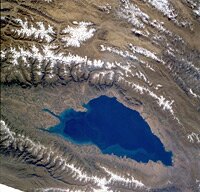
Satellite image of Issyk Kul
There is a story of a journalist interviewing Kim Philby in Moscow. Philby, of course, was the original Third Man, one of the Cambridge undergraduates recruited by the KGB to work for Soviet Intelligence, who went on to follow a brilliant Career in MI6, rising through the ranks to a senior position and was even tipped as a future M – Head of the service. At the same time, however, he was passing information back to Moscow.
Apparently, it is arguable how much faith his masters in Moscow put into his reports … although British and Americans are convinced that he did irreparable damage, there are some claims that Moscow could not believe that a product of the British Public School system could turn out such a “class traitor” and so distrusted and never really acted on the information that he supplied …
Some time after his cover was blown and he defected to take up residence in Moscow, given a desk job in the KGB and wheeled out for training courses, he once gave am interview to a British reporter who, amongst other things … almost as a parting shot, (having been disappointed with the way the interview had gone), asked him if he ever read spy novels like those of John le Carré, and if so – what did he make of them.
Philby’s reply was that he had looked at them, but couldn’t really get into them … they were far too cerebral and complicated.
Now, as I was growing up, the Boy’s Own genre of spy story was virtually de rigeur … standard fare, almost required reading for boys – whether it was Ian Fleming’s James Bond, Len Deighton’s Harry Palmer or John Le Carré’s George Smiley. They were different in style and appealed to different people … I came to George Smiley quite late on, but I like to think that he would have been my favourite.
Mind you, like Kim Philby, I often found the plots convoluted and confusing … I console myself, however, with the thought that that is the job of the author, who should be a skilled craftsman putting together a plot which not only carries a story but maintains excitement, interest, mystery and intrigue; portraying characters and the dilemmas they face in such a way that we, the reader, can identify and live vicariously.
These days I often find myself with the same feelings of confusion and disbelief when I watch action movies liek the latest James Bond, the Bourne series of films or even the blockbusters of soldiers on the front line in Iraq and Afghanistan. They seem to be quipped with remarkable technological backup … Q Division have certainly certainly been at their best.
Even when I was a teacher of computing and Information Technology, almost twenty years ago now, much of groundwork was already done on what we see on the screen today. It seemed fanciful then, but I remember running a lesson on the exponential acceleration in technological development and taking the Back to the Future series of films as an example, tried to show that what we were able to take for granted would have seemed “fantastic” (in the true sense of the word) back in the thirty years beforehand 1950 … and what we thought of as fantastic back in 1980 might well be taken for granted thirty years in the future – in the 2000-and-teens.
In the days when a secret agent carried a mobile telephone in his shoe (Get Smart) and the idea of there being a telephone in the Batmobile (da da da da da da da da Batmaaaan!) were enough to bring a smile to the faces of the audience … the flip open communicator on Star Trek, however, was taken seriously (… well, the series was set centuries in the future and it was recognizably Science Fiction … so it was expected to present possibilities – no matter how fantastic).
Part of my discomfort with the technology in these espionage, action packed blockbusters is simply that it is so good. So food in fact that it seems … too good – remember the old adage – “if something seems to be too good to be true … it probably is!”
For a start, technology is great when it is working properly … but Murphy’s Law comes into play … the gremlins get to work … and things go wrong.
The reality, of course, is that Hollywood is ahead of its time … President Bush and his entourage may well have been able to watch a live feed of the mission on the house where Osama Bin Laden was holed up … but that mission also, very nearly came a cropper, (like the rescue mission to extricate the hostages in the US embassy in Tehran that ended in the helicopters crashing in the Iranian desert … ) … the “fog of war” can create misunderstandings, and introduce mistakes – possibly leading to “friendly fire” incidents even if the technology is working perfectly … which it rarely does.
To give a more mundane example: we have video surveillance in both the office and our hotel in Bishkek … but when an incident occurs and we need to check the footage … something seems to have gone wrong … either the system didn’t turn itself back on after the power cut – which lasted longer than the life of the backup battery power, or the power cut caused damage to the disk and scrambled all the data, or the vital camera is facing the wrong direction – having been moved by the strong winds, or the action takes place just on periphery – or even outside the field of view – of the camera … or when we do get a picture, it turns out to be grainy and unclear … like the security camera pictures of the two seven year old boys leading the toddler off to his death – you can see something, but not very clearly, and not clearly enough to make an identification.
As an aside, I am really very impressed with the quality of the Streetcams here in Bishkek … do go and have a look.
Hollywood presents us with a scenario where the control center can identify individuals in a back lane in a city suburb … either using satellites or drones … great, but I am left wondering how it works in practice … how useful is it really?
Arial observation has been a great tool for the military in planning and conducting operations ever since it became a possibility with balloons … then aircraft – remember the effect of the those photographs in the Cuban Missile Crisis … and more recently we’ve seen lots of examples on the Russian-Ukranian border … monitoring troop movements.
Now, I had planned on a postcard looking at the Satellite images of Kyrgyzstan … but events have persuaded me to take a slightly different approach:
We are used to seeing satellite imagery of the earth’s surface … especially, for example,
- in weather forecasts, tracking hurricanes and so forth or
- when a “breaking news” is being reported and broadcasters want to show the location of the incident … they are happy to show Google Earth images then, or
- to highlight and emphasize particular points – such as
- environmental changes like the retreat of glaciers or of the polar ice caps …
- the contrast between the blank blackness of North Korea in a nighttime shot – compared to the bright city lights which illuminate South Korea, Japan and China …
- the different foliage patterns on either side of an international border – where one side has torn down it’s natural forest cover to plant crops … but the other hasn’t
The most obious and readily available source of satellite images is probably Google Earth – which is brilliant, on the whole … although there are some places which are deliberately obfuscated – for security or other reasons …
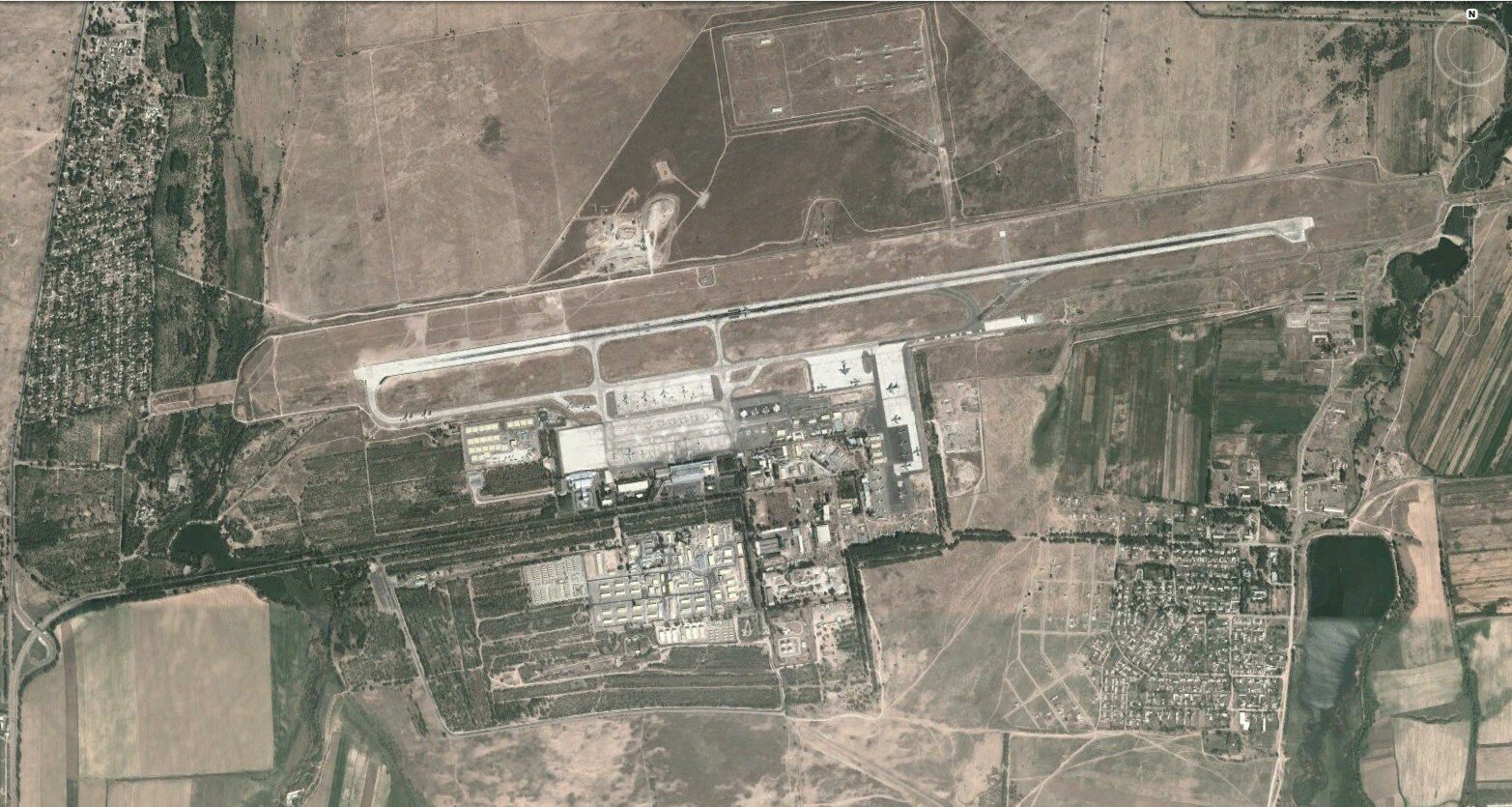
Satellite imagery of Manas airport – as seen on Google Earth – strangely enough, given the military nature and mission of the Transit Center, was not obfuscated in any way … planes are clearly visible parked on the apron … but also lined up awaiting take off.
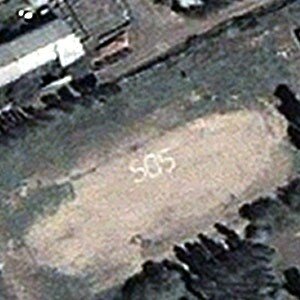
SOS and burnt out housing were identified in satellite images
We saw some examples of satellite imagery when civil order broke down in Southern Kyrgyzstan in June 2010. Pictures were published a few days later that showed districts that had apparently been put to the torch, with frantic SOS messages painted on the ground. Like those security camera images – the pictures show something, but lack the fine detail which Hollywood takes for granted.
Many international organizations, (such as Amnesty International), were, however, able to use these images to highlight the human tragedy that was underway … and urge international action to address the issues that lay behind the incident.
What a good job somebody was looking – pointing the orbiting cameras in this direction and obtaining the evidence.
In the recent past, however, we’ve seen another example of where satellite imagery could have been very useful … if someone had been watching and pointing the camera in the right direction.
Back in March, flight MH370 took off from Kuala Lumpur headed for Beijing … it lost contact with air traffic control and disappeared from radar screens … never to heard from again. A investigation was set in motion which established that it had changed course and led to speculation that the plane could have either clown North – as far as Kyrgyzstan – or South out over the Indian Ocean.
Most of the experts seemed to think that it had headed South. Kyrgyzstan, China, and the other countries on the possible Northern flight path were convinced that it had not passed this way … mind you, we then learned that the Indian Radar system was not as all-seeing as Hollywood might like to have us believe … it wasn’t turned on and no-one was looking for the plane at the time … what data was collected was analyzed and search areas in the Indian Ocean were assigned … but to date, even though several possible leads were identified and followed up … nothing has been found. The fate of the the plane and its passengers and crew remain a mystery.
Then, about a week ago, a New Zealand “expert” hit the headlines by suggesting that the Besh Tash valley, just outside Talas in Kyrgyzstan should be investigated … apparently a column of smoke had been seen at about the time that the plane would have been in the region if it had followed that Northern flight path … “it may be a 1 in a 1000 chance, but someone should go and check it out”, he said.
One of the reports suggested that he had analyzed satellite data – which could have been the Inmarsat data, pings sent from transmitters on the plane … but the reports (for example, this one in the New Zealand Daily Herald) went on to say that he had also been looking at satellite photographs of the region:
The expert then found satellite imagery which showed an apparent smoke plume in the Besh-Tash Valley near Talas in Kyrgyzstan, a remote location at a relatively high, snow-covered altitude.
Dr Kuang then discovered other satellite imagery obtained just a few hours later showed no smoke plume, which would appear to be consistent with a possible aircraft crash.
Interesting … Unfortunately, I haven’t been able to track down any of these satellite images … so, I wonder if anyone would care to put them in the public domain.
.
But then, I came across a video on youtube, a report which not only made me “see red” … but also served to confuse the issue even further … being based on supposition, rumour and innuendo supported by grandiose statements and what looks like allegations of conspiracies under every stone.
For the record: the presenter of the video is Bill Still – according to the Spanish version of Wikipedia (the equivalent page in the English version having been deleted) he is a journalist, film producer and author concentrating on, but not exclusively on financial and monetary policy and issues. His Facebook page says he’s a Public Figure. Apparently he tried to win the Libertarian Party nomination for the Presidential election … On Facebook, he has over 2000 followers – that’s a lot more than me, on Twitter over 3000 - that’s a lot more than me, and on youtube almost 17000 followers – I’m not on youtube … so it’s obviously more than me.
At first I just sat watching … but when Mr. Sill said that Kyrgyzstan had a “long history of terrorism” … hackles started rising up my back. In support of this claim he cited the fact the Boston Marathon Bombers “were born there” – ignoring the fact that they had left Kyrgyzstan many years ago, living in other places before they ended up in the States – and the alleged support that separatists in China’s Xinjiang province are “said to draw” from this side of the border – forgetting the fact that those supporters seem to have launched ther own invasion of Kyrgyzstan, or the support given by the US to Cuban rebels, (remember the Bay of Pigs? launched with the support – even if reluctant support – of no less than JFK) … doesn’t the US also have a “long history of terrorism”, at least in the eyes of some people around the world … and what about home grown terrorists such as the Unabomber – The FBI certainly claimed he was one … but then, Mr. Still doesn’t seem to like the FBI either … criticizing the fact that they seem to be withholding information about flight MH370 … or would he simply classify the Unabomber as a “common criminal”?
Then he started to talk about the future of the Manas Transit Center … ignoring the “long history” that was associated with it … with the US ,”today … hastily announcing that it was closing this base” and saying that the Russian base in Kant had been there since 1941 … Russia (as in the present Russian Federation) didn’t exist in 1941 and the base as it it exists now was only established in 2003.
To be fair, although it rankled with me … I took it to be a case of him, simply, expressing his opinion … much as I do here in my postcards … looking at his videos on his youtube channel he seems to be someone who has strong feelings – most of them appear to be anger directed against – well, almost anyone and everyone … although, to squirrel olympics did provide an element of light relief.
I couldn’t help wondering, however, what his stance would be on the fact that in the last eighteen months, there have been some 74 school shootings in the US … could he possibly find a way to blame them on Kyrgyzstan? No, Mr. Still, that’s not a challenge … it was a rhetorical question, posed with my tongue well and truly embedded in my cheek
When he was talking about the Besh Tasj valley, he made specific reference to a spot of relatively flat land “3000 foot plus” long which could possibly, be used to land a plane, although it would be difficult … but then the pilot had his own simulator at home and who knows what was on that …
Hmmmmm … That didn’t sound like the Besh Tash valley that I know … (I have been there – it was a few years ago so my memory could be playing tricks on me … but all the same – it doesn’t sound like Besh Tash) … so, I took a closer look. Here’s a screen capture of the valley taken from the video, showing that elusive long stretch where he says a plane could possibly have been put down:
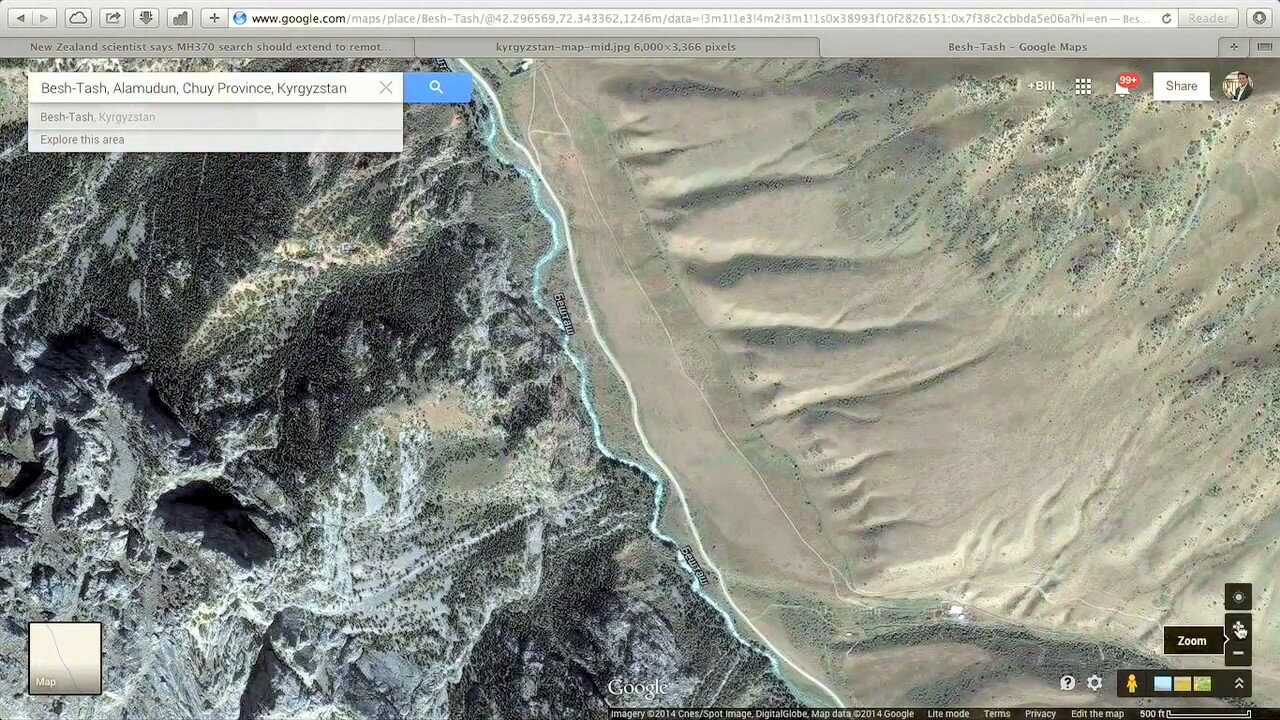
Here’s a screen dump of the valley from the video showing the Tesh Bash valley with the 3000+ foot long stretch of relatively flat land
Look in the top right corner – it clearly says, Besh Tash, Alamudun, Chuy Province, Kyrgyzstan.
“Just a minute …”, I thought to myself, “Besh Tash is in Talas Province …”. It was clearly identified in the original news reports as being in Talas … but, then again, the river here is also clearly marked Besh Tash (in Cyrillic). Si what is going on?
In a way, it’s not all that surprising … there are several place names that are used more than once here in Kyrgyzstan and Besh Tash, (which means Five Stones in Kyrgyz), is the sort of descriptive name which might be used in different places around the country referring to some physical feature or legend associated with the place.
It does, however, leave me wondering … which Besh Tash are we talking about? … which one had the column of smoke? … where should we send a search team to go and check out that 1-in-a-1000 chance? …
.
Now, if akk that seems to be somewhat scathing … I do think that Mr. Still raises some interesting points. He is, at least, right in this: the fate of the aircraft is something that needs to be investigated … and that “no stone should be left unturned”, (as the politicians promised when they thought they knew where it was – that is, at the bottom of the Indian Ocean), even it is only a one-in-a-thousand chance that it will turn up something useful …
… But, likewise, pundits – and in that I include myself – should be careful in making public statements and not simply “play to the crowd” – which is what this seems to be.
.
Please don’t misunderstand me … I accept and acknowledge that I could be wrong, that I could have misinterpreted something, or even misrepresented something … but I don’t think I have … and I don’t put myself forward as an expert … I always try to point out that these postcards are simply “personal observations” from an expat.
.




 Bishkek