And the next word is … (ding!) … Tsundoku
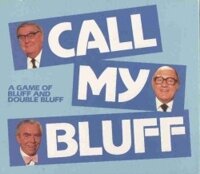
Call My Bluff
Spoiler Alert: This postcard has (virtually) nothing to do with Kyrgyzstan!
Television executives have a predilection for Game Shows … not only do they provide entertainment, they are also very popular … and they are relatively cheap to produce even when they involve celebrity contestants.
One reason for their popularity is that they can provide a great opportunity to give “ordinary people”, members of the public, a chance to participate in the spectacle of television and gain their “fifteen minutes of fame”.
Although some of the Game Show formats are are well known internationally, (such as: Who wants to be a millionaire?, The Weakest Link; Wheel of Fortune; Countdown …), others specific to particular countries, cultures and times …
I have written before about one Game Show that I used to enjoy watching back when I was growing up … Call my Bluff.
This was a panel game which first appeared on our screens in 1965, (in black and white) and lasted until 1988, (when it was seen in colour). There were seven people in front of the cameras: two teams of three people who took turns in providing definitions for strange words taken from the Oxford English Dictionary, announced bya chairman with great flourish with the phrase: “And the next word is …”, ringing his little bell, “ding”, and the word was displayed on the set behind him.
Of course, unless you were the Cheshire Cat, (in which case words means what you want them to mean – a recipe for anarchy and solipsism), most words have just one meaning. That meant that, as each of the three members of one team would, in turn, offer the members of the opposing team a definition of the chosen word, only one of the suggestions could be the true definition whilst the other two were “bluffs” which the opposing team had to listen to and weigh up the probability of each definition being the correct one. If they guessed correctly, they scored a point, but if they got it wrong, the other team got the point.- hence the name of the programme – Call my Bluff.
If I say that it was “popular”, everything is relative. BBC2 was the “elite” channel with intellectual and arts programmes. It tended to attract a smaller audience than the more mass orientated BBC1 or TV, (Independent Television), which relied on advertising for its funding. Even so, it was a well known programme and many features of the game were to pass quickly into popular culture.
Of course, it was a game you could easily play along with, whilst sitting at home. The words were obviously chosen to be obscure, words like: Queach, Strongle, Ablewhacket, Hickboo, Jargoon, Zurf, Morepork, and Jirble. For example, “Queach” was apparently defined as “a malicious caricature”, “a cross between a quince and a peach”, and “a mini-jungle of mixed vegetation”. (For the record, the true definition is the last one, the other two were “bluffs”.
A short while ago I came across a word that would have been an ideal candidate for the game: Tsundoku … apart from the fact that it wouldn’t qualify, because it’s not an English word. For the record: it Japanese.
Of course, English “borrows” lots of words from other languages but I don’t think this is one of them.
When I came across the word, I wondered if it was a hoax … but my mind immediately went to considering possible “bluff definitions” … involving the similarities with with words like Tsunami and Sudoku … the definitions would normally start with a pronunciation guide, and Tsundoku is apparently pronounced “tsoon-doh-koo” and the proper definition is “buying books and not reading them; letting books pile up unread on shelves or floors or nightstands.”
Note that the definition is specific about “buying books” not simply acquiring them, so I presume that it doesn’t include those that are received, for example, as presents.
Now, that raises an interesting question … why would someone do that … buy books and not read them?
When I was a student, I was given a grant from the local church to buy books and I remember approaching one of the lecturers and asking for advice about one particular reference book that I was thinking of buying. His advice was very practical and down to earth … it was a good book … if it is was going to be used … but if it was simply to stand on the bookshelf and look good, or prop something up … then there were probably better alternatives.
Some people buy books as status symbols – especially, large photobooks … with large colourful pictures and very little text … we used to call them Coffee Table Books. I suppose that one place where such books are often found is in waiting rooms … although these usually have magazines rather than coffee table books.
Now, I have to admit that over the years, I have collected a fair number of books that I have never read … a bit like like that reference book – but then, they are reference books … not really meant to be read but to be dipped into, in order to look things up.
As it happens, although some books are obviously meant to be read from beginning to end – novels, for example, or some history books such as those telling the story of the Great Silk Road – but others are not. Many of the books on my bookshelves fit into this category, especially those about Kyrgyzstan and Central Asia, whether History, Geography or about the aspects of nomadic culture … and especially when they are in Russian … I may not actually sit down and read them but I do “dip into them” from time to time.
There’s another (practical) reason for buying books and not reading them … which I have found to be particularly relevant here in Kyrgyzstan … there is a distinct shortage of books in English and so I often take the opportunity when it presents itself snap up books that look as if they might be interesting when I come across them. Unlike reference books or coffee table books, there is actually an intention to read them – but, perhaps, not right now … they go onto a “reading list” and may hang around, (literally), for years before I pick them up and delve into them.


 Bishkek