Tashkent … and the Earthquake of 1966
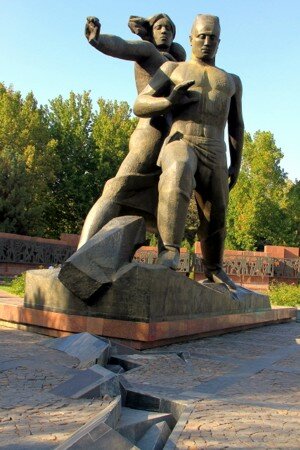
Earthquake Memorial, Tashkent – Photo credit: Mark Abel / Foter / Creative Commons Attribution-NonCommercial-ShareAlike 2.0 Generic (CC BY-NC-SA 2.0)
Kyrgyzstan lies in a seismically active zone … that is, it experiences a number of earthquakes. The frequency and severity of the earthquakes can vary considerably … as can the consequences. Some are relatively mild and pass almost unnoticed, whereas others can be strong and create serious damage.
When they occur in built up, more densely populated areas, the damage and possible loss of life and injuries are of course greater. Fortunately, many of them occur in remote mountain regions which are less densely populated.
Apparently, the strongest earthquake to have occurred on the territory of the present Kyrgyz Republic happened in 1911 in the Kemin region, when the strength at the epicenter reached point 11 on the Richter scale(!)
One of the most important earthquakes to strike the region was the 1966 Tashkent earthquake which struck in the early hours of the morning, (at 5:22 am), on 26th April, 1966.
At just 5.2 on the Richter scale, (although one source says it measured 7.5), it wasn’t a particularly strong earthquake, but the consequences were far greater because it hit a built up area – the main center of the damage being in the old city. Thousands of the ancient, one-story adobe dwellings were flattened.
Although only 10 people were killed in the earthquake itself, about 1,000 were injured … and something like 28,000 buildings, (one source suggests 78000), were destroyed, (including 200 hospitals and clinics, and 180 schools), leaving about 100,000 people homeless, (although one source says 300,000).
In additional, further damage was sustained from the aftershocks which followed, something like 700 of them.
A massive plan of reconstruction was put into effect – “battalions of fraternal peoples” from the Soviet republics, and some from other countries such as Finland, to help rebuild devastated Tashkent. Urban planners and these fraternal battalions created a city of wide streets planted with shade trees, parks, immense plazas for parades, fountains, monuments, and acres of apartment blocks.
Further development in the following years increased the size of the city with major new developments in the Chilonzor area, north-east and south-east of the city.
The Earthquake Memorial, “Courage”, was erected on the banks of the river which divides the city in two. It consists huge bronze figures; a woman holding a child and a man with an expressive stance before a zigzag crack in the ground, symbolizing the resistance of city’s inhabitants against the raw power of the terrible underground forces. The crack leads to a cube broken into two pieces with the date “April, 26, 1966″ engraved on it and a dial of clock displaying the time of the event.
Tashkent lies on the site of an oasis on the Chirchik River – but little remains to show for its more than 2000 year old history as a major trading center as a result of the earthquake in 1966 – destroying much of the city.
The town is based on the site of the original city of Chach and has seen the influence of Sogdians, Kazakhs, Chinese, Arabs, Mongols and, (since it’s fall to the Russian General Chernaiev in 1865), the Russian. Under the Russians it was connected to Moscow and the heart of the Russian empire by a modern railway – and the workers were to play an important role in the Socialist revolution. It became the capital of the short-lived Turkestan Soviet Socialist Republic and won the status of capital of the Uzbek SSR from Samarkand. During the Soviet period, especially following the earthquake, it underwent considerable reconstruction, and by the time of the collapse of the Soviet Union, in 1991, Tashkent was the fourth-largest city in the USSR..
Sights in the city include the Residence of the Grand Duke Romanov; Independence Square; the government building (known as the White House); the Presidential Palace; the Alisher Novoi Opera and Ballet Theater, (and the library and literary museum of the same name); The Sheikhantaur Cemetery in Old Tashkent; Chorsu (famous for its bazaar), and Khast Imam Square with several interesting buildings. There is a wide selection of museums including: the State Fine Arts Museum; the Museum of Fine Arts; two Historical Museums; the Amir Timur Museum erected to commemorate the 600th anniversary of Tamerlane; the Natural History Museum; a number of specialist thematic museums such the Geology Museum; Railway Museum; Defence Museum … and others. Memorials of note include the Tomb of the Unknown Soldier and to the Victims of the 1966 earthquake. There is even an amusement park – “Tashkentland”
A modern Metro runs under the city – with 3 separate lines connecting the suburbs with the city center. Kosmonautalar station is recommended for a visit as “Uzbekistan’s own Space Mountain”.
In the environs surrounding Tashkent are the Zengi Ata Mausoleum; Chimgan– the winter sports resort frequented by the capital’s citizens and Charvak – a beautiful reservoir. Excursions are possible to Turkestan (in Kazakhstan) and Dzhizak (on the road South to Ferghana commanding the strategic Jilanuti pass – the birthplace of Sharif Rashidov, the former First Secretary of the Uzbek Communist Party, who ruled the Uzbek SSR for some 24 years).
Tashkent is the capital of Uzbekistan and lies 600 km to the west of Bishkek. There are several flights a week which take just over an hour to cover the distance. Travelling by road take a whole day, along the edge of the Kazakh steppes. Vehicles from Kyrgyzstan cannot enter Uzbekistan without special paperwork and so most people travelling by road swap vehicles and guides at the Chernoyevka border crossing – some 30 km out of Tashkent. There is also a railway link. Froeigners travelling by road or rail need a Kazakh transit visa was well as an Uzbek one.
The other way of travelling between Tashkent and the Kyrgyz Republic is to travel South to Osh – which takes about 4-5 hours driving and then crossing – and then driving up the Ferghana valley. Although there are many border posts in the Southern regions – most of them are designated as local – and not open for travelers from third countries.





 Bishkek