The price of gas …
Photo credit: TaylorB90 / Foter / CC BY-NC
When I was growing up, my mother had a gas stove and although I never really did much cooking apart from putting the kettle on to make a cup of tea or coffee, I have always felt more comfortable cooking with gas than electricity.
As a student, when I did have to cook for myself, my first set of “digs” had only an electric stove and, although I liked the fact that you seemed to get greater control over the temperature in the oven, I always felt uneasy about the time taken by the element to heat up or cool down compared to the instant response that gas gave me whenever I adjusted the knob controlling the flow of gas to a particular burner.
After a while, when it came time to arrange new digs, I was so happy to see that they had gas. Ever since then, I have always had gas cookers. That’s not to say, however, that I shun completely the use of electricity when it comes to cooking … I do have an electric kettle, electric toaster, a microwave and the stove is a hybrid, (with one electric element on the hob and another in the oven).

Bottled gas
Nowadays, I live in the center of Bishkek – and as a result, I am pleased to say, I have gas in my apartment. I count myself lucky because not everyone does. I have some friends, who live on the outskirts of town, (in what’s euphemistically called “the chastniy sector“, (individual houses – usually single storey – as opposed to living in an apartment in a zhiloi dom - an apartment block). They have a gas stove but they have to buy “bottled gas” – canisters. They have two “bottles” so that when one runs out they can simply switch to the second and then arrange for the empty one to be filled, (actually – they swap it for a full one). One canister is sufficient for about a month.
Those of us lucky enough to be connected to the gas mains have several different ways of paying for the gas we use. I consider myself lucky because I am still on the simple system – where I am charged a set fee every month, (based on things like the size of the apartment and the number of people living in the accommodation). In theory, someone from the gas company brings me a bill once and month and I trot off and pay it at the local post office or one of the payment terminals. I say “in theory” because for I haven’t seen a bill for six months … when I have run into them I have asked various inspectors why – but they always say that they haven’t the faintest idea?
Fortunately, because it is a set rate and not based on the amount I have actually used, the fee is more or less the same every month … so, even though I haven’t got a bill, I trot off and feed the payment terminal … after all, the last thing I want is to run up a debt and get one of those “red letters”, have them cut me off and have to pay fines and additional fees … not to mention all the hassle of getting it reconnected
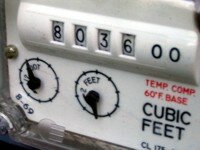
Gas meter … although this one’s not from Kyrgyzstan
One of the disadvantages of the set fee is that it doesn’t really reflect the amount of gas I actually use … and several of my friends and acquaintances have installed gas meters because they thought that it would, in the long run, end up saving them money. Each month an inspector visits and takes the meter reading and then a few days later returns with their bill which they take to post office or payment terminal and pay.
Some of my acquaintances have installed “smart” prepaid meters. These have a individualized card, about the size of a credit card, which records their account details, meter details, (so they cannot be used anywhere else) and details of how much they have prepaid. If the card still has funds available on it, then the gas flows freely, and the balance is adjusted depending on how much gas they use. Once it passes a threshold, the meter starts to beep warning the consumer that they are running out of credit and it’s time to top up their account. The remove the card and take it to a terminal where, in exchange for a payment, it is updated with fresh funds.
When I was growing up we had a similar sort of system – but nowhere near as “high tech”. On a specially constructed shelf by the door we had a meter into which had a slot into which we used to push coins, turning a knob to make sure that the coins fell into the special box. Periodically, an inspector would turn up to empty the meter and collect the coins … In fact the meter overcharged us … so the inspector would calculate how much we actually owed for the gas we had consumed and then leave us the remaining coins so that we could feed them into the meter afresh.
This system had one major disadvantage … it was easy pickings and was often targeted by vandals and hooligans who broke into a house and made straight for the meter, smashing the lock and taking the money drawer. At least the “smart cards” thwart that particular behaviour!
Yesterday one of those acquaintances told me how their meter was beginning to beep, so they took their card to add some funds to their account., They were a bit surprised because this month they seemed to have used more gas than usual, but they thought that was probably down to the extremely cold weather that we have been experiencing … but when they got to the office they discovered there was another reason … the price has gone up. Whereas 250 som used to provide them with enough gas for a whole month, now it bought less gas.
Previously the cost was about 1.30 som a cubic meter, but it has gone up to something like 1.6 som – thats more than an 8% rise … whereas the general rate of inflation since the beginning of the month is only officially about 1.2%. Needless to say, people waiting in the queue to top up their accounts were far from happy.
“Why’s the price gone up?” and “Why’s it gone up so much?” were questions that were on their lips. Someone actually posed the question to the cashier and received the reply, “Well the dollar has been rising.” Their response was simple: “What’s that got to do with it?” … and my friend then went on to complain that everyone seems to be using the same excuse. The price of everything seems to be going up and everyone is blaming the rises on the increasing exchange rate.
It was at this point that I made myself unpopular by saying I could see some logic in this … Kyrgyzstan is not particularly well endowed with Natural Gas and imports huge quantities from our neighbours Kazakhstan and Uzbekistan … and the price is always quoted in dollars.
In fact Kyrgyzstan has huge debts for gas and this had led to some unpleasant consequences, with our neighbours occasionally cutting off supplies – or, at least, threatening to do so – in order to get Kyrgyzstan to clear some of its debt.
KyrgyzGas has to pay for that gas in dollars, but receive soms from the consumers … so, in order to do so, they need more soms to buy the same number of dollars – hence the price has to go up.
Sugar, a staple commodity that has seen dramatic rises recently
To be fair, my friend conceded this point … reluctantly … but then went on to add that the price hike affected other things which weren’t imported and paid for in dollars … even sugar, which is produced here in Kyrgyzstan – from beet grown in Kyrgyzstan, which used to cost 45 som a kilo, went up to 46 som, then 48 som, then 50 som and now costs 55 som a kilo – representing an increase of more than 22% … and the reason given for the price hike was – the value of the som is falling against the dollar. To add insult to injury, she said, the sugar is produced by processing last year’s crop – so what is happening to the dollar now shouldn’t be playing any role at all.
Although I can still see good reasons why it might indeed have a role to play, (for example, they might have to import equipment or other raw materials … and then we should remember that the price shouldn’t just reflect the cost of production but also allow the manufacturer to plan so that they can ensure that have raise sufficient finance to meet the new prices that they might face when the new crop is harvested), … and I felt that she might have had a better argument with – “and when the value of the dollar falls, the price is never reduced” … I decided that discretion was the better part of valour and withdrew from the discussion ….
… and, after all, there did seem to be some justice in her complaint. The rising value of the dollar is an easy and convenient excuse and is latched onto by people, almost as a “knee jerk reaction” as a justification for raising prices … even when it seems to be totally irrelevant.
In fact, I consider myself to have been incredibly lucky in that my friend actually conceded the point. Most people don’t when they feel so indignant and emotional about something and then find themselves faced with a counter argument that seems to not just take “the wind out of their sails”, but “to rip the rug out from under their feet”.


 Bishkek