Cotton Club
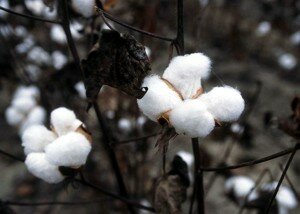
Cotton Bolls
Not long ago I was chatting with a friend who dropped a bombshell on me, (figuratively – not literally), when he told me that Kyrgyzstan was on of the top Cotton producers in the world. I expressed my surprise … I know that cotton is often listed as one of the country’s main agricultural products along with tobacco, and that it was an important product in the Ferghana valley … but it seemed to me that Uzbekistan he was probably thinking of Uzbekistan, not Kyrgyzstan.
Anyway, I decided to look into it.
In fact he is not alone in thinking this … one news report, echoed what he told me, saying: “according to some sources, Kyrgyzstan is among the leaders of cotton production in the world”, although it also added, “Kyrgyzstan does not figure in the National Council of U.S. cotton producers’ list of the top ten cotton producing countries.“
It turns out that Kyrgyzstan is about halfway down the league table of the world’s major cotton producers, (somewhere about 38th place, out of 77 countries), producing around 100,000 bales of cotton a year (about 20,000 tonnes). That’s not much compared to approximately 25 million tonnes produced globally annually; six million tonnes produced by China and India, the three million tonnes from the United States, (the world’s largest exporter of cotton), two million tons from both Pakistan and Brazil or with Uzbekistan, (which is up there in the top ten with about a million tonnes) … but it’s still a significant quantity.
For the record: I have to admit to a certain amount of confusion because some of the statistics are quotes in tonnes – whilst others are quoted in “bales” … a bale weighs 480lbs (pounds) which is the equivalent of about a fifth of a tonne – so, China at the top of the table produces about 32 million bales, or 6 million tonnes. A recent news report (in 2012) commented on the harvest of 100,000 tonnes of the crop that year … but according to one set of figures I have seen, Kyrgyzstan produces around 100,000 bales – which would be only 20,000 tonnes.
Cotton, (Klopock in Russian), is fiber that grows in a round seed bearing capsule, called a boll, of the Gossypium plant, (or cotton plant). The shrub is found all round the world and it was domesticated, (cultibated and utilised), in both the Old and the New Worlds in antiquity. The fiber is almost pure cellulose and is spun into a yarn or thread which can then be use to make a soft textile fabric, and the invention of new technologies in the Industrial Revolution led to a growth in its use and it is now the most widely used natural fiber cloth in the world.

An early, hand powered, Whitney Engine
For the record: Today happens to be the anniversary of an important event in the history of cotton … as important as the invention of the cotton gin. On March 14th, 1794, Eli Whitney received a patent for his engine, basically a wooden drum, spiked with metal hooks – which, when it was turned, separated the cotton fibers from the seeds, husks and other impurities. Whitney’s invention allowed a massive increase in productivity in the extremely labour intensive process … and whilst this led to the success of the cotton industry in the Southern States of America, according to some historians, it also played a role in helping to perpetuate the institution of slavery.
Cotton has been a controversial crop over the years – what with the connections with the Slave trade, Gandhi’s commentary about the economic injustices of the British empire buying Indian cotton at rock bottom prices – transporting the crop to Britain to be processed and then selling the finished product back to India at top dollar prices … and more recently the alleged use of “child labour”, and other economic, environmental and social problems associated with the intensive farming methods of its mono-cultural cultivation.
Cotton requires a long frost-free period, plenty of sunshine and moderate rainfall, (or substantial irrigation – which leads to other problems), and “heavy soils” …
Recent developments have seen the introduction of Genetically modified cotton plants – designed to improve resistance to pests. However, another trend has also emerged, the production of organic cotton – produced from plants cultivated without the use of chemicals such as fertilizers and pesticides.
Apart from its use in textiles, cotton also has a wide variety of uses – such as in the manufacture of explosives, paper – most banknotes are actually made from cotton paper.
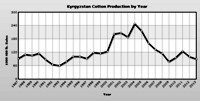
Cotton production in Kyrgyzstan
In the days of the Soviet Union, the collective planners in Moscow decided that the Ferghana valley should become a center for cotton production and set in motion measures to bring this about … plowing up grazing land and damming rivers to provide irrigation for the incredibly thirsty cotton crop, chemical fertilized were purchased and distributed and pretty soon the valley was harvesting thousands of tons of cotton a year.
In recent years, production levels have fluctuated considerably. with a low of 60,000 bales (in 1993) and peaking at 248, (in 2004). The variation is partly due to climatic conditions, but also to variations in the area of land used for the crop year by year, (as in, for example, in 2013 when poor prices paid to farmers the previous year led to few acres being planted with the crop), and the availability of fertilizers and pesticides, … and other socio-economic factors such as improved techniques as farmers receive specialist training – thanks partly to the intervention of international donor organizations.
It’s a cash crop and has a significant impact on the economy of the whole region. When the Soviet Union collapsed, the market for cotton diminished, which led to a downturn in production – according to one source the acreage dedicated to the crop fell by something like 70% – which in turn led to widespread unemployment in the region and increasing poverty among those who worked in its production.
Over the last ten years or so, there have been several projects supported by international donors that have introduced farmers to Organix Cotton production. Although they tend to achieve lower yields they also benefit from lower production costs and premium prices … not to mention additional sources of income from diversification from the production of by-products, (such as Cotton oil for cooking, and press cake for animal feed), which all help to lead to an increase in net profits. In additional these projects also provide for greater access to credit which in turn reduces the pressure on farmers to sell livestock during hard times and perceived improvements in soil.
According to official figures, something like 25% of the production is exported … although some people say the real figure is far greater. Earlier this year, it was announced that Pakistan is looking to purchase Kyrgyz cotton … even though it is a major producer in its right.







 Bishkek