Solyanka
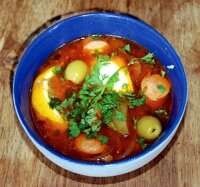
A dish of solyanka
One of the fist Russian dishes I was served when I first came here back in the mid-90′s was a dish of Solyanka.
This is a soup – which may be either Russian or Ukrainian in origin … no-one seems to know for sure – that is very popular throughout Russia and other former Soviet Republics, as well as some other Eastern European Countries.
Here it can be found on the menu in some cafes and restaurants … and some supermarkets stock frozen Solyanka, (in some countries it’s also sold as tinned Solyanka). However, it doesn’t seem to have been adopted by the Kyrgyz themselves … at least, it’s not included in the Kyrgyz Cookbooks that I have.
In a way that is surprising, because it is a very practical an economic dish which uses whatever ingredients that come to hand … (hence the name is sometimes translated as “grab bag” or “hodgepodge”) … although pickles and lemon are the standard base which tends to give the soup its distinctive salt, spicy, sour taste whatever ingredients have been used. Perhaps, one of the main reasons that it hasn’t been assumed into the annals of Kyrgyz Cuisine in the same way as many other foreign dishes is that one of the other staple ingredients is kolbassa - sausage, or simply cold meats – especially ham and bacon … which could cause problems for even the most liberal of Muslims.
As an aside: one of the recipes I came across called for kolbassa, ham, salami, bacon … and Kosher salt (!) … to be honest, I didn’t know that salt could be Kosher … but I still don’t think it’s use would help to make Solyanka either acceptable or palatable to either Jews or Muslims.
To be honest, although I am happy to eat Solyanka, I am not all that fond of it either … and depending what else is on offer on the menu, I will usually chose the alternative. Although most of the descriptions of Solyanka refer to it as a “tasty” soup … I find it it tends to be rather salty and sour for my personal preference.
Other adjectives that are often used to describe the soup are “salty”, “spicy” and “sweet and sour”. The name Solyanka is sometimes linked with the Russian Sol’ which means salt.
Solyanka has been around in one form or another since the fifteenth century … at least, that seems to be when the first historical mention of it in Russia. By the 18th century it had become widespread throughout the country and was known as either solyanka or pohmelka. (The second version ended to be a thicker, greasy soup). There seems to be a theory that it is was also once called “villager“.
If the name Solyanka is possibly tied to salt, the other names also contain clues to it’s history. It was, for example, popular among the “common” people – filling, warming and full of energy … oh, and it goes well with alcohol … (pohmelia is the name given to the “hair of the dog” hangover cure). In fact the aristocracy tended to look down upon it … until, that is, fairly late on.
There are three main types: meat, fish and mushroom. They are all made in the same way:
- a broth stock is prepared – for example, by simmering meat for an hour – then
- the other ingredients are chopped or sliced … lightly fried, mixed together and then
- added to the stock which is seasoned and simmered for about ten to fifteen minutes before
- it is served with sour cream (smetana) and bread … grannery is typical.
The ingredients, can be basically anything to hand … but typical might include: beef (500-600 g); smoked ham (150-200 g); smoked beef (100-150 g); … one recipe says 6-10 different sorts of cold meats … olives (optional); pickled cucumbers (2-3 average sized); lemon (1); tomato paste (2-3 tablespoons); vegetable oil (3-4 talebspoons); onions; carrots; garlic (1-2 cloves); potatoes (2); greens (e.g. cabbage – but this is optional, some people include it, others omit it); seasoning – salt, pepper, spices, lemon … and for serving mayonnaise or sour cream (to taste).






 Bishkek