A Pony of Prime Ministers
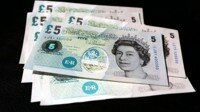
A pony?
I am not sure if there is a recognized collective noun to describe a gathering of Prime Ministers … in my search I came up with a number of humourous suggestions, but I would would like to suggest one … at least for Kyrgyz Prime Ministers … a Pony of Prime Ministers.
If you can have a shrewdness of apes, a blush of boys, a flutter of butterflies, a murder of crows, a convocation of eagles … and so on, why not a Pony of Prime Ministers?
It has a nice “ring” – with a pleasing alliteration, (a P of P …), so, once again, why not?
Let me explain … one of my hobbies when I was a Maths teacher back in Britain, was collecting Maths textbooks.
It all started with a desire to find material that I could use in the classroom – both as a search for explanations and exercises.
Every author had a different way of expressing themselves and I found the different approaches useful when considering how to tackle a new topic with a class – every class is also different and what works with one class might not work so well with another.
The exercises were also helpful because all I had to do was copy them up on the board before setting the class loose to try and solve them. If I tried making the questions up on the spur of the moment, then I often found I made mistakes and could quite easily make up a problem which turned out to be impossible. At least the questions out of of a published textbook should be tried and tested. Then for homework, I could set an exercise out of the textbook that had been issued to the class.
As I accumulated more and more textbooks, I discovered that the books were fascinating in many different respects in their own right. Some of the topics had disappeared from the curriculum to be replaced by more modern topics … Euclid’s deductive geometry giving way to set theory and matrices for example.
One of the biggest differences came about in 1971 – on 15th February Britain dropped the old monetary system of Pounds, Shillings and Pence (where one pound was made up of 20 shillings, each worth 12 pence – so a pound contained 240 pence), and adopted the Decimal system of Pounds and Pence … one pound comprising of just 100 pence. No longer were pupils tortured with questions like:
£25 3s 3½d + £17 16s 11¼d - £11 6s 2¾d
Mind you, it wasn’t just in terms of money … even well after this, we were still using the Imperial system of weights and Measures – inches, feet, yards and miles instead of centimeters, meters and kilometers; ounces, pounds, stone and hundredweights instead of grams, kilograms and tonnes; fluid ounces, pints, quarts and gallons instead of milliliters and liters … and not forgetting the groat and the grain, rod, pole and perch, the chain and the acre … and a host of others which (I have to admit) can still confuse me to this day.
Returning to money … there were other complications like farthings, a tanner, florins, the half crown and crown, the sovereign and the guinea. Some were official terms, whereas others, (tanner and bob) were common slang.
In somewhat antiquated British slang, a Pony was a term used for twenty five pounds, (£25), and it was often used in gambling circles to describe a bet of £25 on a horse in a race.
So … that explains the Pony … it stands for 25 … but what’s the connection with Prime Ministers?
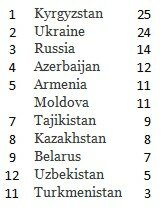
The CIS “league table”
Well … over the weekend we learned that, according to the National Institute for Strategic Studies, (NISS), Kyrgyzstan has achieved first place in the CIS, (the Commonwealth of Independent States – comprising of most of the constituent Republics of the former Soviet Union -with 9 full members, 2 “participating states” and one “former member” … Georgia), when it comes to the number of Prime Ministers in the 23 years since the break up of the USSR … you guessed it … 25!
Pointing out the obvious, that the average term of office is less than a year, they went on to draw comparisons and conclusions about a linkage between the frequency of changes of government and indicators of socio-economic development … suggesting that in countries where there was a stable system of government there is usually a steady economic growth and relative social stability … and that, conversely, where the governments is “sensitive to political agendas”, then those indicators tend be negative.
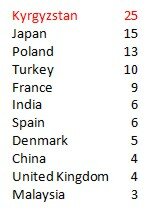
Some international comparisons
It’s interesting to see that Russia comes in third place in this league table with 14 Prime Ministers … but I presume Vladimir Vladimirovich would point to the last few years since 2008 when they have had only two people in that role, himself and Dmitry Medveded, (that is, if you don’t count Voctor Zubkov’s one day in 2012 as Acting Prime Minister when Putin re assumed the Presidency and before he appointed Medvedev), and they’ve had a more stable record of economic growth than in the early years when the other people held the office.
The NISS then went on to hint that, in fact, it might not just be a record within the CIS – but might even constitute a world record! To underline their point, they make some comparisons with a selection of other countries over the same period. It’s not a definitive list – for example it doesn’t mention Italy’s 13 Prime Ministers during this period, or Belgium’s 7.
Now, although there have been 25 Prime Ministers, it’s not quite that simple … it doesn’t mean, for example, that there have been 25 individuals to hold down the job:
- three people have held the post twice, Boris Saliev, (in the capacity as Acting Prime Minister), Kurmanbek Bakiev and Almazbek Atambaev;
- seven people were Acting Prime Minister and were never appointed as Head of the Government in their own right … … hey, you have to have someone in post or else the business of government will grind to a halt. One of them, Boris Saliev, (on the first occasion he held the job), held the portfolio for just two days – another for 4 days … and the second time that Saliev stepped into the breach, it was for just over a week. In their short tenure, they would not have had any significant effect on the affairs of state by reorganizing the structure or composition of the government nor have attempted to introduce new policies or innovations;
- following the Revolution in 2010, the post of Prime Minister basically didn’t exist until following the Parliamentary elections in November that year, (Roza Otunbaeva combined the roles of of Head of State along with that of the Head of Government as the Chairman of the Interim Government).
The longest serving Prime Minister in the country’s 23 year history was Apas Djumagulov – who served for 1561 days – that’s just over four years and four months … not as long as Tony Blair or Margaret Thatcher … but longer than 23 of Britain’s 53 Prime Ministers and longer than David Cameron has held the post. When you consider that he had also served for almost five years as Chairman of the Council of Ministers of the Khirgiz Soviet Socialist Republic, his combined time in office to just short of 9 years – which would put him on a par with both Asquith and Winston Churchill … serving about 100 days longer than both of them.
For the record … here’s a list of the Pony of Kyrgyz Prime Ministers and their 25 terms of office:
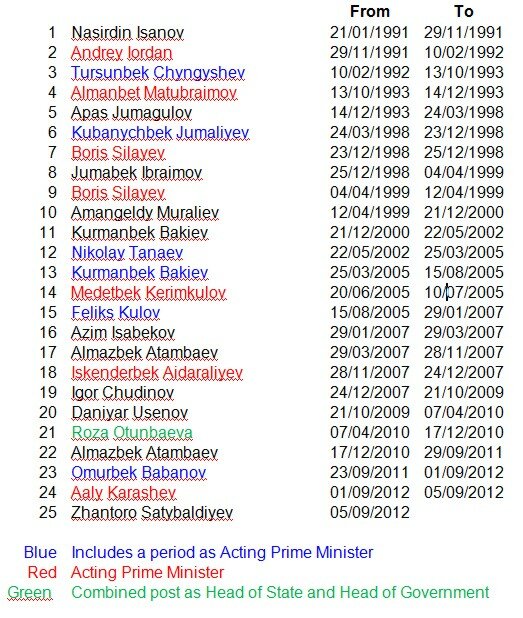
The “Pony” of Kyrgyz Prime Ministers
Please don’t misunderstand me – I am not saying that the NISS are wrong or that they don’t have a point when they say that an average term of office of just 340 days implies problems when it comes to the question of stability in the country … just that the situation is a bit more complicated than might appear at first glance from the straight forward, attention grabbing, headline figure.





 Bishkek