Swastikas … and all that
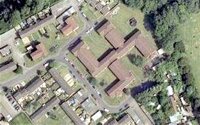
An aerial view revealing the “infamous” layout
A recent report in the Daily Telegraph caught my eye … apparently the residents of a small rural town in southern England were surprised to discover that their housing estate, built back in the 1960′s, is shaped like a swastika.
Nobody seems to have noticed the resemblance before – until, that is, it was spotted in an aerial photograph … no one from the local council seemed to available for comment.
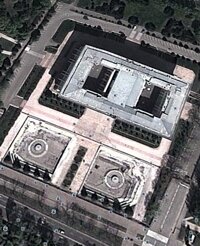
The White House – a “figure of eight” rather than a solid block
Nowadays, aerial photographs, satellite images and Google Earth can give us a different perspective of the world in which we live …
I remember, for example, the surprise expressed by one of my friends when he saw the image of the White House here in Bishkek … he hadn’t realized that it was “hollow” – Google Earth clearly shows the floor plan as a figure of eight rather than a solid massif that he had always assumed it to be having only seen if before from ground level.
As an aside … he wasn’t too happy when I said, “Yes, I know” … and he discovered that I had actually been inside the building. Mind you, he got his chance to see for himself a short while later when we were both “summoned” to a meeting to discuss arrangements for one of the upcoming summits that now seem to be a regular feature of life here in Bishkek.
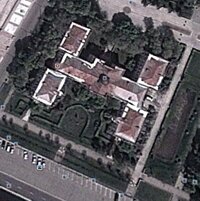
Dom Druzhba as seen on Google Earth
The architect Andrei Zenkov also got into a little bother when someone looked at the plans of the newly constructed building which is now called Dom Druzhba (Friendship House) in 1926. It was built by the workers of the Czech Interhelpa organization as the Soviet House, – to house the Central Executive Committee (the government of the day). Zenkov was a well established architect in the Central Asian region, having designed the all wooden cathedral in Almaty’s Central Park in 1904, (which, incidentally, is still called “Zenkov’s Cathedral”. The floor plan of the new building resembles a large letter “H” – the Cyrillic equivalent of “N” –which led to suggestions that it was in homage to the deposed Tsar Nicholas II, rather than to the glories of the new Soviet regime! Zenkov was almost imprisoned as a result.
Personally, I doubt that there was anything significance intended in the design of the Some Druzhba, or the housing estate for that matter … but it did remind me of the case of the Eki Naryn Swastika.
For the record: Actually, the nearest settlement is Tash Bashat, (Stone Spring), so I suppose it should really be called the Tash Bashat Swastika.
Also: Eki Naryn is a small village to the East of Naryn named after the tributary of Kyrgyzstan’s largest river which flows nearby. There have been suggestions that in Hindi it is similar to a phrase which means “One God” … presumably inspired by the link with the ancient Indian swastika symbol … but in fact it’s much more prosaic in that, in Kyrgyz, it means Second Naryn
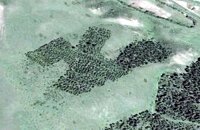
The “Eki Naryn Swatiska” as seen on Google Earth
There on the hillside is a swastika of trees, supposedly planted by German soldiers – some of the 30000 prisoners of War who were forcibly transported to Central Asia during the Second World War. Although, to be fair, this account is not universally recognized.
This “sign of defiance”, if that’s what is was … apparently remained undiscovered until “quite recently”, despite the fact that it measures about 600 meters across and the right angles are pronounced, sharp and clear.
There are, however, other versions of the story, including:
- that it was planted in the late 1930′s as a commemoration of Stalin and Hitler signing the Molotov-Ribbentrop non-aggression;
- that is was created by Kyrgyz labourers from the local collective farm, ( and in support of this version, it is pointed out said that, apparently, there were no German work gangs here … there was one in the North, near what is now Bishkek, and another in the South, near Osh). It is embellished, however, with the claim that they worked under the supervision of of an ethnic German who had been exiled to Central Asia as a Nazi sympathizer;
- that it was planted in 1953 following the death of Josef Stalin … under the supervision of a woman who happened to be an ethnic German – and a nationalist – who had the trees planted in patches at different times and thus was able to keep the overall design secret until the trees had matured some years later.
It is difficult to get a definitive count because the Forestry Service archives are apparently in a state of disarray with few, if any documents dating back before about 1960.
Over the years it has been the subject of much comment.
Critics, for example, point to the differences between the Nazi emblem and the grove of trees – for example it is anticlockwise whereas Hitler adopted the clockwise symbol. Also there are apparently two “tails” missing.
There have also been suggestions that, despite the straight sides and pronounced right angles, that it is a purely natural phenomenon …
Others suggest that, as the swastika is an ancient religious symbol – possible representing the sun which used to be an object of worship in this part of the world – suggesting that if it is indeed a man made phenomenon, then it might reflect something far older.




 Bishkek