Harness
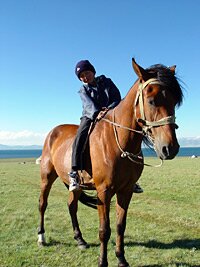
This boy is riding Bareback … but the Kyrgyz have a wide variety of horse livery
There is an old adage that you shouldn’t judge a horse by the harness.
The Kyrgyz sage Toulbai wouldn’t have been fooled by harness – he was renowned for his knowledge of horses. People would bring him their horses and ask for his advice. For example, they might ask if a particular horse was good for Oodarysh, (the traditional Kyrgyz sport of wrestling on horseback), or a good horse for At Chabysh, (long distance racing), and what they needed to do to make the horse into a champion. Tolubai’s answer might include hints about training or feeding.
The history of horse tack is long and varied.
Different nationalities developed their own embellishments – but the whip (kamchi) was probably the first implement to be invented or utilized.
The bridle – providing a link between horse’s head and the rider’s hands first appeared over 5000 years ago.
The bit – although now made of metal – would probably have been originally out of rawhide, wood, horn or bone and would fit naturally into a gap in the horses teeth. Needless to say, they were brittle and disintegrate quickly so archaeological evidence is scant before the introduction of meta.l
The bit would be held in place by straps, or metal plates linking it to a headband and these features would often have been highly decorated – the decoration providing evidence as to who made it, and when.
One of the most important means of controlling a horse are the rider’s legs. The word “Shenkel” refers to the inner side of the legs from heels to knees. Since ancient times, in order to increase the influence of the rider’s legs on sides of the horse, people have used spurs of different designs, structure and length. A novice rider, however, couldn’t use spurs: he could not only damage the spurs themselves, but even cripple a horse and, on top of that, not learn to how ride a horse properly.
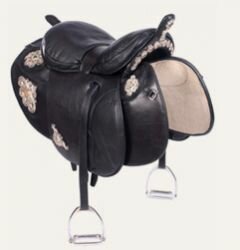
A modern leather saddle
Saddles seem to date back somewhere around the seventh or eighth century BC – although some historians seem to think that some form of saddle may have existed much earlier, soon after the horse was first domesticated.
The development of the saddle was important because it turned the horse from a beast of burden and means of locomotion pulling carts and chariots.
The Kyrgyz have a saying that: “You may not have a horse, but you must have a saddle”. You can ask a neighbour for a horse in time of need – he will give it, it is a commonplace. On the other hand, even if he gives you his saddle, it will be against his will. This is because, for nomads it cost more than a horse. Even nowadays a good saddle costs the equivalent of two horses and can serve for a hundred and fifty years.
Here in Central Asia, some of the earliest evidence of saddles relates to the Saks – the Scythians described by the ancient historian Heroditus. For years – centuries even – many of the details of his accounts were thought to be unreliable … but discoveries in tombs as far afield as Russia, Ukraine, Siberia and Xinjiang in China, as well as depictions in art.
This Scythian saddle basically consisted of two quilted and stuffed cushions sewn to a horsecloth with a gap between them, where the rider would sit across his mount – with a felt pad sewn underneath. These cushions were reinforced and decorated on the front and rear panels, which not only served as decoration – and thus a status symbol, but also helped to create the now familiar saddle shape with the front and rear higher than the middle, providing protection and comfort for the rider whilst maintaining the shape of the saddle.
A strap (“martingale” or “komolduruk”) was used to fix the saddle – attached to the saddle and running along the chest and over the shoulder of the horse.
At this stage, though, they had no tree or stirrups. Wooden spacers were added and in the course of time, (probably in the early Middle Ages), this “soft saddle” was replaced with a wooden frame, often decorated with silver, leather and special coverings. This raised the rider above the horse’s back, redistributing the weight of the rider and making it easier for the horse reducing rubbing and friction on the spine.
There were four main types of saddle – man’s, woman’s, children’s and pack. Early saddles were large and heavy with a large pommel. Later, lighter saddles with a narrower pommel and wider seat were adopted. The wider seats and smaller pommels are typical of saddles designed for women.
A child’s saddle came equipped with holes for leather traces which could be used to tie the child safely in and enable the child to ride without the fear that it fall off – an essential feature for nomads on the move. The pack saddle was used for transporting luggage and was later adapted for use with cattle.
Stirrups appeared in Central Asia about 1500 years ago, although there is evidence of stirrups in India in the late second century BC. At first they may have been developed to minimize the danger of mounting a horse while carrying weapons, (apparently, Cambyses, King of Persia fatally stabbed himself leaping onto his horse in 522 BC).
Later, full length pairs of riding stirrups were developed. It may be surprising that something as the stirrup should have appeared so many centuries after man domesticated and began to ride horses. There are some early stirrups, (identified as Turkish), dating from the 6th-8th Century to be found in the Historical Museum in Bishkek. They were attached to the front of the saddle.
The Horsecloth was an important component of the harness. It protected the animal in hot weather from sweat; in bad weather from supercooling and in combat conditions from the opponent’s arrows, lances and axes. The horsecloths of the Maverannahr’s horses, (a state in Western Turkistan with it’s capital at Samarkand), had a trapezoidal form and covered their croups from the neck of withers to the tail. They were put directly under the saddle. Sometimes instead of a horsecloth, a blanket was put on surface of saddle, which was fastened with special straps. Horsecloths were used in both summer and winter. Those used in Summer horsecloths were produced from carpet, velvet or silk; and for Winter, according to one scholar, from felt – known to the Kyrgyz as a “jeldik”.
A horsecloth consists of two parts: the lower one with embroidered edges, and the upper (tokum), which is smaller, only the middle part hidden under saddle. The sides of the horsecloths are decorated with hanging “teben’ki” (or teminoor), and sometimes additional pendants. Horsecloths were usually embroidered on black velvet, and sometimes on leather. Among fancy motives of embroidery it is possible to see often a round rosette with four horn-shaped curls – kochkor muyuz (sheep’s horn), and a motive of wavy sprouts.
A saddle blanket, (kopchuk), was made from black velvet and decorated with wide embroidered bands along the edges. A breast-collar (kemelduruk) was also embroidered.
A sweat-cloth is used as a lower lining of the saddle and made from several pieces of felt. It covers the horse’s back and fits snugly against its body. A sweat-cloth softens the pressure of the saddle and, (as the name implies), absorbs sweat. It needs constant care and, especially, thorough drying.
A special device (a “baldak”) was adapted to fit onto the saddle to support the rider’s arm when hunting with eagles, or other birds.
Soon after foals were born, they would have been marked on the ears – or in the case of especially valuable horses – the nostrils. The actual cuts used in the marking would have indicated which tribe they belonged to. Both Horses and cattle were also marked with a metal brand – the design was called a “tamga”.
When they arrived on the scene, the Russians taught the Kyrgyz how to shoe their horses. Before this the horses were never shod, and even later on it was not universal.
Although a common sight in the rest of the world these days, helmets are a relatively recent innovation … and are not really found here in Kyrgyzstan, except as a form of armour for use when riding into combat. So, anyone going on a horse trek is probably best advised to bring one with them.







 Bishkek